
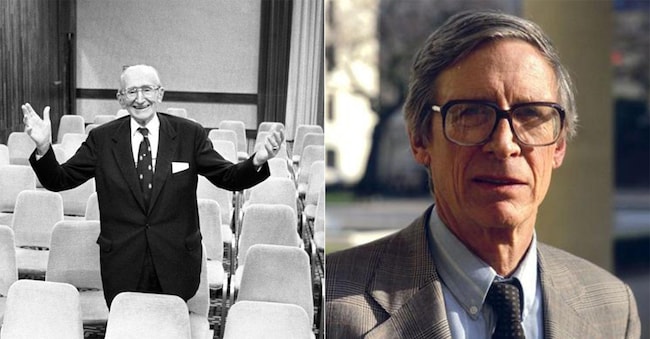
Friedrich von Hayek and John Rawls. Irreducible differences and unexpected convergences

10' min read
10' min read
Friedrich von Hayek is for many 'the' philosopher of freedom. Not only a philosopher, actually, but also the economist and jurist of freedom. That freedom that began as a natural right and became a necessary good when human beings began to live in ever larger groups. A necessary condition to be able to exploit the benefits of the division of labour and exchange. Freedom finds its raison d'être not only in natural law, Hayek argues, but even more so in the fallibility and partiality of our knowledge. It is only through the freedom to pursue our individual ends, in fact, that 'catallaxy' can act, 'An impersonal process,' Hayek writes, 'which produces a greater satisfaction of human desires than can be achieved by any deliberate arrangement' (Law, Legislation and Freedom. Il Saggiatore, 1986, p. 262). If this is true, then any 'deliberate arrangement' that aims to limit that freedom or even to direct individual choices is to be considered illegitimate, to be avoided, prevented and condemned. Because any 'deliberate arrangement' is nothing but a plan of action designed and directed by someone or something - the elites, the state, the government - necessarily operating against the will of individuals and interfering with their 'protected individual domain'. Not even the best of intentions can justify such intrusion into the sphere of individual freedom. Not even the desire to pursue an ideal of 'social justice'. An ideal that, moreover, Hayek considers to be an illusory 'mirage', a meaningless, useless and even harmful idea. The latter is perhaps the point that most distinguishes the Austrian philosopher's thought from that of John Rawls, another giant of 20th century political philosophy. For Rawls, in fact, as Sebastiano Maffettone reminds us in his introduction to the American philosopher's thought, "The main theoretical task of A Theory of Justice was to formulate a theory of social justice" (Introduction to Rawls. Laterza, 2010, p. 10), a theory capable of identifying, that is, that set of principles that determine - as Rawls himself writes "the correct distribution of the benefits and burdens of social cooperation". The theme of social justice is therefore the centre around which much of his reflection revolves while. For Hayek, on the other hand, this idea is, as we have seen in last week's Mind the Economy , something completely meaningless. Two irreconcilable positions then? Actually, the two perspectives are less distant than it might seem at first glance. This is stated, unsuspiciously, by Hayek himself when in the preface to the one-volume English edition of Law, Legislation and Liberty, he writes referring to Rawls, 'The differences between us seem to be more verbal than substantive' (Routledge and Kegan Paul, 1982, p. xx).
Let us begin by making these differences explicit, then, with reference first to what David Hume calls 'the circumstances of justice'. These are those conditions which, by describing the world and the typical characteristics of human beings, give an account of our desire for justice. According to Rawls, who follows Hume in this, there are two main 'circumstances', one objective and one subjective. The objective one refers to the scarcity of resources at our disposal, a scarcity that cannot but generate conflicts as everyone tries to grab as much as possible. The subjective 'circumstance', on the other hand, has to do with the disagreement that exists between individuals about the ends we should collectively pursue. The existence of these two circumstances makes it necessary to reflect on the rules we should adopt to mitigate the conflicts that arise, on the one hand, as a result of the scarcity of resources and, on the other, as a result of the disagreement on the purpose we should pursue as a society. This is the reason why we need an idea of social justice. The issue for Hayek is somewhat more complex. Although, in fact, he agrees with the objective circumstance of justice and, that is, the limited resources available, as far as the subjective circumstance is concerned, the Austrian philosopher's position is very different from Rawls'. He, first of all, is convinced that the second circumstance also has an objective character, that is, that it derives not so much from historical contingencies or cultural differences, because the second circumstance of justice has, for Hayek, an epistemological root. It is linked, that is, to the fact that each of us possesses only a small part of all the knowledge necessary for us collectively to make rational decisions. "The possibility of having a just order," he writes, "depends on such a necessary limitation of our factual knowledge and, therefore, all those constructivists who habitually argue from the assumption of omniscience cannot come to glimpse the nature of justice" (p. 20). Even in a world populated by altruists capable of agreeing on common and shared goals, we would still need a just criterion for deciding how to allocate limited resources. But as Hayek writes in The Mirage of Social Justice there is "no way for the individual to know what he should do in order to ensure a fair return to his fellow man" (p. 272). For Hayek, then, our need for justice does not arise, as it did for Rawls, because of disagreement with the purposes of life but by virtue of our ignorance. Justice is, therefore, the way through which relevant knowledge can be coordinated and can give rise to spontaneous order. As Paul Kelly reminds us in his preface to Law, Legislation and Liberty, 'The fundamental question towards which Hayek's perspective directs us is not: how should benefits and burdens be organised in a world of limited resources and limited benevolence or endemic disagreement? Rather, it is what institutions of justice enable us to discover how benefits and burdens should be distributed under conditions of limited resources and knowledge?" (Routledge, 2013, p. xxvii).
Beyond this initial difference that we might call methodological, Hayek and Rawls diverge sharply with regard to the role of the market and public intervention. For the Austrian philosopher, the price mechanism must be able to operate in both allocative and distributive functions. This means that not only must it be left to the free functioning of the market to direct the productive resources, capital and labour, towards those sectors that on the basis of prices are from time to time considered most profitable, but also the task of distributing among all participants in the game of production and exchange the benefits deriving from economic activity. Rawls also welcomes the allocative function of the market but is also convinced, as he writes in A Theory of Justice, that "The distribution resulting from voluntary market transactions (even if all the ideal conditions for competitive efficiency are met) is generally not fair unless the initial distribution of income and wealth as well as the structure of the market system are fair" and that it is therefore up to the state to intervene in the institutions of the basic structure to counterbalance the market influence on the distributive function.
A third important area of disagreement between Rawls and Hayek concerns the interpretation of the 'liberty principle', the first Rawlsian principle of justice. As political scientist Lawrence Connin points out, 'If personal liberties are truly sacrosanct then - consistent with the Hayekian reading - all other ultimate goals (e.g., equality of outcomes) must be rejected [and] all attempts to regulate market exchanges, property rights, or inheritance law, are clearly prohibited' ('On DiQuattro, 'Rawls and Left Criticism. Political Theory 13, 1985, pp. 138-141). To this should be added Hayek's hostility to any fiscal policy aimed at redistribution and any other form of market regulation. But is this what the principle of freedom really prescribes for Rawls? Not really. On the contrary, in fact, for the American philosopher, the first principle not only permits the activities that Hayek would prohibit in the name of freedom, but even obliges the state to intervene with income redistribution and even through 'the necessary adjustment of property rights'. And this is precisely to defend freedom. Too much inequality in the distribution of wealth, in fact, would generate a concentration of power and a consequent risk to "the fair value of political freedom and the equal equality of opportunity", Rawls writes. Freedom, therefore, cannot be set against equality, but is seen, rather, as a particular concretisation of it.
And yet, despite these marked differences between Hayek's and Rawls' thought, there are unexpected lines of convergence between the two. Both thinkers, after all, refer to the tradition of liberalism, albeit in its classical sense as far as the Austrian philosopher is concerned, and with egalitarian accents, on the other hand, for the American. This strange proximity between Hayek and Rawls has not gone unnoticed by commentators and has provoked various criticisms from the different poles of the political spectrum. From the left, it has been argued that if Hayek and Rawls have anything to do with each other there is probably something wrong with Rawls, as argued, for example, by Connin. From the conservative front, on the other hand, 'lady liberty' Ayn Rand herself has described Hayek as 'our most pernicious enemy'. In the centre, finally, not a few have worked on a kind of 'Rawlsian synthesis'. Andrew Lister in his Oliver Smithies Lecture, for example, identifies four areas of convergence in the two philosophers' thought. We will discuss two of them here, leaving the remainder for next week's Mind the Economy. The first common theme concerns the relationship between merit and distributive justice. We have already seen how Hayek's critique of the idea of social justice is linked to his aversion to the concept of merit. Distributions based on merit, in fact, would generate for Hayek situations of great injustice, characterised by equality between unequals, to use the well-known expression of Don Lorenzo Milani. Hayek writes in this regard: 'Justice demands that the conditions of life determined by public authority be equal for all. But equality of these conditions necessarily entails inequality of outcome. Neither the equal provision of particular public services nor the equal treatment of our various voluntary business associates guarantees a reward proportionate to merit. Compensation for merit is compensation for obedience to the wills of others, not compensation for the benefits we have procured for others by doing what seemed best to us' (La Società Libera, Rubettino, 2007). The affinity with Rawls on this point is obvious; the American philosopher, in fact, also denies that merit can be considered a fundamental principle of justice. "A just scheme," he writes, "enforces valid titles; it satisfies legitimate expectations based on social institutions. But valid titles are neither proportional to, nor dependent upon, intrinsic merits. The principles of justice that regulate the basic structure and specify the duties and obligations of individuals make no mention of moral merit, and the distributive shares do not tend in the least to correspond to it'.


