
Free loans for use to tackle depopulation: how Occhiuto’s ‘Ripopola Calabria’ plan works
Social housing in small towns allocated for 10 years to those who move their place of residence there. The Region pays for the refurbishments

Key points
Via Guzzolino, Rovito, in the province of Cosenza: a dream-like rendering of a historic building in the heart of the town. “A proposal for a family wishing to embark on a new chapter, choosing a home with links to the village’s heritage,” reads the Ripopola Calabria website. Eighty-two square metres, 2 rooms, 1 bathroom, first floor. Everything is ready for allocation. Applications are now open.
How the Plan works
Here’s how it works: under the Region’s programme – funded by the 2021–2027 Development and Cohesion Plan – local councils make unused social housing available and the Region funds the refurbishment work. Prospective residents – provided, as an absolute prerequisite, that they come from outside the region – can choose from three options in the catalogue. And they do not pay a single euro towards the refurbishment. They do, however, help to breathe new life into these places.
Accommodation in all provinces
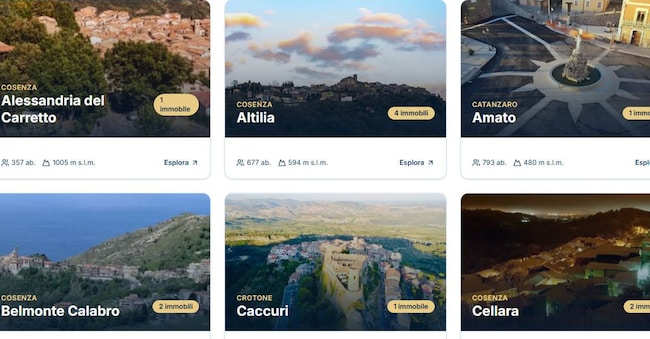
Via Convento, No. 5, Caccuri, province of Crotone, 72 square metres, two rooms and a bathroom, ground floor. Evergreen shrubs and pots of hydrangeas feature in the stylised, digitally created image. As it stands, the property is in need of complete renovation. And then there’s Torre di Ruggiero, in the province of Catanzaro: a charming period building at No. 1 Via Vittorio Veneto. Here the rooms are larger, at 135 square metres, with five rooms on the first floor and a garden. The virtual photograph is truly enticing. But there are properties available in every province. Some municipalities, such as Altilia, Dipignano and Grotteria, are offering blocks of four.
10-year loan for use
To tackle depopulation – a highly complex regional phenomenon in Calabria – and consequently the decline in population and the gradual weakening of the settlement, social and economic structures of many municipalities in inland areas, the President of the Region, Roberto Occhiuto, has come up with the following scheme: you do not buy the property and you do not pay rent. You are granted a house (up to 140 square metres) on a 10-year loan for use. The local council and the Region may then adopt further measures to potentially extend the period of occupancy in the property, “through procedures to be established at a later date and which, by way of example only and without being binding, may take the form of renewal of the loan for use agreement or purchase at controlled prices”. An experimental proposal to implement an integrated local policy based on the regeneration of existing properties.
Twenty million to fund the project
Will the 50 homes listed in the catalogue – though they are only the first batch – be enough to attract people of school-going, working and family-forming ages to these areas? Will those individual homes be able to breathe new life into small, ghost towns, stripped of services and community life? The analysis of the project, set out within the plan, is thorough. To begin with, it highlights the programme and financial profile of the initiative: ‘ordinary section of the Development and Cohesion Plan, thematic area “Urban Regeneration”, intervention sector “Building and Public Spaces”, with a budget of 20 million euros.’

