
Freedom is never a private matter, solidarity is its political heart
"On Freedom" by Tim Snyder is an ambitious book, in which the author reactivates reflection on one of the founding concepts of modernity

4' min read
4' min read
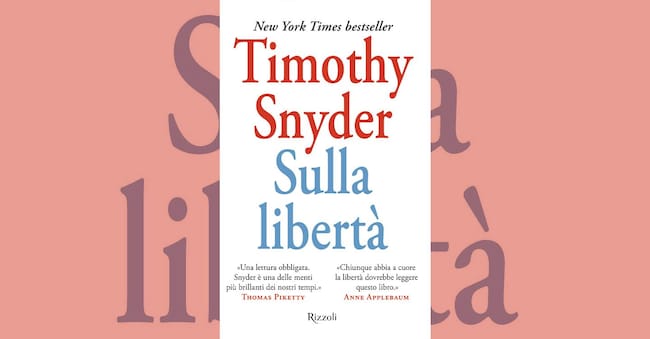
On Freedom by Tim Snyder (Rizzoli, pp. 468, € 22) is an ambitious book, in which the author reactivates reflection on one of the founding concepts of modernity: freedom. The author is an intellectual recognised not only for the quality of his research, but for the ethical tension that runs through it: a non-ideological militancy, which led him to investigate the processes of post-socialist transition in Central Europe and the collapse of the democratic order in Russia. It is in this space of convergence between historical knowledge and social criticism that this work is located, whose theoretical roots lie in the lessons of Tocqueville, Isaiah Berlin and the dialogue with Tony Judt, the author's teacher. The book confronts the tradition that has explored the unresolved tension between individual autonomy and collective structures. Snyder, however, does not merely rework models: his thesis is that the distinction between freedom 'from' and freedom 'of' is now useless. Freedom, he argues, is relation, construction, process; it is not to be thought of as a quality of an isolated individual, nor can it be confused with a property to be exercised in a neutral space. It is embodied practice, which interrogates the social anatomy: freedom is inseparable from the body that lives it, from the flesh that denies it or makes it possible.
The Italian edition of the book comes ten months after its American publication and seven months after Donald Trump's election, at a time when the US institutional order is showing signs of unprecedented disassociation. But the text - written in the midst of that election campaign riddled with manipulation and brutal populist twisting of language - does not only respond to the American political emergency. It is an attempt to deconstruct the neoliberal rhetoric that has emptied the concept of freedom to the point of making it functional to inequality; to relaunch an idea of freedom that is not afraid to confront the historicity of bodies, institutions and asymmetries. Here the body is not a metaphor but the place where the political, legal and affective experience of freedom is inscribed.
Snyder identifies as a critical node the unchallenged dominance, since the 1980s, of the idea of negative freedom - understood as the absence of state interference in the economic sphere - whose hegemony has obscured the material conditions that make all forms of autonomy possible. Freedom, he writes, is not an 'empty' space to be defended, but a field of forces that is constructed through social practices, symbolic devices and collective infrastructures. To think of it as the 'absence of evil' is to exclude the very possibility of justice, which is always the active presence of good.
Snyder weaves his critique within a grid that thinks about freedom in action, in the everydayness of subjects, in the gestures of individual sovereignty and in the materiality of the choices that are given or denied. Central to this is the reference to the distinction between Leib and Körper, between the lived body and the objectified body: it is in Leib, in the relational body, that freedom is played out, not in the abstract mind of the disembodied individual. Freedom is recognition of the other as a subject of rights and desires, it is co-ownership, not solitary self-determination.
The theoretical architecture of the book unfolds along five dimensions: sovereignty, unpredictability, mobility, factuality and solidarity. It is a layered and dynamic palimpsest, in which each concept is superimposed on the others, a true conceptual choreography: sovereignty is the ability to define oneself; unpredictability is resistance to algorithmic profiling; mobility is the denied right to choose one's place in the world; factuality is adherence to the real against post-truthful impudence; solidarity is the premise - not the consequence - of any effective freedom.

