
Frieze New York 2026: The Ecology of Friction
Animals and plants appeared not as subjects to be illustrated, but as presences capable of transforming the aesthetic experience into an encounter
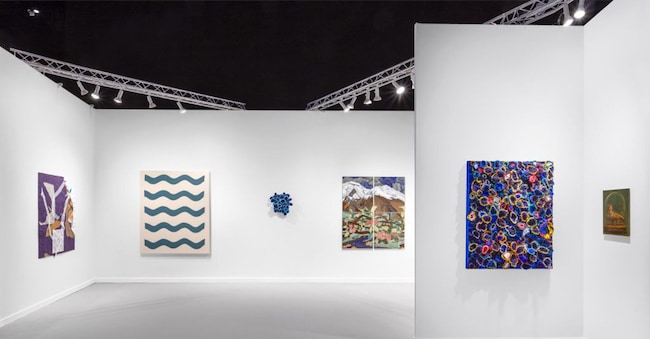
Frieze New York 2026 closed at The Shed with the air of a fair that has regained energy without abandoning caution. The market gave positive signs: crowded stands, museum acquisitions, collectors back in front of the works. But what will remain is not only the return of commercial confidence. It is rather the feeling that, within an increasingly polished apparatus, the most interesting artists have worked to introduce friction: moisture, fabric, weeds, light, colonial memory and bodily vulnerability.
Ecological Imagery
The most visible trend was an ecological imagery no longer confined to climate alarm or the rhetoric of sustainability, but rooted in a rediscovery of nature as relationship. Animals and plants appeared at Frieze not as subjects to be illustrated, but as presences capable of transforming aesthetic experience into encounter. In this sense, Kelly Sinnapah Mary's stand by James Cohan was one of the most intense moments of the fair. The gallery built a sort of mental garden around her new paintings, continuing the series The Book of Violets, where Caribbean mangroves, family genealogies and diasporic memories intertwined without resolving. His figures seemed to emerge from vegetation that did not act as a backdrop, but acted as a living archive of the violence of history and the stubborn possibility of imagination. Another form of restless vitality came from Esther Schipper with Anicka Yi's kinetic sculpture. Yi has long been one of the artists capable of expanding the frontiers of the posthuman without reducing it to a technological aesthetic. Her works ask what happens when the machine no longer imitates man, but takes on biological qualities and metabolic behaviour. The animatronic sculpture presented at Frieze, Nonseparable Parsley, was inspired by bioluminescence and explored the dissolving boundaries between living organisms and machines, drawing on forms reminiscent of deep-sea radiolarians. Powered by microcontrollers capable of simulating natural movements and breathing rhythms, it redefined the relationship between artificial intelligence, biology and art. More ironic, but no less incisive, was the presence of Tony Matelli's Weeds on the OMR stand. Their strength lay in their false marginality. They grew where they should not, at the edges of the gaze, as sabotages of fair neutrality. Matelli turned the weed into a perceptive device: what we normally remove or do not see became the focus of attention. The fair promised order and value; the weed responded with stubborn irreverence. Tanya Bonakdar offered an articulate reading of this sensibility, bringing together works by Olafur Eliasson, Tomás Saraceno, Ernesto Neto, Yuko Mohri and other artists for whom the environment is not a representation, but a system to be perceived. Eliasson's light, Saraceno's nets, Neto's sensory structures and Mohri's fragile devices converged towards a question: how does one build ecological consciousness through experience, and not just through message? Here, ecology became pedagogy of the senses. Another trend that emerged clearly in this edition was the incisive presence of galleries and artists from Latin America as a real shift in sensitivity. In many cases, the works resisted international polish through a return to material craft: Maria Nepomuceno's ropes, ceramics and beads, Denilson Baniwa's Amazonian signs, Vivian Caccuri's embroideries on mosquito netting, Marcela Cantuária's political images, and Seba Calfuqueo's synthetic hair, ceramics and videos. This material craft did not appear nostalgic or decorative; it introduced into commercial space indigenous memories and forms of bodily knowledge that modernism had often relegated to the margins of art.
Matter is never neutral
At Frieze, these practices suggested that matter is never neutral: it brings with it geographies and wounds, but also more tactile and enduring patterns of resistance. Read through these examples, Frieze New York 2026 appeared less as a fair of novelty than as a laboratory of re-configuration. The art that really counted was that capable of making one forget, for a few minutes, the transactional logic that surrounded it. Amidst Caribbean gardens, mechanical organisms, weeds and luminous atmospheres, Frieze gave a glimpse of a richer and more engaged artistic panorama than that presented in previous editions.

