
Fringe benefits 2027: the challenge facing SMEs in the digitalisation of corporate welfare
Italian small and medium-sized enterprises have never invested so much in workplace welfare: this is demonstrated by data from the Amilon SME Observatory, which shows an unprecedented increase in the uptake of fringe benefits. All this is happening as the three-year regulatory period governing exemption thresholds approaches its 2027 expiry date, with no certainty yet regarding its renewal.

For small and medium-sized Italian businesses, recent years have been a financial balancing act. Profit margins have been squeezed by inflation, labour costs are rising, and it is becoming increasingly difficult to find and retain skilled staff in a labour market that has become more hybrid and more demanding. In this context, making structural changes to pay is often difficult or, in any case, insufficient to meet the expectations of employees who now assess a company’s overall package rather than just their pay packet. It is against this backdrop that fringe benefits have seen their greatest uptake: a practical and tax-efficient lever for sustaining employees’ real purchasing power without permanently affecting costs. All this against the backdrop of an approaching deadline: the three-year regulatory period that established significantly higher exemption thresholds for fringe benefits compared with the standard regime is due to end in 2027. What will happen next remains to be seen: however, the market is taking shape, and this fact reveals something important about the direction in which employee welfare is heading in Italian SMEs.
Employee welfare in SMEs: what the 2025–2027 legislation on fringe benefits provides for
The starting point is the Budget Law, which has confirmed higher exemption thresholds for the 2025–2027 period compared with the standard regime. Up to €1,000 per annum for most employees and up to €2,000 for employees with dependent children for tax purposes: within these limits, fringe benefits do not form part of employees’ taxable income and are exempt from social security contributions. A comparison with the standard scheme (€258.23 per year per employee) highlights the scale of the benefit. For an SME with twenty employees, the difference between the two thresholds amounts to up to €15,000 per year in benefits that can be provided under the preferential scheme. These figures highlight a tangible lever for remuneration policy, accessible even to the smallest organisations, which does not require structural changes to labour costs: it is precisely the combination of high thresholds and three-year certainty that has triggered the acceleration now reflected in the data.
Data from the Amilon SME Observatory: a market that has taken shape
Amilon, a company specialising in digital solutions for gift cards, rewards and fringe benefits, and part of the Tillo Group, is closely monitoring the evolution of this market through the Amilon SME Observatory, set up to analyse the behaviour, choices and trends of Italian small and medium-sized enterprises in the use of digital fringe benefits. The Observatory (based on a panel of around 10,000 Italian small and medium-sized enterprises) paints a picture of growth that goes beyond short-term economic fluctuations. Over the past year, the average amount paid per employee has risen to 170 euros, almost double the 90 euros recorded in 2024. The number of businesses that have introduced fringe benefits has increased by 25 per cent. In the first half of 2026, the transaction volume of the ideaShopping Fringe Benefit Card (Amilon’s multi-brand card, which brings together over 150 brands across retail, transport, e-commerce and electronics) grew by 51 per cent compared with the same period the previous year. These figures do not merely reflect the trialling of a new tool; they point to a market that is consolidating more structured approaches to managing employee benefits and is changing the way in which SMEs organise their financial relationships with their employees.
The market’s response: digitalisation to look to the future
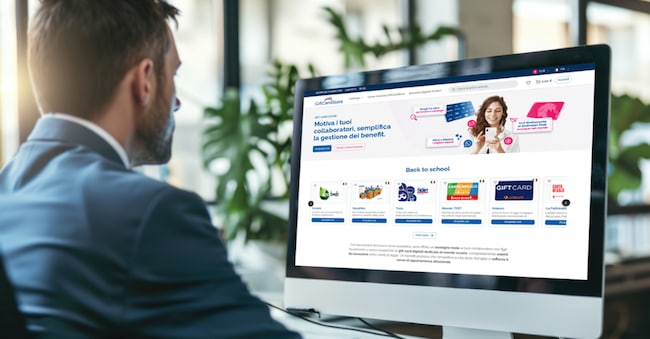
An example of this evolution is GiftCardStore, Amilon’s B2B platform for the purchase and distribution of fringe benefits, which in recent months has been working specifically on simplifying processes for businesses. The growth recorded by the Observatory reflects the adoption of the platform by a growing number of SMEs which, until a few years ago, managed benefits manually or not at all. The platform’s recent update moves in the same direction: direct distribution to employees via email eliminates a further manual step, and employees receive their benefits on their smartphones without the need for internal intermediaries. Digitalisation reduces organisational costs and helps transform fringe benefits from an initiative linked to tax advantages into a more stable component of company policy that can be adapted to different regulatory scenarios.
Fringe benefits in 2027: outlook and market expectations
The question the market is asking with increasing interest is what will happen to the exemption thresholds after 2027, and proposals are converging towards two scenarios. The first is the confirmation of the current thresholds through a new fixed-term renewal, along the lines of what has already happened for the 2025–2027 period, whilst the second is a structural stabilisation of the legislation, with a permanent increase in the thresholds that would allow SMEs to plan welfare investments over longer timeframes. In both cases, the signal coming from the market is already clear: SMEs are not waiting until 2027 to make a decision; they are investing now in digital tools that will make the management of employee benefits sustainable over the long term.
How are Italian SMEs organising themselves to manage fringe benefits in 2027?
The most significant signal emerging from the data is not the growth itself, but the direction that growth points to. Italian SMEs are not using fringe benefits as a temporary response to a tax advantage: they are integrating them as a standard component of their remuneration policy, regardless of what happens to the thresholds. This shift, from a tax tool to a structural component of the relationship between company and employee, is what distinguishes the current phase from previous ones. SMEs that have built a digital welfare infrastructure will be able to adapt to any regulatory scenario at marginal cost.

