Renewables

Friuli-Venezia Giulia: authorisation granted for power plants totalling 569 MW

Since 2021, 1,003 MW of capacity has been installed in the region: this represents 51 per cent of the 2030 target, but the regional plan envisages more

5' min read

Translated by AI
Versione italiana

5' min read

Translated by AI
Versione italiana

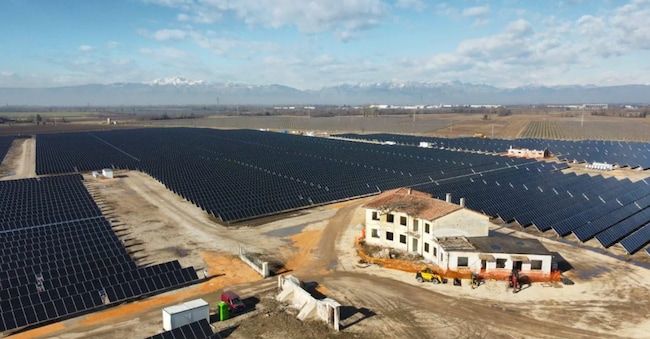
The targets set for Friuli-Venezia Giulia by the Ministry of the Environment’s ‘Suitable Areas’ decree – which has allocated the national 2030 target of 80 GW of additional capacity from renewable sources, compared with 31 December 2020, amongst the regions and autonomous provinces – amount to 1,960 MW of new green capacity to be installed between January 2021 and December 2030. The update on the situation, compiled by the Energy Transition Service – the body responsible for issuing single energy authorisations across the region – for *Il Sole 24 Ore*, indicates that the Region has authorised photovoltaic capacity (ground-mounted plants) totalling 1,232.5 MW as at 20 July 2026 (the provisional figure for the first few months of the year is 166.5), with a further 569 MW currently undergoing the authorisation process.

In Terna’s latest report on the electricity system, the net change in installed capacity from January 2021 to July 2026 in Friuli-Venezia Giulia amounts to 1,003 MW out of a target of 689 (a target determined by reference to the regional allocation set out in the Ministerial Decree on ‘Suitable Areas’, with the additional capacity forecast for the current year being reallocated on a monthly basis). These figures indicate that the target has not only been met but exceeded by 314 MW. Friuli-Venezia Giulia is, in fact, among the group of regions which – according to Terna’s latest update – are currently installing capacity at a rate that is on track with or ahead of the schedule. The installed capacity achieved so far represents 51 per cent of the 2030 target and 130 per cent of the interim target for December 2026, set at 772 MW.

Loading...

‘Taking into account the capacity already authorised and that currently under review, it seems reasonable to expect that the Pniec target (the National Integrated Energy and Climate Plan, i.e. the instrument through which Italia pursues the European objectives of decarbonisation, energy efficiency and the development of renewables, ed.) by 2030”, explain officials at the Regional Government: “Historically, it has been observed that, on average, two years elapse between the granting of the single authorisation and the start of operations. Of the authorised but not yet built plants, 953 MW still need to be started and completed. If all of these were to be built by 2030, the target would be met.”

The facilities

It is worth noting a number of authorised plants linked to specific uses, such as (in 2025) the Trieste Hydrogen Hub: this is the region’s first green hydrogen production plant, with an electrolyser capacity of 5 MW and a connected 4.8 MW photovoltaic system, currently undergoing testing. In 2026, the Elettra Sincrotrone Trieste centre began work on the construction of the Green Energy photovoltaic plant in a disused quarry that is undergoing environmental restoration. The plant will cover part of the electricity consumption of the international research centre, which, since 2024, has had to halve the number of its projects due to the sharp rise in the cost of electricity. Work has already begun.

Given that there are projects totalling 569 MW currently undergoing the authorisation process, if all of them were to be approved and the authorised parties were to complete the construction of the plants, it is easy to see how the 2030 target could be exceeded.

Regional legislation

Friuli-Venezia Giulia has adopted a regulatory framework that sets out a target of climate neutrality by 2045: this has given rise to scenarios envisaging the installation of 3.3 GW by 2030, a target exceeding the 1,960 MW of new installed capacity by 2030 mentioned above. It would therefore be necessary to receive new applications, and to authorise and construct further photovoltaic and agrivoltaic plants by 2030, according to the Region, ‘as the wind farms provided for in the national plan are difficult to locate in the region due to factors relating to wind conditions and the terrain. In light of the authorisations granted, the pending applications and the growth trajectory of the photovoltaic and agrivoltaic sectors, this target appears challenging but achievable’.

Approved on 17 December 2024, the Regional Energy Plan sets out two overarching objectives: energy security and energy independence, which are broken down into general objectives and plan-specific objectives, and then translated into 43 actions. In this context, the region’s energy requirement for 2030 is set at 3.3 GW of renewable energy capacity to be installed from 2021 onwards. On 4 March 2025, the law on ‘Regulations for the installation of renewable energy plants within the region’ was also published, coming into force on 7 March, through which the Region identifies the sites and areas suitable for the installation of plants for the production of energy from renewable sources within the region. Many companies have gone ahead and set up a photovoltaic plant: ‘Perhaps too many, in the sense that there is a problem with the time required to connect to the electricity substations, of which there are too few despite the planned upgrades. The wait can be as long as two years,” explains Marco Bruseschi, president of COSEF, the Consortium for Economic Development in the Friuli region, and Confindustria’s energy representative.

Restrictions and safeguards

The measure is based on three key principles. On the one hand, it prioritises the use of industrial and craft areas, disused quarries, contaminated sites and already built-up areas, whilst simplifying authorisation procedures in areas of lower environmental value. On the other hand, it tightens restrictions on plants situated on agricultural land, including a requirement to preserve an adjacent area at least nine times the size of the area occupied by the plant for those with a capacity exceeding 12 MW, or by stipulating that the combined area covered by the proposed plant and by other plants of the same type authorised in the same areas must not exceed 3 per cent of the agricultural land within the municipal territory.

At the same time, the legislation aims to encourage the involvement of the public and local authorities. Proponents of power stations with a capacity exceeding 1 MW will, in fact, be required to implement compensation measures and launch public communication and consultation processes. There have been several cases of contested power stations in the region: in the case of the proposed 10 MW plant in Aquileia (covering 21 hectares, with an estimated lifespan of 30–35 years) situated close to the ‘buffer zone’ of the UNESCO site; the institutions acted in unison, culminating in a negative opinion from the local council and the Ministry of Culture, via the Superintendency for Archaeology, Fine Arts and Landscape of Friuli Venezia Giulia.

Copyright reserved ©
Loading...

Brand connect

Loading...

Newsletter

Notizie e approfondimenti sugli avvenimenti politici, economici e finanziari.

Iscriviti