
Friuli Venezia Giulia, a strategic bridge between Japan and Europe
Strategic location, excellent logistical infrastructure, highly qualified human capital and a solid industrial ecosystem are the keys that make the Italian region an excellent partner for foreign companies, particularly those from Japan

6' min read
6' min read
(Il Sole 24 Ore Radiocor) - Strategic location, excellent logistic infrastructures, highly qualified human capital and a solid industrial ecosystem are the keys that make Friuli Venezia Giulia a partner of excellence for foreign companies, especially Japanese ones. The Italian region is, in fact, a net exporter to the land of the Rising Sun of food and beverages, but other key sectors also register a positive trade balance: analysing data updated to the first half of 2024, the wood and furniture sector registers exports of 4.8 million euros and the manufacturing industry a balance of 3.4 million, in addition to electronics production, another area of regional excellence. On the other hand, Japan is also an important import partner for several sectors, including automotive and textiles. In this reciprocal exchange, at a time when global connections become the key to economic competitiveness, Friuli Venezia Giulia thus confirms itself as one of the most attractive Italian regions for foreign investments, particularly those from Japan.
An international crossroads between sea and rail
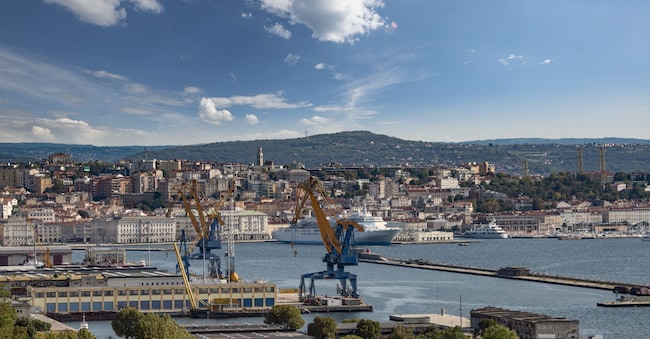
FVG is a strategic location, situated in the heart of Europe, between the Mediterranean and the markets of Central and Eastern Europe. In this context, the Port of Trieste plays a fundamental role and is one of the main assets of the region. A key infrastructure for import-export dynamics, the Free Port of Trieste is unique in Europe for its facilitated tax and customs regime. Thanks to its natural depth, it is the most important Italian port of call for freight traffic and one of the main European terminals for connections with Asia, via the Suez Canal, as well as the first port in Italy in terms of rail traffic and cargo handling. Traffic from Japan can also find in Trieste an ideal entry point to European markets. Once in Trieste, in fact, goods can count on anefficient rail network connecting the region to Central European countries: over 3.6 million tonnes are moved by train, with main destinations in Germany (30%), Austria (23%) and Italy (18%) and connections to Luxembourg, Belgium, Germany, Hungary, the Czech Republic, Poland and others. With five intermodal freight villages and a network of high-performance logistics connections, Friuli Venezia Giulia is a strategic bridge between Japan and Europe: Kansai (and in particular Osaka) the second largest economy in the Asian country after Tokyo, represents a region of great strategic importance for the Friuli Venezia Giulia region, with significant opportunities in the biotech, logistics, aerospace and advanced manufacturing sectors.
A 'business friendly' region
.In addition to logistics, one source of attractiveness for foreign companies is the set of advantageous economic conditions offered by FVG: zero IRAP (business tax) rate for the first three years (1% for the next two), subsidised loans with favourable rates, non-repayable contributions for research and development projects, as well as free personnel selection services, advice on incentives and support for networking events. In addition, the region has a financing body that supports companies in capitalisation and access to strategic financial instruments for growth. Recently, the Simplified Logistics Zone has also been established, which provides companies with simplified procedures and the possibility of taking advantage of a tax credit on investments, as well as customs benefit corridors.
Innovation and human capital
The attractiveness of Friuli Venezia Giulia also passes through prestigious scientific institutions, such asthe University of Trieste, the International School for Advanced Studies, the International Centre for Theoretical Physics and the Area Science Park, which attract the interest of Japanese high-tech companies that intend to develop joint research projects in cutting-edge sectors such as physics, artificial intelligence, medicine or new materials. Japanese interest also extends to advanced manufacturing: Danieli, an industrial engineering giant based in Buttrio (in the province of Udine), has been collaborating for years with Japanese partners in the steel sector.
"Selecting Italy": a window on the Japanese market
In this perspective of reciprocal entrepreneurial and cultural exchange, "Selecting Italy" took place last 25 April, the event, staged in Osaka in the context of Expo 2025, dedicated to the attraction of foreign investments and jointly organised by the Autonomous Region of Friuli Venezia Giulia and the Conference of the Regions and sponsored by the Ministries of Foreign Affairs and International Cooperation and of Business and Made in Italy. The meeting opened a window on the Japanese market by calling together over 130 stakeholders including institutions and companies. "Our Region is convinced that strengthening ties with Japan is fundamental to foster new opportunities for reciprocal investment and to consolidate that Indo-Mediterranean logistic axis, whose importance is strategic in times of international crisis, which starts from the Rising Sun and arrives in Italy and Europe via the port of Trieste," commented the President of the Friuli Venezia Giulia Region, Massimiliano Fedriga. The governor then recalled the various initiatives that have led to the union between the region and Japan: "There have been numerous occasions in recent months that have concretely kick-started this journey. From the first institutional meetings in Japan in November 2024 to our participation in the Osaka Expo last April, where we organised a special edition of the Selecting Italy event on attracting foreign investment. We also hosted in January a delegation from Jetro, a Japanese government organisation that promotes investment and trade between Japan and the rest of the world. We want these events not to remain an end in themselves, but to serve as a apipist for a long-term cooperation programme,' Fedriga concluded.

