
From the 1995 referendum a turning point for contemporary Italy
4' min read
4' min read
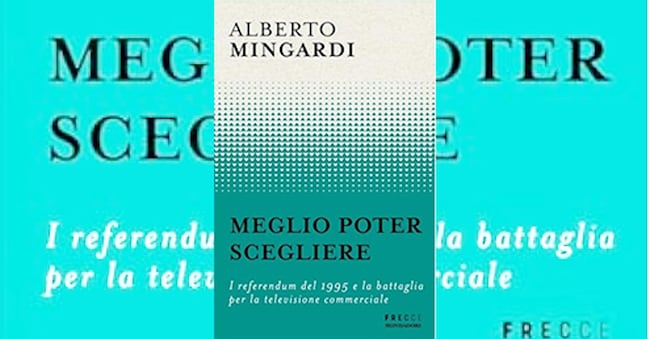
One thing seems to be accepted today: instead of replacing television and bringing back the written word as originally thought, the Internet has become a piece of television. Yes, that's right. In fact, the platforms on which we watch films and dramas, which we continue to call 'TV series', come from there. One figure above all: YouTube is a network with 2.5 billion monthly viewers. So, to paraphrase Mark Twain once again, the news of the 'death of generalist TV' has been greatly exaggerated. It is still part of the media diet of millions: the 'duopoly' has not been overcome by law, technology has taken care of that. Alberto Mingardi, a liberal historian and political scientist, in his latest book Meglio poter scegliere. I referendum del 1995 e la battaglia per la televisione commerciale (Mondadori, pp. 420, EUR 22), takes an in-depth look at what happened thirty years ago, a political passage that today is mostly forgotten but in its profound essence one of the most important, a key passage between two historical phases and the premise for the opening of other changes, which we are still living through today. It must be said: there is a before and an after. And there was an aftermath because the vote thirty years ago went that way, the system set up by Berlusconi - with all the known political flanking - remained, and so the Cavaliere's political career, which had just begun and was immediately crippled by the notorious 'ribaltone' - according to the story orchestrated by the Quirinal, the 'strong powers' and who knows who else - prepared for a grand comeback a few years later. Minardi's book shows that it was better to have television. "Moved by his own self-interest, as he climbed the rankings of the richest men in the country, Berlusconi had made the liberal revolution before taking the field. When, with his televisions, he had liberated culture, cinema, information. If, at the beginning of the 1990s, Italy could get fed up with being the country of state-run panettone, it was because, after too long, it had finally come to know the alternative, and the alternative was the colourful world of commercial television'. In short, the 'duopoly' had been conquered with an ingenious and ruthless competitive guerrilla war, and has been, year after year, defended in a war of position against the public company that has the greatest grip on the Italian political class, today as yesterday. Since we start with the vote, let's see how it went. And it went surprisingly well: participation was high: out of 48 million voters, 28 million turned up at the polling station, more or less 58% of the eligible voters. We are far from the success of the 1993 referendum (73% of those eligible), but above the 1990 referendum on hunting (which did not reach the quorum) and not far from the one on single preference, which in 1991 broke the first domino, leading to the end of the party system (62.5%). No referendum has since reached a quorum in Italy, with the exception of the 2011 referendum on water services and legitimate impediment (54.8%). The referendums of June 1995 met Silvio Berlusconi just over a year after he took office and while his political career seemed to be reaching rock bottom. "Thrown out of the government in a bad way, mocked by an ally to whom he had handed over conspicuous parliamentary representation, the sloppiness with which he moved in the palaces of power contradicts the premise of all his electoral promises: only an entrepreneur can straighten out the company Italy. Despite the glittering 30 per cent he achieved in the previous June's European elections, it is widely believed that the plutocrat has burnt his fingers in politics. I told you so. Observers who are anything but clueless imagine that, in a few months' time, the founder of Forza Italia will sit in a museum case, leaving room for what is evidently the best-equipped leader of the Italian right: Gianfranco Fini. Perhaps this is exactly how things would have been if, on that 11 June, the voters had cut off the conflict of interests once and for all. Only they didn't. Some of them undoubtedly go to the polls to vote on Berlusconi, to defend the country's designated saviour or to get rid of this scourge of democracy'. For Mingardi, however you look at it, the 1995 referendums were one of the real turning points of contemporary Italy.
"If they had had a different outcome, perhaps Silvio Berlusconi would really have thrown in the towel and he would have lacked the resources and the gumption to stick it out between 1996 and 2001. Even on the left the balance would have been different and the following legislature would probably not have had the 'reformist' intonation that it did. But that political transition thirty years ago has fallen into oblivion, even those who were protagonists of those years retain a vague memory of it. The pro-Berlusconians have removed them, because they prefer to tell themselves the legend of 27 March 1994, Berlusconi against Occhetto, a 'new' way of doing politics against the old party, Scalfaro's plots against the Cavaliere, and so on. "The anti-Berlusconians," writes the author, "not only have the shrewdness to forget a defeat, but are persuaded in good faith that nothing relevant has happened: in a world dominated by television and in which His Emittance moved his acolytes around like toy soldiers, in hindsight those referendums could only be lost. Of course, if D'Alema had made an effort and said something left-wing...'.


