Once-in-a-lifetime trips/3

From Algeria to Mauritania and on to the Global South: the desert route

It is not a route through the most remote expanses of the planet. It is the call of the endless expanse of sand and rock, where people seem like mirages and space stretches as far as the eye can see.

L’insediamento neolitico di Akreijit risalente a 4.000 anni fa, nella regione di Dhar Tichitt sempre in Mauritania.

7' min read

Translated by AI
Versione italiana

7' min read

Translated by AI
Versione italiana

On the sandy ground, the dromedary’s gait lulls me like a lullaby. Against the starry night sky, I make out tall, darker silhouettes. But, in a few moments, a glimmer of light. Beyond the crown of the Merzouga dunes, the dawn is an explosion. It is 1998, and I have arrived in the Moroccan desert. Since then, a sense of urgency, curiosity and a deep fascination have drawn me back to the Sahara. From Tunisia to Libya, from Algeria to Mauritania, and then Egypt, Mali, Senegal, all the way to the Namib at the very edge of Africa and along Oman’s Arabian Empty Quarter. It’s not just about geography. It’s a call to discover what lies hidden on another rust-coloured plateau, or beyond the ring of sand that marks the boundary of the chalk bed of an ancient lake. A journey to be undertaken.

For me, this is what the desert is. And so much more. It doesn’t take much to start feeling nostalgic for it, even whilst you’re still down there. Then, at last, we set off; the vast expanse takes up the whole horizon. And in the misty air of a January morning, outside the tent, before the sun brings back the feel of summer, I think I understand that connection. At least until the next trip.

Loading...

ALGERIA, ROCK PAINTINGS AND ENGRAVINGS

It is the largest country in Africa – Italia could fit into it seven times over, with room to spare. Here, the desert reveals every facet of its character: endless sand dunes or stony ridges, mountains thousands of metres high, and labyrinths dotted with stone pinnacles. ‘My’ Algeria lies in the south, amongst the oases of Djanet and Tamanrasset – or ‘Tam’, if you prefer – reached via a Saharan expedition, not by road but along tracks, when conditions allow.
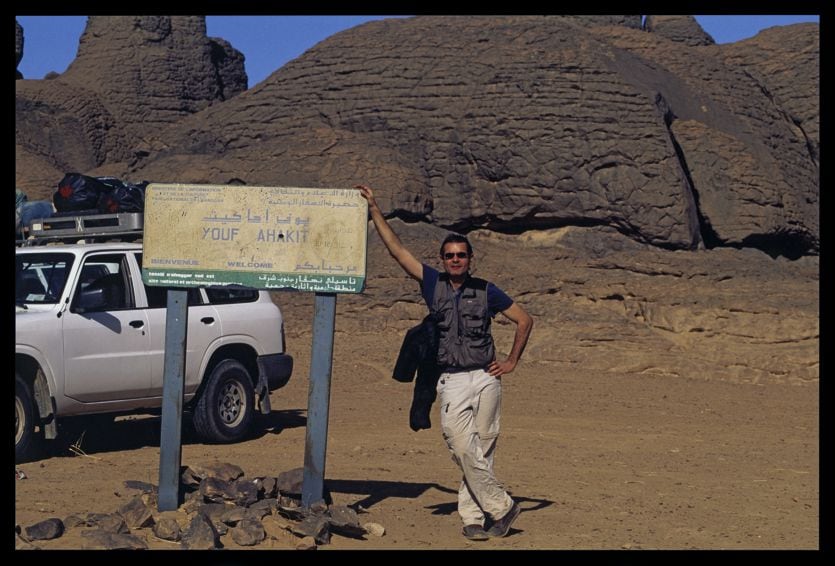
Mauro Querci, autore del testo e delle foto di queste pagine, in Algeria a Youf Ahakit: la località è nota per le sue guglie di roccia a canna d’organo.

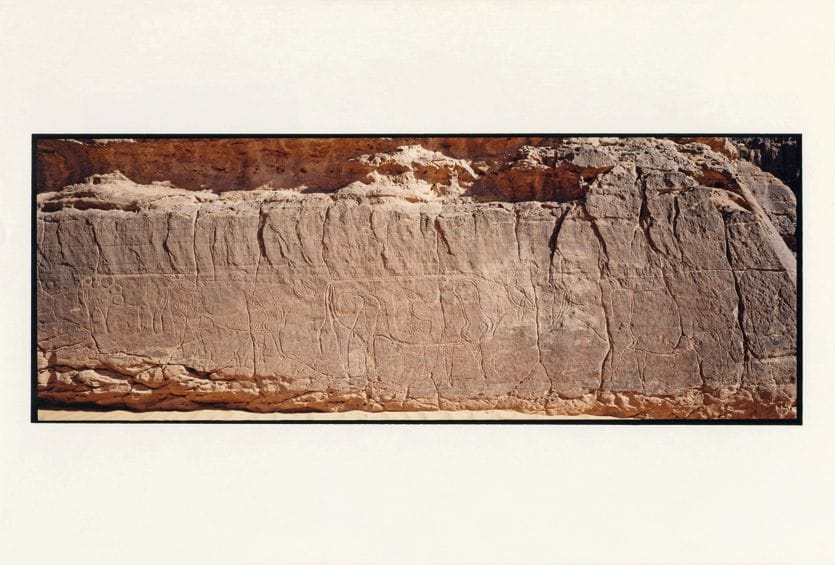
Just outside Djanet – at an altitude of 1,000 metres and home to 30,000 palm trees – the magical atmosphere of the place is revealed at the Tin Amali solar tomb. Two concentric circles with a small mound in the centre. All around, nothing but sand as far as the black basalt spur that marks the boundary. It looks more like a megalithic monument oriented towards the sun than an actual burial site: yet archaeologists are not entirely certain. In these parts of the Tassili n’Ajjer – the mountain range that eventually becomes Libya – they have discovered a marvellous concentration of 15,000 rock paintings and engravings. There is the Picasso-esque portrait of the ‘Crying Cow’ carved into the sandstone, as well as giraffes, elephants, antelopes, herds of cattle and, above all, human figures – some of which may well be the earliest depictions of deities.
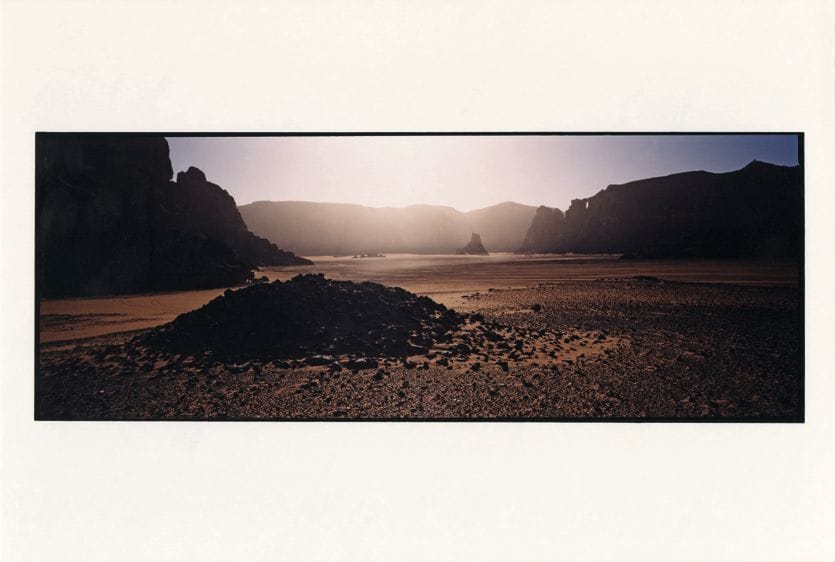
The off-road vehicle makes its way through a petrified landscape, a jumble of rock and stone over which the tyres keep skidding. Then, at last, the blessing of the Erg Admer dunes: its waves of reddish sand rise to a height of 300 metres. The gaze rests, then drifts away. Here, one must be careful even with words. It is precisely the oueds – the riverbeds that now serve as shortcuts along the route and where a few thorny acacias and solitary tamarisk trees grow – that have Tamasheq names which can be confusing. Timâguessin, Tiouârdiouine, Tin Tarâbine… It’s easy to get them wrong.

Un tipico paesaggio di pietra e sabbie del Tassili.

Fortunately, we set up camp at the foot of immense, pale dunes. We have a bite to eat by the cosy fire. The Sahara, however, is always littered with unexpected, ambiguous apparitions. In the darkness, a muffled sound: dozens of dromedaries filing along this track leading up from the Niger. In the cold moonlight, I feel compelled to chase after them. Madness – and, in an instant, they are far away. Then I turn round and am dazzled: a gigantic white dromedary, a mehari. Riding it is a Tuareg wrapped in his chèche of the same colour. He waves his hand and disappears too. A mystery amongst the sands.

Mount Gautier is also something of a mystery, rising abruptly from a sandy expanse. When the sun is at its zenith, it can appear to be yet another mirage. Although it is only a few tens of metres high, it looks like a fortress. After a short stop, you need only walk a few minutes along the track for it to have vanished.

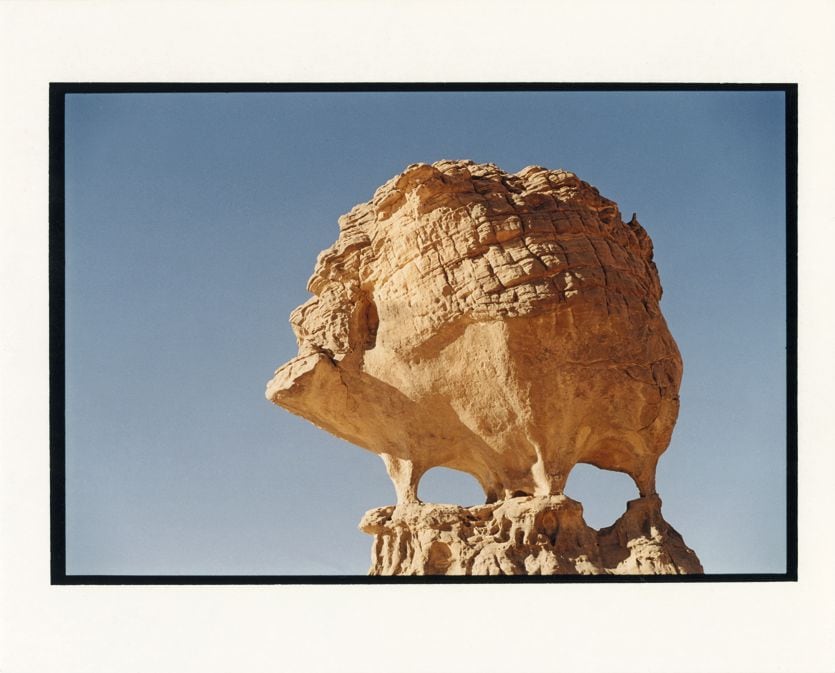
Un porcospino modellato dal vento nella regione del Tadrart.

I keep wondering whether I really did see it, even though a photograph now bears witness to it. And I still have my doubts even when I look for it on a detailed French map: it isn’t immediately easy to spot, almost on the border with the Nigerien Ténéré. Yet living there makes one familiar with these places. Like that painter who, on a café sign in Tamanrasset – at the end of my journey – is sketching the stylised outline of the great ‘panettone’ of Iharen. With yellow on blue and the café’s name in red, that landmark becomes familiar to me too, even though it remains just a name.

Ancora in Algeria, Oued In Djeran, un canyon spettacolare nel massiccio del Tassili n’Ajjer, nel deserto del Sahara. Qui si trova una concentrazione ben conservata di arte rupestre neolitica e pastorale.

THE OMAN DUNES THEOREM

Loading...

There is the formation and the erosion of a dune. The wind piles up grains of quartz, causing the crest to rise on one side and a curve to form on the other. The slope can reach up to 34 per cent. Then, like an advancing wave, the sand slides forwards. And it moves.

I observed the physics of the dunes at close quarters in the Wahiba Sands, one of Oman’s deserts. You travel inland from the coast of the Arabian Sea and the tranquillity of the capital, Muscat. Here, the dunes boast fascinating colours: they range from pink to gold, right through to the purple of dusk.

I arrived in a 4x4, and some people are trying their hand at bizarre sports – surfing on boards down the gentle, 100-metre-high peaks. Even more beautiful, though, is simply kneeling before the sunset, whilst the monsoon breeze makes the grains of sand dance in the air.

These sands seem less harsh. Perhaps it’s because an oasis like Wadi Bani Khalid is just ahead, where you can take a dip in natural pools that quench the thirst of the palm groves too. Narrow roads wind their way through mountain canyons to the date plantations, their vivid green contrasting with the ochre of the rocks. Right where one finds respite from the journey, I met Hamad, the master of water. He showed me how to distribute the most precious liquid in these parts fairly. Using a palm plank with holes of different diameters, depending on the amount needed for irrigation. And depending on each family’s entitlement. In the desert, the things that really matter are shared.

MAURITANIA, ENCOUNTERS IN THE VASTNESS

Oualata. The journey also begins with a name that evokes mystery. In the Middle Ages, it was a crossroads for trans-Saharan caravans. A place of Koranic universities, and of trade in gold and salt from the legendary Kingdom of Ghana. Today, it is an elusive mirage amidst the sands and stony terrain of remote Mauritania. I arrived there many years ago – though time passes at a different pace here – to see the white and coloured designs hand-painted by the women on the ochre walls of the houses. Symbols of fertility, floral motifs redrawn each time after the season of the wind, the rye, which consumes everything.

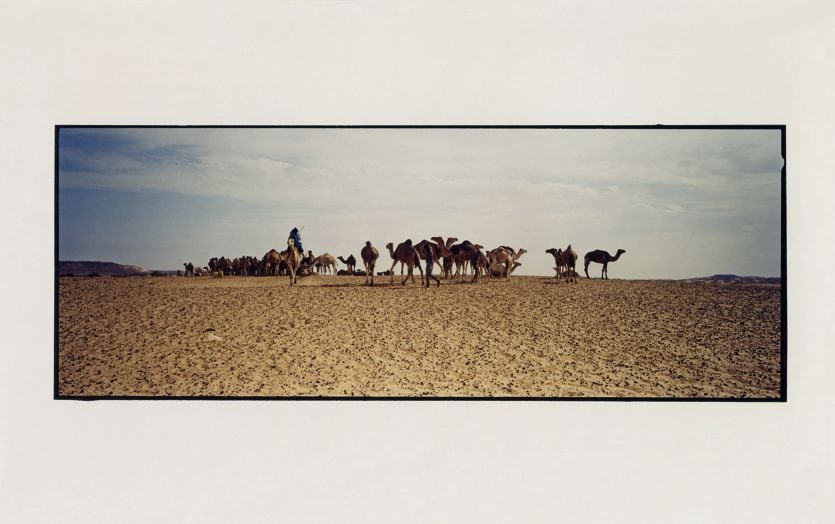
Nel deserto dello stesso Paese, dromedari si abbeverano a un pozzo.

In the narrow alleyways, sheltered from the sun, there seems to be no one about. But a group of children suddenly appears. They shout and bang on a tin can as if it were a drum, amused by the strangers. In the courtyards, their faces half-hidden by a light malafa, the mothers watch…

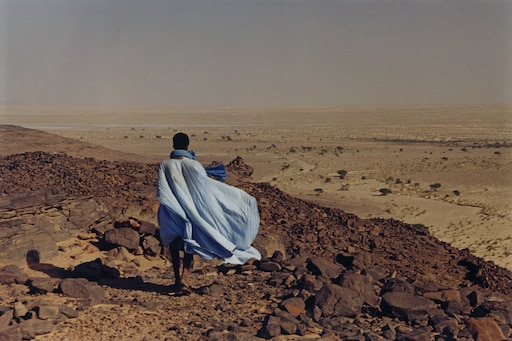
This is what Mauritania is like: an endless, empty desert of dunes, rock and craters widened by primordial meteorites. And yet, one keeps coming across people. The nomad in the blue cloak who appears out of nowhere and takes me to discover the remains of the Neolithic village of Akreijit on a hill. Or the university student Ahmed Ould Hamd who, instead of the usual tip, asks me to send him – to the remote Oued Rachid – a book on philosophy. And then there are the newlyweds who invite the white people into the khaïma, the desert tent, for their wedding feast.

On a plain, the Maghrouga stone circle rises up, like a primitive Stonehenge. We set up camp there. And even here, at the end of the world, a camel driver approaches. A few words are exchanged with Zeidane, the expedition’s guide, as they head towards the horizon. Singing, though. As well as revealing its vistas, Mauritania teaches you the patience required to conquer the trail, and the joy of an encounter in the middle of nowhere.

After Tichitt and Ouadane – once thriving centres when the Sahara was more forgiving, and now little more than silhouettes of stone – here is the final destination: Chinguetti, which strives to preserve its past as the seventh holy city of Islam. In its family libraries, encircled by sand, there are thousands of manuscripts dating back centuries.

And this is a place where poetry still matters, a heritage shared by those who live here. On a night lit only by the moon and a few oil lamps, it is quite a sight to hear the young Moors reciting verses long before the poetry slam became fashionable in our part of the world. All around, the amphitheatre of dunes at Erg Ouarane or, a little further on, the stark, rocky landscape of Guelb el-Richat, the 40-kilometre crater carved out by a piece of a star.

Yes, I came to understand the essence of the desert in Mauritania. It is real, uncompromising; yet in this vast expanse, even an encounter with a stranger regains its value. And it becomes the very essence and measure of things even on the other side of the world. I rediscover it in Patagonia, on Ruta 41, the dirt track that leads from Argentina into Chile. Mountains of giant stones – red, green, sandy yellow – swept by the winds of the Andes. From the low plateau, the elderly Tehuelche people would retreat up here. To contemplate its beauty, once again. This, too, is a desert, one that offers the comfort of distance.

Copyright reserved ©
Loading...
Loading...

Newsletter

Notizie e approfondimenti sugli avvenimenti politici, economici e finanziari.

Iscriviti