
From missiles to armoured vehicles, from fighters to helicopters: 41% of industry funds go to Defence
Almost half of the Mimit budget to 2028 for the development of frigates, fighter jets, helicopters: 10.3 billion out of 25.1. Weighing down the decline in cars, steel and traditional sectors
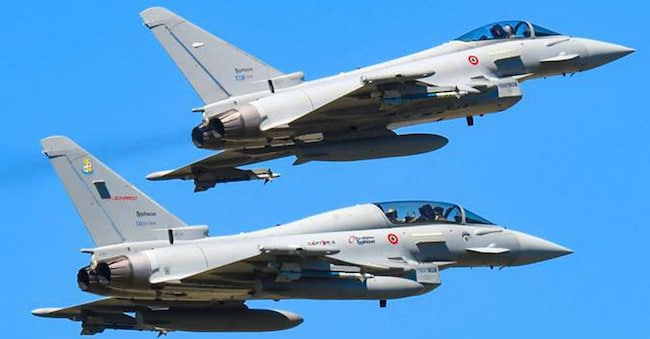
Missiles, fighters, helicopters, frigates, armoured vehicles. One has to delve into dozens of tables of public accounting documents to discover that the ministry responsible for industry is the real privileged channel for financing defence investments, starting with those made in the context of Italy's participation in NATO.
The annexes to the draft budget law now before Parliament, cross-referenced with those of the latest Documento programmatico di finanza pubblica (Dpfp), carve out figures accurate to the decimal point: in the three-year period 2026-2028, defence will absorb 40.9% of the budget of the Ministry of Enterprise and Industry, EUR 10.29 billion out of a total of EUR 25.16 billion.
The Dpfp explains the relevance of the sector as follows: 'In order to contribute to the strengthening of the European defence capability and the consolidation of the European pillar of NATO, Italy is taking an active role in increasing defence investment, enhancing industrial integration and supporting joint research and development programmes. Awareness in this field is constantly growing, as shown by the conclusions of the NATO Summit held in June in The Hague in June 2025, from which emerged the commitment to increase defence spending, with a target of 5% in relation to GDP by 2035, divided into 3.5% to finance core defence capabilities and 1.5% for security-related activities, including, by way of example, innovation and strengthening the industrial base.
Some changes of an almost structural nature, however, cannot be considered recent, and the trend of Italian industry must be re-read, which in recent decades has lost its vocation in sectors such as information technology and telecommunications, has been severely downsized in others, such as household appliances, and is experiencing a deep crisis in what were once two areas of excellence, the automotive and steel industries. An indirect consequence is also the transformation of the map of industrial policies and the incentive system, affected by interventions that are sometimes discontinuous or modified year after year, and perennially conditioned by the identification of financial coverage, as the latest events of the Transition 4.0 and 5.0 plans paradigmatically demonstrate.
In the meantime, the budget of the ministry representing the interests of industry seems to have become an ideal vehicle for financing defence investments, in which Italy counts on international players such as Leonardo and Fincantieri. This is not a novelty of the Meloni government or of the last manoeuvre, but only since this year has the document 'Nota illustrativa sulle leggi pluriennali di spesa in conto capitale' attached to the Dpfp (which replaced the old Nadef) made it possible to make a proportion of the total budget.


