
From automotive to chips, Piedmont, Liguria and Lombardy together to protect key supply chains
The regions aim to create new synergies and esg strategies for the automotive industry. According to Ires 2022 data, 60 per cent of industry companies are located in the North West. Many interact with the key sectors of aerospace and semiconductors

3' min read
Key points
3' min read
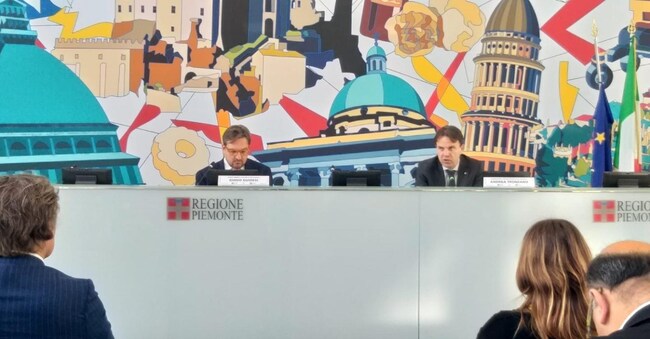
Reducing emissions, attracting new companies and strengthening existing ones. These are some of the objectives set for the automotive sector by the North-West Economic Council. After previous meetings in Genoa and Milan, the regional councillors for development Andrea Tronzano (Piedmont), Guido Guidesi (Lombardy), and Alessio Piana, met in Turin. At the centre of the discussion, in addition to the automotive sector, the other crucial sectors for industry in the region: aerospace, the logistics chain, the energy industry and microelectronics. With a view to the next meeting, on 4 April in Turin, 'the road is mapped out,' said the three councillors, to 'build interregional networks on topics of common interest. In this way, it will be possible to achieve 'greater development and new opportunities for companies' in the three territories, through cooperation and the enhancement of specific skills.
Decarbonising Automotive and Creating New Synergies
Automotive is a key sector for the economy of the North West. In fact, 60% of companies in the sector are located in the area, distributed mainly between Piedmont (33.6% with 730 companies) and Lombardy (26.9% with 590). According to a study by Ires Piemonte, it is the main manufacturing sector and among sectors. It therefore has an additional value multiplier for the region of 3.1. The automotive industry faces several challenges, such as relocation and the need to reduce its environmental impact. During the thematic round table, the North West Cabin therefore pledged to strengthen the conditions for retaining companies, including components, in Italy. For the councillors, it will also be fundamental to attract technological research and development to the region, strengthening investment in renewable fuels, without focusing only on electricity. Collaboration between the regions is a great opportunity to create enhanced synergies on European funds, for the shared needs of the individual sectors.
From cars to aerospace
.Many automotive companies, thanks to their technological skills and adaptability, have easily converted to seize the new opportunities offered by the aerospace sector. The creation of an inter-regional ecosystem would allow not only the pooling of policies, skills and research spaces, but also the international opening for the SMEs that make up the supply chain. The North West could thus become a single and cohesive interlocutor for national and EU players, but above all an attractive pole for new entrepreneurial initiatives, which would then have the capacity to retain them after their initial growth. With this objective in mind, the Politecnico, the Piedmont Region and the Chamber of Commerce have invested over 40 million in the City of Aerospace , whose first nucleus was inaugurated in November.
Energy Communities and Hydrogen
.Renewable energies play a key role in the national energy strategy and in the transition from a fossil fuel-based economy to a more sustainable model. Piedmont, Lombardy and Liguria are focusing on hydrogen and energy communities to reach the national target of covering 40 per cent of gross final consumption with clean energy by 2030. The North West Cabin is trying to understand how to integrate hydrogen into production processes, especially for the decarbonisation of hard-to-abate ones. Many companies in the area are already active in autoproduction and self-consumption of renewable energy, but are waiting for clearer national rules and more information on renewable communities.
Prepare for the chip challenge
.The North West intends to be ready for the challenge of microelectronics. With the Chips Act, the European Union intends to achieve a 20% share of global chip production by 2030, starting from the current 10%. Piedmont is currently the only Italian region in the European Semiconductor Regions Alliance, set up on 7 September with an agreement between 27 territories from 12 European countries. Turin has assumed the vice-presidency and will take over from Saxony for the presidency in 2025. The aim will be to contribute to the growth and competitiveness of the semiconductor industry and support the training of new professionals for the sector.


