
From boutique fair to global hub: Abu Dhabi Art enters the Frieze phase
The expanding event, between blue chip returns and new collectors, this year also welcomes the Italian Cultural Institute's project dedicated to 20th and 21st century Italian art

Key points
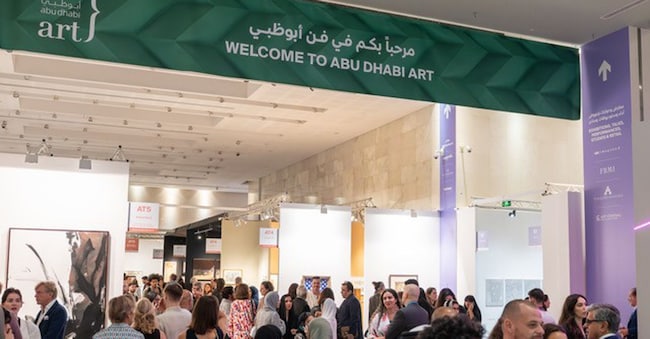
From 19 to 23 November 2025, Manarat Al Saadiyat hosted the 17th edition of Abu Dhabi Art, the largest ever: 142 exhibitors, compared to just over 100 last year, from 52 cities and 37 countries. A record edition that also marks a historic transition - the last under the current name before the transformation into Frieze Abu Dhabi in 2026. It calls for a chapter and, at the same time, the start of a new phase for the Gulf art market, at a time when even Art Basel is preparing its debut in the region with the fair in Qatar scheduled for next February.
"The move to Frieze Abu Dhabi is not a change of identity, but an evolution of our capacity and integration into the global scene," says Dyala Nusseibeh, at the helm of the fair since 2016. Reinventing itself, after all, is nothing new: founded in 2007 as ArtParis Abu Dhabi, the following year it was taken over by the Abu Dhabi Authority for Culture and Heritage (ADACH) and renamed Abu Dhabi Art. 'Every change of pace,' Nusseibeh emphasises, 'requires strategic scaling and in the last ten years,' he adds, 'the Gulf has gone from being a place perceived as speculative on the global art map to becoming a real centre of gravity.
The big dealers in pole position
This new force of attraction is attracting major international dealers. As many as 53 galleries are making their debut at this edition, flanked by some notable returns such as Pace who is returning to the fair for the first time since 2011, presenting iconic works such as a small edition of Robert Indiana's famous "Love" ($850,000), new sculptures by Arlene Shechet ($120,000) and works by other leading sculptors. 'We can see the role that Abu Dhabi has achieved in the Middle East,' says Marc Glimcher, ceo of Pace, 'here the attitude is very positive: everyone comes because there is still an awareness of taking risks and capital does not seem to scare as it did in the rest of the world ten years ago. The second reason is that they have built an incredible infrastructure here and it is, therefore, time to come back and participate in this wind of change. We have no particular expectations for the fair, other than to revive our relations in the area; we are very surprised by the number of international collectors present: they did a great job'.
And what about the explosion in the number of galleries invited this year? Is this a normal level for a Frieze-branded fair? "Next year will be different," concludes Marc Glimcher who meanwhile has also confirmed Pace's participation in Art Basel Qatar next February in Doha. With the growing Western influx in the region - fairs, galleries, collectors, visitors - director Nusseibeh stressed, however, the need to maintain a "balance" in order to preserve the "intimacy and coherence" that distinguish the fair that has always been considered a boutique fair. For Mohammed Hafiz, co-founder of Jeddah's ATHR gallery, the event has made a decisive leap from being a simple regional showcase to a fair with genuine 'curatorial weight'. He attributes this evolution to the continuity of the region's institutional and museum presence and the curated sections highlighting West Asia, North Africa and South Asia, "rather than following a purely Euro-American model". This year, Hafiz is collaborating with the Mennour Gallery in Paris to present the large charcoal drawings of Mohammad Al Faraj, offered at prices ranging from $4,600 to $21,000, which were highly appreciated with several sales at the opening. "The expansion of the fair," says Maryam Al Falasi, founder of Iris Projects, "seems a natural reflection of the momentum we are seeing in Abu Dhabi's cultural ecosystem. The fair is considerably bigger this year, but it seems to have evolved with intentionality and collectors have been actively present this week. With Frieze on the horizon and the fair strengthening its position regionally and internationally, I am optimistic, which makes the prospect of attending next year a very real possibility."
Affordable prices for a growing collection
Initially, the fair hosted mainly blue chip galleries, flanked by some of the leading regional realities. In recent years, however, a space has been built in which emerging emid-career galleries could take a central role. This approach applies as much on a local eregional level as on a global scale. In this context, the participation of galleries with works in more affordable price ranges was encouraged in order to dialogue with a growing collector base. In addition to an established core of major collectors with significant collections at the same time there is a promising growth of younger collectors with disposable income who are starting to emerge as crucial future interlocutors and to whom galleries can look to develop their markets. This new dimension has favoured the participation of newcomers such as AWL (Girona, Spain) presenting Syrian artist Talin Hazbar whose artistic practice is rooted in an elemental involvement with the earth and its changing formations. Sand, coral, clay and stone are not passive materials in her work, but unstable systems that oscillate between collapse and cohesion. The artist approaches them as volatile and adaptable bodies, bearers of both immediacy and memory (prices from 6 to 12 thousand euros). Space was also given to the Italian galleries that chose Abu Dhabi Art for the first time, including Galleria Anna Marra (Rome) with an all-female stand: Veronica Botticelli (4,900-8,000 euros), Khadija Jayi (10-15,000 euros) and Turiya Magadlela (10-30,000 euros). This first experience was positive not only for sales but, above all, "for the incredible cultural liveliness of this city and the fair," comments the gallery owner. This is the first time in Abu Dhabi for Galleria Studio G7 (Bologna), but Giulia Biafore, the gallery's director, has already tested the area several times by participating in the Dubai fair, which has now become a consolidated event: "This is our fourth participation and we are confirming our presence for the 2026 edition; as a first experience, I must say that I am very happy with how it went, I have already had several sales and I was surprised by the incredible cultural liveliness of this city and this fair". The three artists who were present at the fair (Anneke Eussen, Jacopo Mazzonelli and Franco Guerzoni) all received great attention, and for each of them we have concluded several sales". Always an excellent response for P420 (Bologna), which concluded sales of the works in the series 'Abachi' (2018) and 'Arbusti' (2025) by Riccardo Baruzzi (price range $7,500-10,000) and Rodrigo Hernández (price range $7,500-10,000), which won not only new collectors, but also the interest of critics and curators present. Moreover, the strong interest of the public in the region for the works of Adelaide Cioni and Irma Blank was confirmed
The homage to historicised Italian art
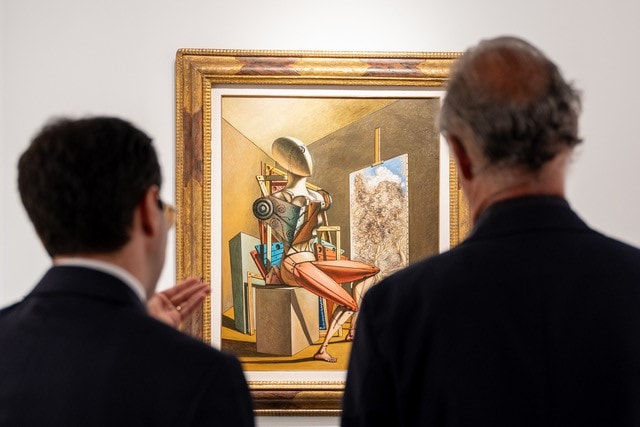
Among the novelties at the fair this year, a space was dedicated to more historicised Italian art. The Italian Cultural Institute of Abu Dhabi and the Italian Embassy in Abu Dhabi, in collaboration with Galleria Mazzoleni, presented at the fair the exhibition project, 'The Roots of the 20th and21st Century Italian Art', through the works of seven artists: Agostino Bonalumi, Enrico Castellani, Giorgio de Chirico, Lucio Fontana, Giorgio Morandi, Michelangelo Pistoletto and Salvo.this exhibition is intended as a tribute to the complexity and richness of Italian art, in an international context such as Abu Dhabi," says Susanna Iacona-Salafia, Director of the Italian Cultural Institute, "to create a cultural bridge between Italy and the United Arab Emirates, between the Mediterranean and the Gulf, between tradition and contemporaneity. As Director Susanna Iacona-Salafia explains, many of them have rarely been exhibited in the UAE, and bringing them back to the exhibition means filling a gap in the local panorama.
In addition to presenting the voices of the great masters of the 20th and 21st centuries, Mazzoleni also brought contemporary experimentation to the fair with works by Marinella Senatore, Andrea Francolino and Davide Reimondo.

