
From wine to carasau: the international strategy for Sardinian products
A positive outcome for the eight Sardinian companies that took part in Foodex Japan

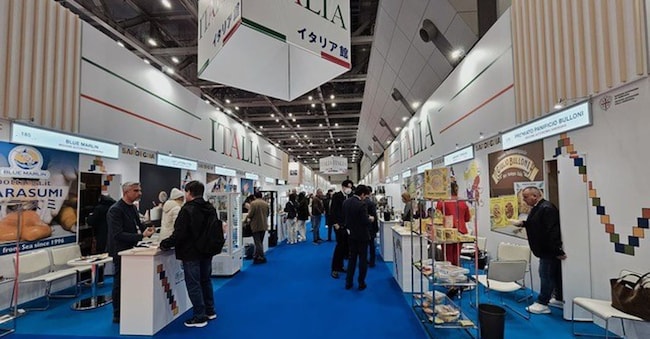
From wine to carasau bread, via tuna and bottarga, and rounding off with pecorino. Sardinian produce is winning over Japan. Indeed, the outcome of the Sardinian companies’ participation in the 51st edition of Foodex Japan, promoted by the Region of Sardinia, has been positive. For three days, eight Sardinian companies took part, under the coordination of the Department of Industry, in the collective exhibition of Italian companies organised by ICE Agenzia at the Big Sight exhibition centre in Tokyo.Among the highlights of the three-day event was a gathering involving institutions, companies, potential buyers and the local press, during which Michelin-starred chef Yoshimi Hidaka created an exclusive menu using ingredients from Sardinian producers. During the evening, Gaia De Donato, an official from the Department of Industry, conveyed greetings from the Councillor for Industry, Emanuele Cani. ‘For us, this evening represents much more than a promotional event,’ she said, ‘it forms part of a broader process of strengthening institutional and economic relations between the Region of Sardinia and Japan, building on our participation in Expo 2025 in Osaka. This marks the third time the Department of Industry has attended Foodex, demonstrating a constant commitment to consolidating the position of Sardinian businesses in a strategic market such as Japan’s.” From Sardinia came products from the wine sector, sourced from a network comprising nine producers from various parts of the island. And then there is bread, tuna and pecorino cheese.
The cooking demonstration by a local chef using Sardinian produce, held in the Region’s exhibition space and introduced by the director of the ICE office in Tokyo, Giampaolo Bruno, who thanked the Directorate-General for Industry ‘for its vision and constant support for the project to promote the finest products of this beautiful region on the Japanese market’. Not only that, but the director also added: ‘The role of the ICE agency is to support Sardinian businesses on their path to internationalisation in the Japanese market,’ he reiterated, ‘by transforming these tasting sessions into concrete opportunities for commercial collaboration, creating solid and lasting links between Sardinian producers and Japanese operators’. However, that is not all, as the Sardinian producers’ trip to the East also concluded with a visit, organised by ICE, to two major food retail chains. And on the horizon lies the possibility of new agreements and growth in the Japanese market and neighbouring markets.

