
From the City to shirts for Prince William: Luca Faloni is the anti-establishment figure
The story of a brand that goes against the grain: permanent collections, high-quality Italian craftsmanship, but an international clientele. Its forthcoming debut at El Corte Inglés

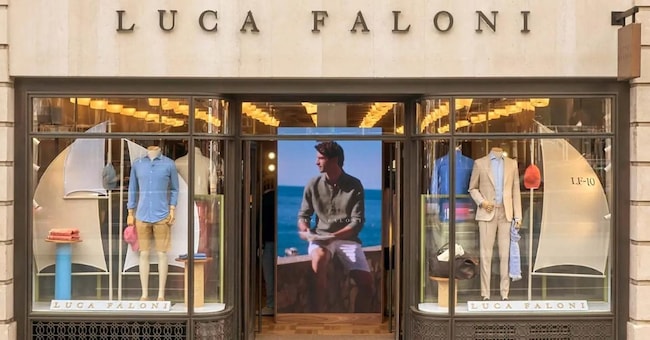
It is a Saturday in April 2023, but not just any Saturday, as it is the day before Easter; and in the VIP stand at Villa Park, the historic stadium in Birmingham home to Aston Villa, its name: sitting amongst the VIP supporters is Prince William, heir to the throne of England, with his son George, who will also one day be King. He is wearing a shirt and a jumper tied round his neck. At first glance, these are unremarkable garments, but on closer inspection they are also very elegant and refined. Experts on British royal affairs, ever attentive to every detail of the House of Windsor, immediately set about investigating and discovered that the future King was wearing garments by a virtually unknown Italian brand: Luca Faloni. A scandal erupts: some time later, an Aston Villa executive walks into a shop and reveals that he had recommended Faloni’s shirts to Prince William because he wore them himself. Even in the age of the digital world, of constant global connectivity, good old-fashioned word-of-mouth remains the most effective marketing strategy. Strolling along Piccadilly, the Italia brand’s sign stands out between the eponymous Arcade and the historic bookshop Hatchards. It was the brand’s first physical shop and opened five years ago: for many years, Faloni had only sold online.
British understatement
Faloni’s luxury is perfectly suited to British understatement and is therefore ideal for a member of the royal family: classic, understated, no excess, no visible logos. It goes almost unnoticed. It relies entirely on the quality of the product, the fabrics and the craftsmanship, all of which is carried out exclusively in Italia. Luca Faloni launched his brand 12 years ago, starting from scratch and with no experience, history or established reputation to fall back on: he was one of the many consultants working in the world of finance in London.
At the age of just 20, he left his native Turin to study at Bocconi University in Milan. With his degree in hand, he flew to London: he was one of the many young Italians arriving in the City, which in those years was experiencing one boom after another. He enrolled on an MBA and entered the world of consultancy, one of the most obvious career paths for recent graduates. The year was 2012, and that’s when the turning point came: Bain & Co sent him to San Francisco to work with a client in the fashion sector. ‘I knew nothing about it, but I noticed two striking things: everything is made in China and the prices in department stores are exorbitant.’ Just 10,000 kilometres from home, he realised something that is taken for granted in Italia: the beauty of Italian products.

From there, he began to develop an idea: to create a high-quality clothing product and sell it exclusively online, directly to customers, bypassing the ‘Caudine Forks’ (for the customer) that department stores represent. Two years later, he left his job and became an entrepreneur: at a time when the luxury sector was booming everywhere and growing at a dizzying pace, Faloni set himself a contrasting mission: ‘To offer good quality at a fair price’. He chose to name the company after himself: “It may seem presumptuous, but in Italia all the big brands bear the founder’s name. It instils confidence in the customer: Massimo Dutti is a made-up name; there is no such person as Massimo; Armani, Prada and Fendi are, on the other hand, real people”.
Out of the Chorus
How a former consultant from the City of London managed to establish himself amongst the most exclusive Italian luxury brands, even going so far as to dress Prince William (though the first celebrity to discover the brand was Bob Iger, the former head of Walt Disney) lies in the deceptive nature of the manufacturing process: ‘The textile industry appears to be an industrial sector, but the real key to making it work lies in cash flow and costs’. In this respect, his background in finance and accounting has helped him. Of course, capital and a network of suppliers were still needed to get started: “To secure funding, I pestered Goldman Sachs, whilst to start production I went to a friend who owned a men’s belt factory and began to learn the ropes. At the start, there were no contracts with suppliers, just handshakes.’ Success wasn’t immediate: ‘It took a long time; the advice I’d give to anyone launching a business is to be patient. Many start-ups give up too soon.’

