Paris, days 5, 6 and 7

From Celine to Hermès to Miu Miu: a blend of lightness and bold reinterpretations

9' min read

Translated by AI
Versione italiana

9' min read

Translated by AI
Versione italiana

Every so often, the fashion world chooses its guiding lights – leaders capable of capturing the spirit of the times, creatives whom the entire industry regards with a reverence that quickly turns into imitation, ranging from the subtle to the brazen. Those icons are now Matthieu Blazy of Chanel and Michael Rider of Celine: their influence can be seen everywhere. Their styles are similar, characterised by an accumulation and juxtaposition of opposites, although Rider possesses an ineffable lightness that Blazy lacks, and which is irreplicable.

Day 5

Loading...

The Loewe collection has a distinct Celine feel to it: the third collection by Lazaro Hernandez and Jack McCollough, a step back from their previous ones. Or rather, a step forward in defining the Loewe wardrobe – straddling leather and technical outerwear, sport and ornamentation – but a marked decline in terms of stylistic character. Let’s be clear: the pair have always looked elsewhere for inspiration, even when they were at Proenza Schouler, but they had got off to a good start at Loewe. Now, the echoes of this and that have resulted in a collection that is formally impeccable, at times even exciting – the little dresses made of layered coloured veils – but entirely lacking in vigour, stripped of any distinctive signature. In today’s fashion world, there are far too many outfits like this, and the skill in working with the materials is not enough to make a difference.

As for clothes like those designed by Satoshi Kondo and his team for Issey Miyake, however, there are never enough of them. Here, they invent from scratch, create and make you think, with a lightness that conveys the message in the very best way. True to Issey’s experimental and humanistic spirit, yet free from conventions and codes, this season Kondo focuses on the ‘ma’ – which, in Japanese culture, is the space between the body and the clothes: a void brimming with possibilities. The movement in this highly successful collection is a breath – like the powerful breath of the dancers who open the show, playing with an enormous piece of fabric – ranging from short to long, from the minimal space of the corsets that outline imaginary torsos—encompassing true nudity with mimicked nudity—to the maximal space of the parachute-like dresses that billow out and pull away from the figure, fluttering with every step. This magnificent detour around form and movement is abstract, yet not overly intellectual, and results in a truly memorable moment.

A master of the craft, a designer as tenacious and poetic as they come – the likes of whom are no longer to be found – Yohji Yamamoto continues to make his mark well beyond the age of eighty, ever intent on deconstructing, breaking down and dismantling in order to reassemble. This season, deconstruction becomes liquefaction: the garments split into spiral-like movements, unfurl into interlaced patterns and fringes, and curl into tangles of threads, in a lyrical tension towards a primordial state that is not merely a piece of fabric, but the very fibre itself.

Peter Coppings’ Lanvin has finally found its form: vertical, linear, elegant; drawing on archival research but without being stuffy. Yet, it still lacks a sense of urgency and relevance. At Givenchy, Sarah Burton speaks of both clarity and diversity without this becoming an oxymoron. The sharp, masculine tailoring, the flowing jersey suspended by metallic scrolls, the leather dresses and trousers clinging to the body, the deconstructed jackets and the Japanese-inspired motifs are all clear and precise. Everything is meticulously crafted, designed to give the wearer a sense of confidence, strength and elevation. These elements, however, come together in a kaleidoscopic narrative, characterised by a rapid-fire multiplicity. Rather than centring the message on a single female figure, Sarah Burton prefers to acknowledge the complexity and variety of the female world. There is coherence in her fragmentation, and the result is compelling.

Victoria Beckham, finally, finds coherence by moving away from avant-garde pretensions accompanied by abstruse styling. She focuses on precise tailoring, fluid outerwear and flowing little dresses with a 1920s feel – and, for once, she’s convincing. Nothing we haven’t seen before, mind you, but impeccable.

Day 6

No spectacular embellishments, no beautifying filters, no narrative flourishes: the Parisian fashion shows, at best, reject artifice – or at least tone it down. Of course, this is still the world of fashion, so staging is inevitable, but at the moment it is cinéma-vérité – or rather, a sort of magical realism – that sets the tone. Michael Rider was one of the instigators of this shift. He is certainly its most spontaneous and ineffable interpreter. His his Celine embodies the modern ‘French touch’, capturing the crumpled yet erudite nonchalance of today’s Parisian style – as it perhaps ought to be, rather than as it is. He does this precisely because Rider is American: the outsider’s perspective, the foreigner’s viewpoint, helps. This season, Rider reinforces this message, with a particular emphasis on the emotionality inherent in the act of dressing, on the value of the fabulous, and above all on the exchange of garments between women and men – not unisex, but expanded possibilities. His, after all, is an aesthetic system that operates through successive additions, not through seasonal deviations or contradictions. This is what makes it relevant and urgent: the wardrobe he proposes is made up of co-existences, rather like our digital present where everything is available at the click of a button. What is fascinating about the new Celine is a singular contradiction: the garments are exquisite, designed with an architectural intent, full of unique details, deeply desirable, yet they are treated without pretension, mixed together as if carelessly, as if getting dressed in a hurry because one is running late, too caught up in flirting to look at the watch. This is Rider’s magic touch. Everyone looks to him, everyone copies him, but no one captures the essence of his style – so spontaneous and yet so precise – because, as Helmut Lang said, ‘You can’t copy the soul.’

From Hermès, Nadège Vanhee works by subtraction, following an ethereal approach that essentially involves stripping away weight and embellishments. The result is a dynamic, even sharp, lightness that truly breathes new life into the maison’s aristocratic and classical spaces. For a few seasons now, Vanhee has been stripping everything back to maximise cut and fabric, enhancing the sensuality of the body in its relationship with the garment. This new collection, which is particularly successful, represents the pinnacle of her journey so far. It is ‘sleek’ – to use an adjective much loved by fashionistas and one that always sounds like a compliment. It is also sexy, in a stark, martial way that pays a subtle homage to the brand’s equestrian roots. Occasionally there is a risk of a certain coldness, but the warm, natural colour palette dispels any trace of chill.

Loading...

Elsewhere, artifice remains the rule. The Japanese designers associated with Rei Kawakubo are, and always will be, the standard-bearers of an alienating and raw theatricality, which at this moment, however, risks appearing anachronistic or unnecessary. Rei herself, from Comme des Garçons, envisions a clash between royalty and everyday life, which she develops through the bulbous, sculptural and monstrous forms that have now become her signature and a permanent stylistic hallmark. She uses denim, corduroy and tablecloth-weight cotton, setting them in dialogue with the gold, epaulettes and crinolines of courtly language. There is something lighter than usual that pleases the eye, but otherwise it’s all been seen before, and we find ourselves once again waiting for the moment when Kawakubo will make clothes rather than costumes.

Junya Watanabe explores, in his own way, the idea of ‘funky’: self-indulgent bling, voluptuous physicality and a swaggering attitude. There’s something decidedly more playful than usual, which, right now, feels liberating. However, in reality, not much is changing here. Stripping away the catsuits, chandeliers and statement dresses, what remains are the perfecto jackets and deconstructed and reconstructed trench coats, and the maxi skirts, which are the brand’s bread and butter. The fusion of punk and delicacy is a recurring oxymoron in Kei Ninomiya’s vision for Noir, which this season revolves around the concept of ‘Petal Rebellion’. The garments are the exact embodiment of this concept: ruffles and studs, pure black and a sugary allure. The execution is flawless, but the approach is formulaic.

Stefano Gallici, from Ann Demeulemeester, moves with confidence within a framework of his own creation, in which Ann’s signature elements – from androgyny to feathers, via dangling ribbons, her sulky romanticism, are contextualised within a highly personal aesthetic system. Whilst the Antwerp Gothic blends into Californian Gothic and everything takes on a battered, worn, gloriously tattered yet also paradoxically playful patina – as if someone were fishing old clothes out of the loft and combining them to – the target audience shifts, and the brand sheds its skin without compromising its spirit. It is a compelling achievement.

From Alaïa there is no creative director, yet the fashion show goes ahead all the same – and that’s no bad thing. The collection, designed by the team, sits halfway between Pieter Mulier’s abstractions and the stylistic tropes of Azzedine, the founder. From sculpted leather to flowing skirts, via figure-hugging dresses, it is a plausible and systematic recapitulation. Honest, whilst we wait for Alaïa to find its new identity.

Day 7

Contemporary life is in a state of constant acceleration. It races aimlessly, destroying everything in its path, with nothing lasting. In such a context, fashion is no longer able to stay one step ahead of the times. At best, it simply goes with the flow; at worst, it struggles to keep up.

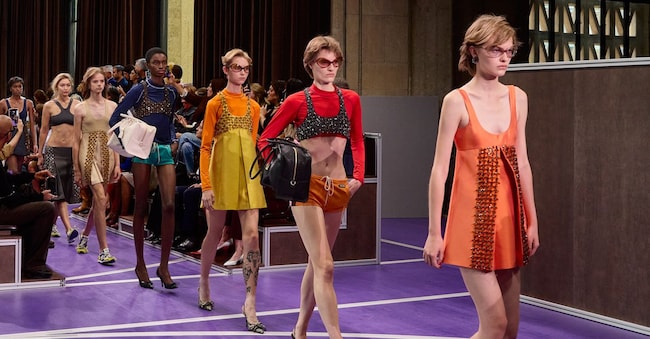
From Miu Miu, Miuccia Prada sees the here and now as the undisputed realm of sportswear – in the real world, that’s all anyone wears – which she embraces, incorporating it into her own aesthetic and thereby transforming it through an unprecedented fusion with the classic – the librarian’s suit, schoolgirl’s jumper – and elevating it through the clash with embroidered dresses, precious silks and widespread sparkle. It is the method that Mrs Prada has always perfected, which she has executed to the highest standard in the past through her creative dialogue with Manuela Pavesi, and which now seems more relevant than ever. The fashion show gets straight to the point, without ever losing its edge. What is always appreciated in Miu Miu – such a deeply personal project – is the love of clothes as malleable objects and of dressing as a subversive form of individual expression. In this sense, the collection is a triumph. Yet, in being a variation on a formula, it lacks a sense of urgency and an edgy spirit. Perhaps these are no longer necessary.

This season, everyone’s attention is entirely focused on the clothes rather than on narratives. On the product, one might hastily say. In truth, it is a way of opening up to what lies beyond the catwalk, recognising that a dress is a repository of possibilities, and that the real story begins there. It is this idea that inspires Alessandro Michele, who, at Valentino, does not abandon his storytelling flair, but rather condenses and redirects it. The show is entitled ‘Antibiblioteca’ and takes place in the halls of the Sainte-Geneviève Library. Books, like clothes, are repositories of possibilities: whether they be volumes never read or even volumes never written, such as those listed in the invitation – a true masterpiece of thought and copywriting. This is the connection – perhaps subtle, but certainly inspiring. That said, the only ‘bookish’ element in this collection is the embrace of glamour – and of ruffles, bows, bling and drama – which is inherent in the Valentino code, for otherwise it is sexiness that reigns supreme. Michele continues to strip things back: a direction he has been pursuing for several seasons now. He hasn’t abandoned the rebellious touches – crumpled bows, rumpled ruffles – but the days of eccentricity are long gone. Now beauty takes centre stage, just a little less conventional than usual, and certainly far more sensual.

Pelagia Kolotouros, from Lacoste, takes all the elements associated with the brand and the sport of tennis – from clay courts to the yellow ball to the polo shirt – and contextualises them within a ‘fashion’ setting without it feeling like a gimmick or, worse still, a stretch. The polo shirt collars are thus transformed into the flaps of a small handbag, whilst the balls are cut into the shape of giant sequins and the entire collection takes on the colours of the tennis court. The lines are fluid and dynamic; the transition feels natural. The only limitation of the project seems to be that it is merely an exercise in style, lacking any real commercial outlet, which is a shame.

It is clearly an exercise in style accompanying a thriving perfume business, including Mugler, where Miguel Castro Freitas does not even attempt to approach reality but instead indulges in a costumetic exercise drawn from the animal kingdom in various ways; although executed with great skill, appears entirely devoid of purpose. Castro-Freitas is a talented designer, but so far his work has come across as self-indulgent. He seems more intent on showcasing technical virtuosity and design skill than on building a genuine brand identity: an approach that will get him nowhere, and which calls for immediate correction.

From Gaultier, Duran Lantink faces, in a way, the same problem. Or rather, his vision is clear: to carry out the same experiments with the body and sexuality as the line that bore his name, but to do so in the Gaultier style – that is, with an even greater sense of elegance, if possible. The disconnect from the Gaultier universe is as disorienting as it is fascinating. Add to this the fact that Lantink’s approach is somewhat erratic and not always easy to follow, so the collection – which opens with the whiteness of the canvas and its infinite possibilities and closes with boxy, prismatic tailoring – proves complex to interpret. The inventiveness is to be commended; the rest requires careful consideration.

Copyright reserved ©
Loading...

Brand connect

Loading...

Newsletter

Notizie e approfondimenti sugli avvenimenti politici, economici e finanziari.

Iscriviti