
From Cuccia to the Mps turnaround, 80 years of Mediobanca
It all began with the trip to Washington by De Gasperi, Mattioli and Enrico Cuccia. With the takeover of Mps, an era ended and a new one began

There is a very little-known fact in the history of Italia, then not yet a Republic (it would shortly become one), that shaped the balance of power of the nascent state. We are on a day between the end of 1945 and the beginning of 1946. The recently installed head of government, Alcide De Gasperi, and the CEO of the Banca Commerciale, Raffaele Mattioli, fly to Washington to meet with the highest levels of the administration. Very few knew of this mission of the Prime Minister (his famous trip would take place in 1947) together with the undisputed head of Italian finance and trusted man of the western establishment. The purpose was to explain to the Americans on which 'pact' the Italia emerging from the twenty-year period was based. An agreement with a brief text: politics to the Catholics, finance, industry and publishing to the secularists. Accompanying the two among others was Enrico Cuccia, who had grown up until then under the wing of Fascism's greatest financier, Alberto Beneduce, whose daughter Idea Socialista had married, and who had personally hired him at Iri, of which he was chairman, triggering a then virtuous mechanism for selecting the ruling class (today, perhaps, it would end up in a parliamentary question).
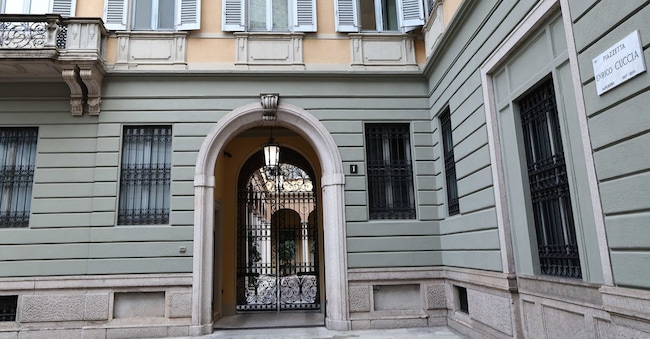
In order to understand what Mediobanca was and in part still is - 80 years after its foundation - we must start from there, from that pact, revealed by Ettore Bernabei, and which marked the entire life of Italy's first business bank: Via Filodrammatici, today Piazzetta Cuccia, was the sole guarantor and the engine that was always on in that structure, which guaranteed Italia an international financial breathing space and provided capital lungs for the major companies, but certainly at some stages also represented a limit. That Cuccia had direct access to the global world of bankers and grand silversmiths was clear from the outset, before his creature was born: witness the secret mission to Lisbon in 1942 to take a memorandum from the anti-fascists to the Americans, or in 1944 being in the delegation together with Mattioli and Quinto Quintieri, again in Washington, to re-establish economic relations.
The embryo of Mediobanca was born in that brief and troubled time between the end of Fascism and the vote for the Republic (also 80 years old), in an Italia still split in two, in the north torn apart by the massacres of the Nazi-fascists and with partisan fighting in the mountains, but also of great political and economic ferment. It was clear to Mattioli that this was the moment to lay the foundations for a financial system that would be able to guide the economic rebirth and the day after the liberation of Rome, the head of Comit presented Iri with the idea of a specialised institution for medium-term financing in which the banks of national interest were to participate. The project remained suspended for a while, the war in the north was still going on, transatlantic relations were being defined, but we arrived at 1946, 10 April, just under two months before the referendum. At first, the group of shareholders was thought to be fairly composite, but then the three 'bins' were set up, 35% to Comit and Credit, 30% to Banco di Roma, which entered the company not without some resistance: it would remain so until 1956, the year of its listing on the stock exchange. This, too, is (perhaps) an anniversary: following the acquisition of control by Mps, it could leave Piazza Affari after 70 years, but this decision could hypothetically be reviewed after the definition of Siena's governance structure, which will be decided next week by the shareholders' meeting.
In 1956, the first foreign shareholders entered the capital (including the Ior, a Vatican institution), especially the investment bank Lazard Frères in New York, which was to represent the closest and most personal relationship between Cuccia and André Meyer for a long time. International relations - above all the USA and France, and a growing projection into Africa and Iran - and consolidation of capitalism in Italia, achieved with continuous operations of capital increases, bond loans, consortia formation, mergers and listings. The banking framework was stable, apart from the cyclone Sindona in the 1970s, with whom Cuccia had relations first of difficult dialogue and then of rupture. But the basic structure, the De Gasperi-Mattioli pact, by then transformed into the 'Cuccia lodo', withstood the first political upheavals, and in particular with the advent of the organic centre-left. Testimonies of the time state that Aldo Moro's plan in the two-year period 62-63 was to advance politics while holding firm to the entrepreneurial structure: "He would be an advocate of the stability of the relationship between the entrepreneurial Holy Alliance, the one that Cuccia began to lead, and politics" writes Franco Briatico in his Ascesa e declino del capitale pubblico in Italia (Mulino). The change in the political framework led to the nationalisation of Enel: Mediobanca was against it, the electors were big customers, but once it left it would throw itself into the management of compensation, orchestrating the subsequent operations, including the one that led to the birth of Montedison, the vicissitudes of which would deserve a separate anniversary.
But things were destined to evolve, especially at the beginning of the 1980s with the advent of Romano Prodi at Iri, and with the influence of Nino Andreatta, who 'had said many times that the extraneousness if not outright hostility of some major centres of economic power to the largest private party in Italia's government, of which the DC was the main component, of an important part of the indispensable armamentarium for conducting economic policy" writes Giorgio La Malfa, who acknowledges the significant influence of this group on the history of the Partito d'Azione and then the PRI.


