
From Taylor Swift's deepfakes to fake news with ChatGpt: how to defend yourself against election disinformation?
There have long been online data journalism tools and tips to reveal the source of a news story or, for example, to discover the metadata of a photo. But now the strategy of hoax producers has changed

4' min read
Key points
4' min read
Former US President Donald Trump posted a series of artificial intelligence-generated images, including a fake endorsement from pop star Taylor Swift, on the social site Truth over the weekend, sparking protests and controversy over election misinformation.
'I accept,' she wrote, after sharing a series of images showing women wearing T-shirts that read 'Swifties for Trump'. The staff of the hugely popular singer and Time's Person of the Year 2023 denied any support.
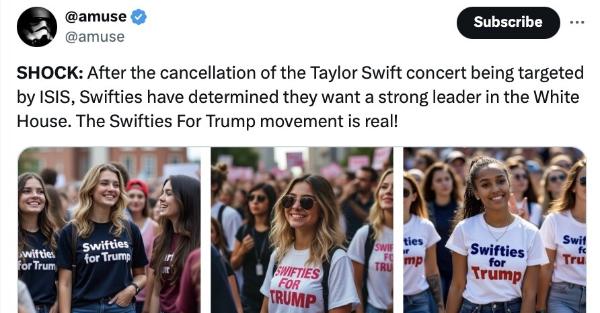
Many of the photos posted seem clearly manipulated, while another is from a satirical newspaper claiming that the cancellation of Taylor's concerts in Vienna due to a terrorist threat would have convinced the singer to side with Trump. Finally, there is a photo of Swift herself wearing an Uncle Sam costume: the image, also clearly manipulated, is juxtaposed with the message 'Taylor wants you to vote for Donald Trump'. The reason why Trump did so is clear. Taylor Swift in 2020 expressed her support for Joe Biden. She has not yet spoken out for Kamala Harris but as of today she is one of the most influential artists on the world stage, on social media she has 283 million followers on Instagram and 93 million followers on X and they are all young and very young. We are talking about an audience that any election candidate is interested in. By any means, even by posting clearly fake content.
How can deepfake be counteracted?
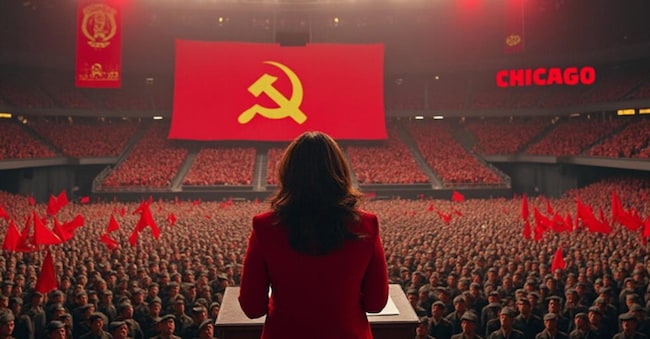
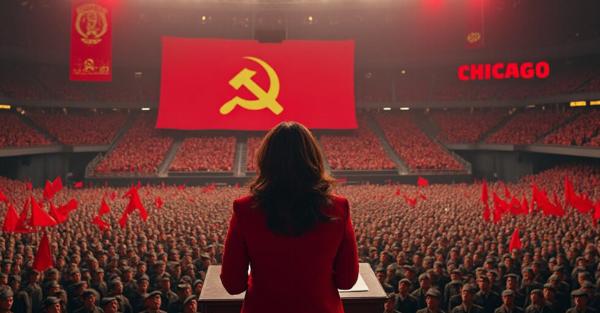
In the United States, several states have introduced laws against election-related deepfakes; these laws mainly apply to plausible representations. The photos re-posted by Trump are anything but plausible. Probably only Taylor Swift could appeal to the courts for unauthorised use of her image or for defamation. However, a dangerous precedent is being set, because by using the Ai in a crude way, creating unrealistic and extreme images, content is being circulated that contains blatant fake news but may in some way influence the election. In a country as careful as the US about freedom of expression, it can be tricky to prosecute this kind of content, which could be mistaken for satirical content. An example is this photo of Kamala Harris at the Chicago rally surrounded by hammer and sickle flags.
The Storm 2035 campaign case
.AI-generated fake news is a different matter. OpenAI has just discovered and blocked some Iranian accounts that used ChatGPT to spread disinformation online. Among the content produced, some concerned the US presidential election. In a note, the company said it had identified accounts that exploited the chatbot to generate content for five websites, both in English and Spanish. The campaign, called 'Storm-2035', aimed to sow division and confusion on hot topics such as the presidential election, LGBTQ+ rights and the war in Gaza, impersonating conservative and progressive sources. As Engadget writes, the Iranian hackers created a network of fake websites and social media accounts to spread manipulative content, but their efforts were largely in vain. Most of the published posts received very little attention, revealing the fragility of the campaign. The cyber criminals allegedly also tried to influence public opinion on international issues such as the Olympics and Venezuelan politics.


