
From effort to outcome: how Aubay is rethinking IT consultancy in the age of AI

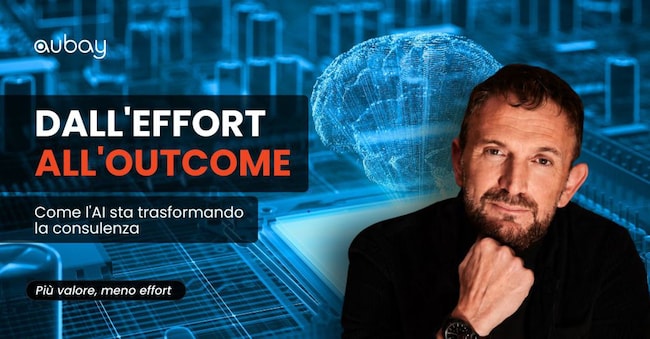
Generative artificial intelligence is rewriting the rules of IT consultancy. It is no longer just a future prospect, but a factor that is already changing the way we estimate projects, put teams together and demonstrate value. And at Aubay Italia – the operational arm of the French group listed on the Paris Stock Exchange – the vision is clear: AI is an opportunity to be harnessed, not a risk to be endured. The company is tackling this by drawing on the assets it has built up over more than a quarter of a century: more than 2,200 professionals, vertical specialisation focused primarily on banking, insurance and telecommunications, and proprietary products that embody domain knowledge that is difficult to replicate.
An Italian company within the circle of European multinationals. Aubay’s history in Italia began in 1998, when, in parallel with the founding of the French parent company, Applied Resource and Technology – a start-up comprising thirteen people – was established in Rome. In 2000, Art became part of the group, which is now a Digital Service Company listed on the Paris Stock Exchange: 9,600 employees across 7 countries and revenues of over 675 million euros. The Italian subsidiary, led by Chairman and Chief Executive Officer Paolo Riccardi, employs over 2,200 professionals and has consolidated a turnover of around 120 million; the stated target is to reach 180–200 million over a three-year period, supported by targeted acquisitions and growing investment in artificial intelligence.
The financial model is consistent with the group’s DNA: reinvested profits, virtually no debt, and growth through both organic expansion and external acquisitions. In the Italian market, a strong presence in two key sectors – banking & insurance and telecoms – is complemented by progressive growth, with the aim of diversifying revenue streams across all other major segments of the business world: manufacturing, energy and media. The six stated values – responsiveness, listening, expertise, customisation, proximity and flexibility – encapsulate a service offering that aims to be bespoke, close to the client and capable of adapting to every stage of technological maturity.
When AI reshapes service delivery: fewer days, more seniority. The picture Aubay paints of the market is free of rhetoric. Numerous national operators – particularly large banks and insurance groups – are already issuing generative AI licences to their IT teams to trial their use on a day-to-day basis. The direct consequence is that projects reach the consultancy firm at a more mature stage, requiring less effort on basic tasks and generating greater demand for skills in design, integration and governance. The estimation model and the mix of professional roles within teams are undergoing structural change.
According to the firm’s projections, the share of value generated by senior staff – currently standing at around 40 per cent in a traditional structure – rises to 75 per cent in the AI-driven model. Junior staff do not disappear, but are retrained for new roles involving the ‘training’ and ‘monitoring’ of generative models: structured prompt engineering, assessment of the quality of outputs, and oversight of security and regulatory compliance. Margins per day rise, whilst the volume of billable days falls. A new economic equilibrium that demands a strategic choice: to transform the margin difference into investment, rather than letting it evaporate through price reductions.
From ‘doing’ to ‘training and monitoring’: people at the heart of the transition. The most profound transformation does not concern technology, but people’s mindsets. Aubay begins with a systematic inventory: taking stock of resources, skills and tools already in use, mapping seniority and functional profiles within the delivery team, and identifying AI tools currently being trialled. Only on the basis of this knowledge can a realistic roadmap be drawn up, priorities and milestones set, and resources allocated in a manner consistent with delivery and sales objectives.
Training programmes follow two complementary paths. On the hard skills front, the focus is on the advanced use of the main tools on the market – Copilot, Claude, GPT-4 – structured prompt engineering, and the critical evaluation of AI outputs. On the soft skills front, the emphasis is on critical thinking, managing uncertainty, and the ability to engage with stakeholders who are now ‘AI-aware’. Overseeing this change is a central AI governance framework that ensures process standardisation, the quality and security of deliverables, operational efficiency and continuous innovation. There is also a permanent internal observatory monitoring competitors’ moves, the evolution of models and enterprise adoption, from which to identify signs of early commercial adoption.
Vertical products and domain knowledge: the competitive edge. Aubay’s true capital lies not in man-days but in the vertical products built up over the years for specific industries, primarily banking and insurance. These are assets that have enabled the company to preserve and concentrate its domain knowledge; and which today represent its main advantage in the era of generative AI. In-depth domain knowledge is, in fact, a prerequisite for training specialised language models, capable of going beyond generic prompts and producing outputs that are genuinely usable in regulated contexts.
There remains a burden to be lifted: many of these products still run on outdated technology, in some cases mainframes, developed in design contexts far removed from today’s realities. Here, AI acts as an accelerator for modernisation: assisted refactoring, cloud-native migration, and the simplification of code and documentation. The expected result is a more secure go-to-market strategy, as the customer purchases solutions that have already been modernised and is freed from the burden of technological risk.
The sales equation is changing: from effort to outcome. The final piece of the jigsaw concerns the go-to-market strategy. The questions customers bring to the table are no longer ‘how many days’ or ‘how much does the team cost’, but ‘which business problem are we solving’, ‘which KPI are we improving’, ‘how much value will we generate over the next six months’, ‘how do we move from experimentation to scale’. This is the shift from an effort-based approach to an outcome-based one, which requires the sales force to adopt a new language, comprising priority use cases, expected value, reusable accelerators, progressive roadmaps and recurring services.
Aubay identifies four roles that IT consultancy must fulfil in parallel: strategic adviser, technology integrator, adoption enabler and managed services provider. The relationship with the client becomes evolutionary and long-term; and the IT consultant establishes themselves as an enabler of transformation rather than a provider of implementation capabilities.
The three messages the company conveys to the market bring things full circle. Act now, because every month of delay is an advantage ceded to competitors. Leverage existing domain knowledge and vertical product expertise, an essential foundation for building a differentiated AI offering. And invest in people, because the shift from ‘doing’ to ‘instructing and monitoring’ cannot be improvised: it requires training, time and strategic vision.

