
From food to longevity: unique health debuts in Osaka
The links between human, animal and environmental welfare in the event organised by the National Centre for Biodiversity and Sapienza University

3' min read
3' min read
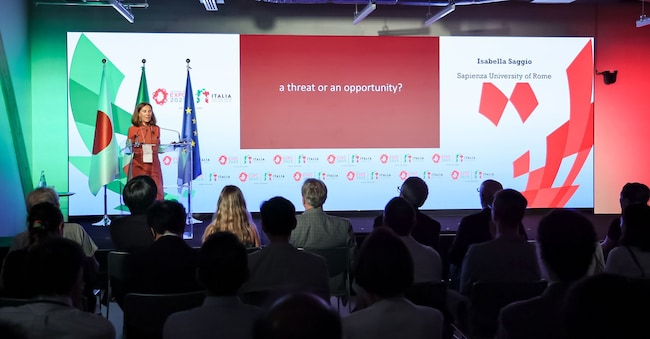
The key to addressing the global challenges of sustainability, food security and longevity? It is a new paradigm based on the concept of 'one health', where human health is strongly interconnected with animal and environmental health. This theme was the focus of the panel 'One health - From food to longevity: scientific approaches to health and sustainability'. The event was promoted by the National biodiversity future centre (Nbfc), the first national centre dedicated to biodiversity, chaired by Luigi Fiorentino, and Sapienza University of Rome within the Italian Pavilion of Expo 2025 in Osaka. During the conference, Italian and Japanese experts discussed science, diplomacy and sustainability and explored the contribution of biodiversity and sustainable diets to health and quality of life, in an integrated and global vision. As Ambassador Mario Vattani, Commissioner General for Italy at Expo, pointed out, the meeting took place as part of the World Expo week dedicated to health and well-being and saw Italian and Japanese universities at the forefront.
A new paradigm
.The term 'One Health' was introduced just over 20 years ago by veterinary surgeon William B. Karesh to study the Ebola epidemic in central Africa that affected both humans and gorilla groups. "But it was above all the Covid 19 pandemic that projected this concept onto the global stage," says Isabella Saggio,Professor of Genetics at Sapienza University and Spoke 7 coordinator of the National Biodiversity Future Centre, who opened the conference. "The new emergency," explains the scientist, "has confirmed that the health conditions of animals have a direct influence on those of people. In other cases, such as Xylella (the bacterium that has infected millions of olive trees, compromising the economy and food security) or more generally natural disasters, the consequences can also be indirect. To turn this threat into an opportunity in the pursuit of collective well-being, the vision must be unique. Such a vision also helps to address the growing challenge of longevity: while in 2015 12% of the global population was over 60 years old, we expect this percentage to almost double by 2050'. The lens through which reality is observed therefore changes: 'The city, understood as a living ecosystem, the protection of nature, relations between companies and even the legal system must be readjusted to this new single health perspective that also involves the economic and political spheres in order to orient legislative action towards criteria of sustainability and justice that will stand the test of time. In this context, the role of scientists is fundamental: they must come out of the ivory tower of their laboratories and interface with a myriad of interlocutors in order to help face the political-strategic challenges of the present-future with an increasingly multidisciplinary approach'.
Pictures and sounds to tell the story of biodiversity
The event also included a virtual visit to the exhibition In Praise of Diversity, which was held between November 2024 and March 2025 at the Palazzo Esposizioni in Rome. The digital exhibition 'Bioverso' told the story of biodiversity through images, sounds and narratives, highlighting the intertwining of nature, culture and health. The virtual presentation was followed by a tour of the Italian Expo pavilion with some physical elements of the exhibition. The Nbfc's participation in Osaka is part of a broader strategy of international scientific cooperation. In April, a Nbfc delegation took part in the institutional presentation mission of the five Italian National Research Centres, with meetings in Osaka and at the Italian Embassy in Tokyo.


