
'From Formula 1 to Sinner: the secret is to train the brain as well as the rest of the body'
Riccardo Ceccarelli, doctor and mental coach of the tennis champion, motorsport stars and other athletes, tells how to get rid of anxiety and tensions that undermine results

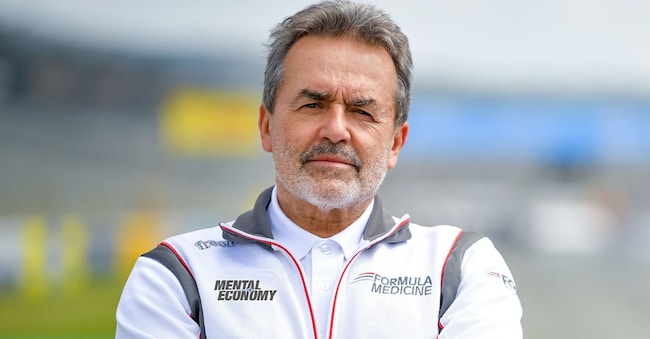
One enters and is immediately struck by a large photo at the entrance: on an Australian beach, Ayrton Senna, Pierluigi Martini, Riccardo Ceccarelli and Maurício Gugelmin run side by side. A shot that comes from another era: we are in 1989, Jannik Sinner will be born 12 years later, Senna has five years left before that cursed 1 May at Imola. An image that declares the starting point of where we are, indicated, moreover, by the name itself: Formula Medicine - in the footsteps of Formula 1 - the company created by Riccardo Ceccarelli, doctor to great drivers (from Ivan Capelli to Michele Alboreto, from Charles Leclerc to Fernando Alonso) and, from the end of 2019, mental coach of the tennis champion most loved by fans (Sinner won the 'Atp fans favourite Awards' in December).
We are in Viareggio where Ceccarelli was born, born in 1960, a doctor specialising in Sports Medicine. He invented Mental Economy Training 30 years ago, and has refined it over time, so much so that not only sports stars, from skiing to swimming, from fencing to golf, but also companies, banks, and pharmaceutical companies turn to him. All with the same goal: to improve their performance by ridding themselves of anxiety and tension. During his adolescence Ceccarelli tried a bit of all sports ('which came in handy,' he says, 'because I understand the language') but his dream was motor racing, a path he tried without success. Except... during his university years in Pisa he attended a course at Vallelunga launched by the Italian federation in search of young talent to take to the pro ranks. His roommate was Ivan Capelli, with whom a beautiful friendship was born and who a few years later would land in Formula 1 and ask him to follow him medically. 'Imola 1989 was my first Grand Prix,' says Ceccarelli. "I soon realised that there was no sports culture, there was only the technical component, focused on the car: the human element was missing, the driver's sphere, his training. There were no studies, no one knew what psycho-physical effort racing in Formula 1 required. So the data collection began. Yeah, but what kind of data? "Heartbeats. I still remember when, without asking anyone's permission, I put the first heart-rate monitor on Capelli: a huge chip on his seatbelt in Hockenheim, Germany. I applied it on Sunday, just before the race, without trying it out in free practice. Today it would be unthinkable. The first graph showed an average of 173 beats for two hours: that's a lot for an athlete sitting down.
That was the beginning of everything, from there was born - with the aim of filling that cultural void - Formula Medicine, which soon equipped itself with the tools for measuring and reading data by building hardware, software, applications. "For years I monitored many drivers on the track, we took about thirty of them body parameters while they were driving, we took blood samples immediately before the race and immediately after to understand the trend of mineral salts, glycaemia, cortisol. And this helped me to develop specific training systems. Many things have changed since then, Ceccarelli's company has kept up with the times by creating a fireproof instrumentation now adopted by the international federation and, above all, has defined a training method that has attracted many champions. But what exactly does the mental gym consist of? "We have to think of the brain as a muscle," he says. "When an athlete trains - after having tested his condition and identified what he needs - everything goes well until any problem appears, a tear or something else: at that point you enter the pathology quadrant, you call the rehabilitator who acts until you return to the physiology quadrant, when the athlete is now healed (when the athletic trainer comes back into play). Well, the mental part has always been considered as if only the pathological aspect existed. Who needs the psychologist? Those who are seized by anxiety, panic attacks or lack sufficient selfconfidence? Studies monitoring drivers have shown the opposite: some were able to drive the whole race to the limit, others could not. And they couldn't do it because they consumed so much mental energy. That is why the Met (Mental Economy Training) that we invented here also works in the area of physiology'. The assumption, says Ceccarelli, is that in times when a tennis match can be decided on one or two balls (does the Roland Garros final ring a bell?), just as a Formula 1 world championship can slip away by two points (Verstappen knows this well), the management of mental resources often makes the difference.
All clear. But how does it work, concretely? What do Sinner (who acknowledged the important progress made with Ceccarelli in an interview with Sole 24 Ore last August in New York) and the others do to keep cool and in control? "We have devised exercises that take you to the limit, out of your comfort zone: they are tests in front of a screen in which you are tested on automatisms, cognitive processing, memory, dual tasks. Sometimes we do them in groups, creating competition,' Ceccarelli explains. 'While the test is in progress we measure, by means of a headband and a heart rate monitor, how much the brain is activated and how much the heart beat is, and then, once the exercise is over, we check whether there has been excessive energy consumption: the superfluous to be eliminated'. The point is to work on the awareness of a possible fragility or mental expenditure: 'If you do a marathon, you certainly don't run with a rucksack full of stones. The fact is that you notice the weight on your back, while what's in your head you often don't recognise: sometimes you have a perception of it but you don't know how to get rid of it. The resulting tests and graphs serve to have objective data: we start from there to reduce the superfluous. Which is what impairs performance because it leads to tiredness, lack of clarity, negative thoughts.
"The point is not to think of never making a mistake, but of making fewer mistakes than the others," comments the doctor, who was in Sinner's box at Wimbledon last July, where the Italian triumphed with Alcaraz (the duopoly is overt, resoundingly sanctioned by Atp points, and also by exhibitions, as yesterday's match in Seoul shows). Did he come to Jannik's rescue after the stinging defeat in Paris? 'When we started with him, we told him: "the goal is to make sure that if we come to a tournament, it's because you give us free tickets, not because you need us. We don't want to generate dependency between us and the athlete, otherwise we create a weakness. Our goal is for everyone to be their own leader. I went to Wimbledon because there was the Silverstone grand prix, I was passing through, there was no trainer and no physiotherapist (Marco Panichi and Ulises Badio fired on the spot and not replaced, ed.) and I made a contribution of serenity, my first time at a Slam. But Jannik knows very well what mental training he has to do, with his home kit. He could explain it to me!' jokes Ceccarelli. Who then describes what he calls the 'Sinner ecosystem' as a close-knit environment, in which everyone is perfectly tuned to the tennis player and knows how to behave. Fifteen people work in Viareggio, including psychologists, athletic trainers, doctors and secretarial staff, 'outside of here there are 95-100 professionals who travel for us, assist on the court, are stationed in Bordighera at the Piatti tennis centre (Sinner was there when he started, ed) or in Milan'. During the Mental Economy Training tests there is always a psychologist next to the athlete, who must 'put in his 50%, be honest with himself, analyse himself and work on himself. He leaves here with ideas and notions that he did not have and that he must use to the best of his ability'.


