
From shed to hall: when the factory becomes a hotel
From Milan to Sorrento, via Turin and Puglia, more and more former, often abandoned, factories are being transformed into hotels, bringing life, beauty and work back into their places

Key points
From the moment we first encounter it, when we are about eight years old, we will never forget that formula: the economy is based on three sectors, primary (agriculture), secondary (industry) and tertiary (services). As we grow up, we experience the evolution of the contribution of each of them: and staying in a hotel that was once a factory is a plastic representation of that transition. In times of circular economy, it is also a way of recovering and giving new life to spaces that often have fine architecture and a dense history, but are just as often abandoned, or worse, in a state of decay, in a country like Italia where, according to the most recent Istat census, there are as many as 7 million disused buildings.
Where fish and tobacco used to be processed
This is the case of the former Cirio factory in Porto Ercole, founded in 1926 to produce sardines and canned tuna and closed since the 1970s: at the beginning of the month, the municipality of Monte Argentario gave planning permission to the Swedish group Miramis, which will transform it into a luxury resort with 50 rooms (the project is by Marco Casamonti) with an investment of about 30 million. On the other hand, the Towers Hotel Stabiae Sorrento Coast, in Castellammare di Stabia, a 1930s cement factory, also overlooking the sea, has turned the structure, abandoned since 1974, into a four-star hotel with 150 rooms, a private beach, a popular restaurant, and the surprising Vertigo Suite, built where the two towers join together and offering generous and original views over the Gulf of Naples. Last year, the Vista Ostuni opened in the Apulian city, an ambitious and sophisticated project in the spaces of the former Manifattura Tabacchi, which in their centuries-old history had also housed a hospital, an orphanage and a convent, as can be appreciated from the scenic Il Chiostro bar. From the top of the 1,200 square metres of terraces, before reaching the Adriatic, the gaze crosses the three hectares of garden (designed by the landscape architect Erik Dhont); in the 28 suites and rooms, local materials such as Trani marble and creations by local craftsmen stand out, while the restaurant is designed by Andrea Berton.
In the city workers' memories
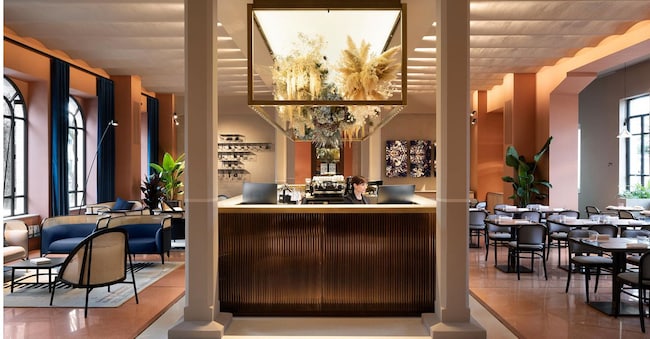
factories As can easily be imagined, the industrial capitals of Italia, Milan and Turin, offer numerous projects of this kind: in Milan, at Corso Sempione 5, almost 25 years ago a 1920s telegraphy instrument factory, which later became a printing house for the Settimana Enigmistica, was transformed after a long period of neglect into the Enterprise Hotel, with custom-made furnishings by Cassina and Flos. In the spaces where the rotary presses once stood there is now a large restaurant. The Magna Pars, a former perfume factory belonging to the Martone family converted into the world's first five-star "hotel à parfum" in the Tortona area, where fragrances, their storytelling and exploration are also the focus of a perfume laboratory (LabSolue) and aromatic cocktails created specially by famous noses. In Sesto San Giovanni, on the other hand, the former workers' club of the Falck steel mills, an area redeveloped by Renzo Piano, has become the Best Western Falck Village Hotel, where works of art and photographs tell the story of the place. In Turin, in the former Lingotto, a landmark of the city abandoned since the early 1980s, the NH hotel Torino has maintained the industrial architecture already praised by Le Corbusier by placing in the common areas some of the cars that were born there, such as the Topolino; and a short distance away, the Ac Torino stands on the old site of a pasta factory.
The former manufactures between Rome, Venice and Tolentino
Industrial traces also pass through Rome, where on Via del Corso the Singer Palace Hotel has revitalised the magnificent palace that housed the Italian headquarters of the sewing machine company, and Venice: in the lagoon, in addition to the hotel that symbolises this transition, the Molino Stucky (at the end of the 19th century the first grain producer in Italia, since 2007 a Hilton luxury hotel), which rises majestically over the waters of the Giudecca, the Langham Murano, a project by Matteo Thun & Partners is scheduled to open in 2027, whose 14,000 square metre area will also include a former glass warehouse. For textile enthusiasts, the Hotel Filanda in Cittadella (Padua) already reveals its past in its name, and in a former textile factory is also the Alter Hotel in Barge (Cuneo), overlooking Monviso. It feels more like New York than Tolentino, in the heart of the Marche region, entering Interno Marche, a hotel located in the former Nazareno Gabrielli factory recovered by Franco Moschini, patron of Poltrona Frau and a leading figure in the Italian design industry: each of the 30 rooms is inspired by a designer or an artistic movement and houses its most significant creations, and in the L'Opificio restaurant the décor with the brand's matrices and designs stands out.


