
From Mozart to AI: the renaissance of 432 Hz in the age of algorithms
What if artificial intelligence could bring music back to its most natural and harmonious frequency?

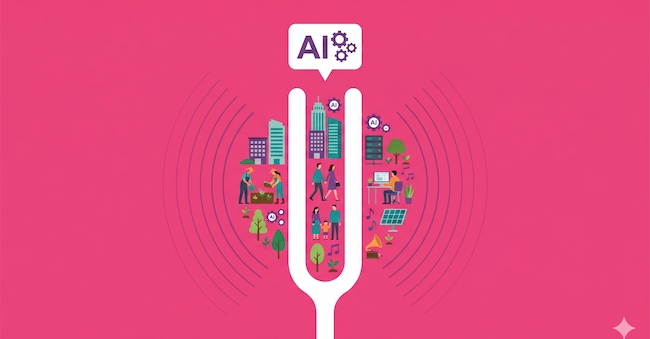
In order for a musical instrument to play at its best, it needs to be tuned. And here we all agree, but there is a need for this tuning, i.e. that of the individual strings, to reach a certain note. Entering the field of acoustics for a moment, each note corresponds to a certain frequency. The higher the latter, the higher the note will be (incorrectly called 'high'). This happens because a note is nothing but a frequency, hence a sine wave, and the more it oscillates - hence the more it moves - the sharper it will be.
Every tuner, whether app or physical, tunes the note to the same frequency. However, before technology, or even before the tuning fork invented in 1711 by Englishman John Shore - i.e. a small forked instrument that, when struck and then amplified through a sound box, emits an A - tunings throughout the western world were different. We need only think of the numerous letters Mozart sent to his father Leopold: during one of his tours, while in Vienna, he wrote to his father that the tuning of the instruments was lower than in Salzburg. This makes us realise that in past centuries, each orchestra, or even certain parts of the city, had different tunings.
It was not until the 19th century, when the first studies on frequencies began, that the Paris Commission arrived. This, composed of the most important composers of the time including Rossini and Berlioz, established the exact frequency of the tuning fork, i.e. the A, and consequently of all tunings. To understand the chaos that preceded this, we need only mention the tuning forks of Italian cities: Florence 444.9 Hz, Naples' Teatro San Carlo 444.9 Hz, while in Milan the double standard reigned with the city's 446.6 Hz and La Scala's 451.7 Hz.
The 440 standard: the London decision
On 11 and 12 May 1939, during the London congress of the ISA (International Federation of the National Standardising Associations), a group of telecommunication workers - and I stress: not musicians - decreed for signal transmission requirements that the tuning fork should be standardised at 440 Hz. This decision stipulated that every organ, keyboard or any other instrument, played in church or at home, should have the central 'A' tuned to that specific frequency.
It is important to note that Italia, which sent its own delegate to the conference, had to accept the proposal, going against Giuseppe Verdi's historical battle. The composer from Parma had sent a letter to the Music Commission of the Italian government in 1884 because orchestras were increasingly raising their tuning to achieve a brighter sound. Verdi, opposed to this trend and aware that this would force the singers to work even harder, officially requested the adoption of the "A with 432 vibrations". The government of the time agreed and implemented a decree that gave birth to the term 'Verdi tuning fork', a standard that unfortunately, as we have seen, was short-lived in the face of the technological demands of 1939.

