
From party collapse to AI: how politics lost the lead
At the Festival of Economics, the debate on the crisis of the ruling classes, the political vacuum and democracy called upon to take the lead again in the face of the challenges of the economy and the new global balances

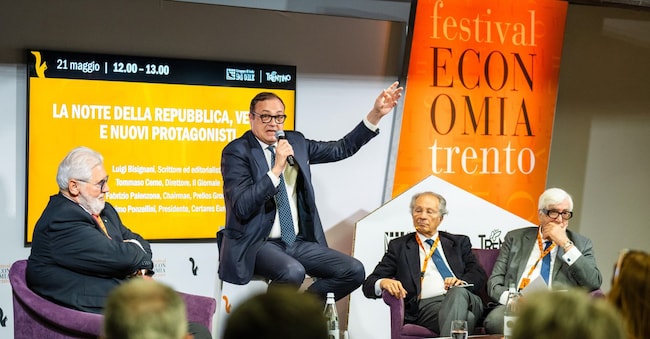
The night of the Republic did not end with Tangentopoli. It has remained in Italian politics like a long shadow and today we have a democracy struggling in the face of economics, finance and technology. At the Economics Festival of Trento, at the Castello del Buonconsiglio, the panel"The night of the Republic, old and new protagonists" brought together Luigi Bisignani, Tommaso Cerno, Fabrizio Palenzona and Massimo Ponzellini. The former premier Massimo D'Alema joined in the discussion. Cerno posed the basic question: who decides today whether politics has lost the ability to lead processes?
Palenzona brought the comparison back to Clean Hands. "In '93 we did not eliminate corruption, we eliminated the parties. It was an excuse not to hit corruption but to hit the parties, and that was a damage'. Those parties were training schools: sections, congresses, budgets, rallies, political masters. With politics, Palenzona reasoned, respect for institutions was also lost. The country found itself without a replacement just as decisive choices were being made, starting with the euro. 'The euro was a leap in the dark that cost us dearly: we had the ambition to be together with others but we did not have a political class capable of guaranteeing a changeover that would not kill Italia, as then happened'. Because 'there was no prepared ruling class'. Hence his idea of Europe: uniting on defence, foreign policy and research, enhancing diversification and building a 'new humanism'.
Ponzellini pointed out the disease of the present: governance that becomes paralysis, fear of decision-making, controls that extinguish responsibility. On artificial intelligence, he ruled out illusions: 'We cannot be the ones to invent artificial intelligence, but we must follow its development carefully: we will find branches and niches in which to be the best, but above all we will be able to dictate what is lacking now, i.e. the legal framework, moral principles, the fields of administrative jurisdiction'. Because 'we will have to regulate these things: this is where I see the role of the democratic worlds'. At the end he was moved: a farewell to a public culture based on preparation and respect.
Bisignani took the debate to Andreotti's memory. "Talking about Giulio Andreotti for me is always a thrill," he said, recalling when Sergio Cusani announced the storm to him: "Look, we're going to go wrong here, because in Milan there is a gentleman who is upsetting politics. His name is Antonio Di Pietro'. Years later he asked Andreotti where the Dc had gone wrong. The answer was clear: 'The big trouble, for the Christian Democracy, was remaining a party-museum. We were too divided into currents, and the currents had become small fiefdoms that fought each other'. In the face of artificial intelligence, according to Bisignani, Andreotti would have called to Palazzo Chigi professors from all over the world 'to ask what failures artificial intelligence can cause for our democracy and government action'. Today, however, 'what is not being done is to understand the damage that this revolution can do to the economic and social fabric of Italia'.
Then the lunge: 'In the last three years, Palazzo Chigi has been a besieged fortress, always small, that does not look ahead, does not expand space, but always closes in on itself. If it opened 'the windows a little' and called in 'the country's most important intelligences', perhaps what Italia possesses and often fails to see could be modernised. D'Alema finally shifted the field to the West. "China is stronger than us. It has not broken the relationship between politics and culture and maintains the idea that politics must continue to guide social processes'. Hence the conclusion: 'Either democracy becomes capable of leading social processes again, or the countries where political leadership has been defended will be stronger than us'.


