
From Pavia the prototype machine that cleans rice without herbicides
Agriculture. The technique used allows a 70% water saving The idea of a young farmer from Mede, awarded with the Coldiretti Oscar

3' min read
3' min read
An ancient technique to protectrice seedlings, thanks to a collaboration between India, China, the University of Turin and a company in the Pavia area, can become an innovation and save up to 70% of the water normally used in rice cultivation.
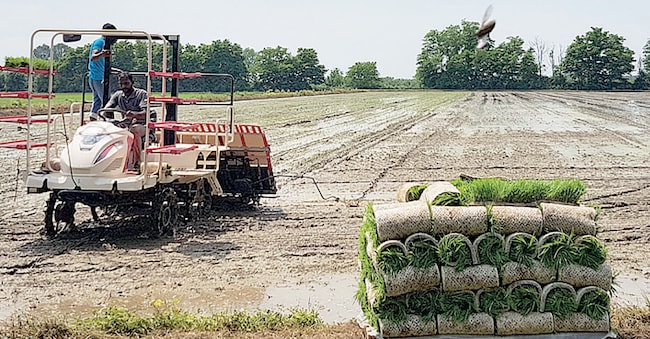
This is the transplanting of rice seedlings, in other words what the mondine used to do throughout the Po Valley, and which thanks to Giuseppe Zafferoni, a farmer from Mede in the province of Pavia (and his collaboration with the University of Turin) can now be carried out by a machine with a precision similar to that of the human hand.
For a long time, transplanting machines were considered unreliable (in some places in the field they did not reach or they cut entire pieces of crop), whereas today by applying precision farming techniques these problems can be avoided.
"It all started from a technique that has been used for many years in India and Japan. - says Zafferoni, who was awarded Coldiretti's Oscar Green - We have brought it to Italy, designing machinery that offers greater working speed. The challenge is to make it compatible with our type of agriculture. My contribution has been to bring new technology with sensors and automatic guidance for both transplanting and weeding'.
This is the special practice of 'clearing' the field of weeds and pests, which means that herbicides are not used. A practice that used to be done manually, but today can be done with machinery.

