The cycle traveller

From penal colony and model farm to terrorists and mafiosi: the hidden paradise of Pianosa

A strip of land just a few kilometres from Elba, the island had been chosen by the Romans as a place of luxury exile, then turned into an enlightened penal colony, always devoted to agriculture. Today, it remains a fascinating, semi-abandoned village with a future to be written. Starting with sustainable and wild mobility

by Manlio Pisu

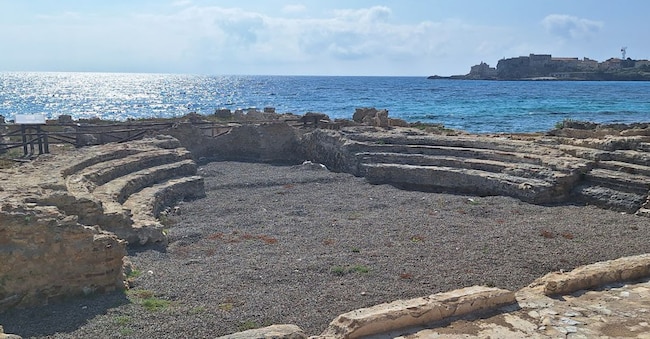
 Il teatro della villa sul mare di Marco Agrippa Postumo. Sullo sfondo il borgo di Pianosa

7' min read

7' min read

There is a hidden pearl in the middle of the Tyrrhenian Sea. It has miraculously remained sheltered from mass tourism, protected by its history and geography. It is so low above sea level that a few miles away you cannot even see it. Since Roman times, it has been a place of exile, isolation, suffering and confinement. But it has also been a flourishing granary, a centre of agricultural production that gave every good thing, exported wine, oil, poultry.

There is a tiny, pretty 19th-century village, once lively and bustling and now in a state of total abandonment. In the memory of those who have known that little old world, it has left an indelible memory, like a kind of lost paradise.

Loading...

A triangle in the sea

.

It is Pianosa, a triangle of land outcropping from the sea, a dozen kilometres off the south-west coast of the island of Elba. Geologists tell us that over the last 500,000 years the sea level has risen and fallen several times to the rhythm of the Earth's breathing. Pianosa and Elba have alternately been islands, as they are today, or part of a single large peninsula that ran from the coast of what is now Tuscany into the Tyrrhenian Sea, stretching towards Corsica.

The ten square kilometres of this platform are nothing more than compressed, emerged seabed. The soft, porous rock is formed by fossil layers of shells, corals and other debris from the sea. It is to this conformation that we owe the Caribbean colours of the seabed, turquoise and emerald green.

In bici tra storia e natura

Photogallery23 foto

Inhabited since Neolithic times, Pianosa (Planasia for the Romans) was chosen by Augustus as a place to keep Marcus Agrippa Postumus, one of his grandsons and adopted son, away from Rome. In the power plots of Livia, the emperor's second wife, he could have threatened the accession to the imperial throne of Tiberius, Livia's first-born son. A gilded prison was created for Agrippa Postumo: a splendid villa by the sea, complete with baths and theatre, the ruins of which can still be seen today. Then, in 14 AD, Tiberius, by then emperor, sent an assassin who killed Agrippa.

Two harbours, to the north and east, ensured the berthing of Roman ships in all sea conditions. The island was cultivated. Water was secured by a system of wells. Then, after the collapse of the Western Roman Empire, came the long decline.

With the highest elevation of just 29 metres, the island was indefensible, easy prey to raids. For centuries, Saracen pirates did their dirty work, only partly thwarted by the maritime power of the Republic of Pisa.

The agricultural penal colony

.

In more recent times, the Grand Duchy of Tuscany tried in vain to repopulate the island. So it was that in 1858, just three years before the birth of the Kingdom of Italy, Grand Duke Leopold II started the great Agricultural Penal Colony, a very innovative experiment for the time, which in fact anticipated today's practice of alternative punishments. Thanks to the work of enlightened managers, the Colony's director and agronomist, Pianosa quickly became a large model farm, subdivided into estates dedicated to various crops: wheat, olives, vines, fruit, vegetables, but also cattle, sheep and chicken breeding (a five-hectare poultry farm was the largest in Europe at the time).

The prisoners' living conditions were very harsh, but still better than a prison cell at the time. The wine from Pianosa reached as far as England. The penal colony successfully participated in national agricultural events, winning prizes for quality and technological innovation, including - during the twenty-year Fascist period - Mussolini's awards at the time of the Battle of Wheat.

Out of this world

.

In the world wars of the last century, Pianosa remained on the margins of history. Food was never lacking. Isolated on a strip of land outside the rest of the world, even the German soldiers, during the military occupation that followed the armistice of 1943, showed a human face, sometimes going so far as to familiarise themselves with the locals. The chronicles, however, also tell of a massacre that cost the lives of some fifteen inmates.

Then after the Second World War came the economic boom and the 'anni di piombo'. On the initiative of General Carlo Alberto Dalla Chiesa, the penal colony was enlarged. In the 1970s, two new maximum security pavilions were built. Various exponents of the Red Brigades and bandits like Renato Vallanzasca passed through here.

The island has come to house about two thousand people, including the prison population, prison guards, their families, the police, the military, and administrative staff. The last chapter of the penal colony is that of the 41bis, the hard prison regime. Between 1992 and 1997, Pianosa housed prisoners for mafia offences.

Abandonment and decay

.

Finally in 1998 the closure of the prison, which also marked the end of all activities related to the prison. Life has withdrawn from Pianosa. There are no more families. No more children. There is no more school or post office. The small village has emptied out.

The buildings, built in the mid-19th century in a graceful eclectic style reminiscent of the architecture of the past, are unsafe and boarded up. In the few streets, there is no public lighting. The only lights are those of the moon and a breathtaking starry sky. In summer, only barracudas roam the crystal-clear waters of the small old harbour.

Little remains today of almost two centuries of penal experience. The farms, once fertile and cultivated gardens, have been reclaimed by spontaneous vegetation. Some 20 inmates from the Porto Azzurro prison (Elba Island) can benefit from a semi-freedom regime for reasons of good conduct. They live in one of the buildings of the old Colonia. They move around on foot or by bicycle.

Their labour contributes to running the only hotel on the island (Hotel Milena, about ten rooms in all), converted from the nineteenth-century house of the Colonia director. The prisoners also run Pianosa's only restaurant in the former prison guards' canteen.

Vicina and remote

.

There are no shops on the island today. There is no bar. There is no ATM. There is no pharmacy. Since the mid-1990s, Pianosa has been part of the Tuscan Archipelago National Park. It is a place at once near and remote.

The island is a treasure chest of immense value in terms of landscape, nature and environment. It is a stone's throw from Mount Capanne on Elba (1,000 metres high). The view sweeps between Corsica and Montecristo. It is an ornithological paradise. It is a huge playground for marine biologists. It is part of the Upper Tyrrhenian Cetacean Sanctuary. It is easy to see sea turtles coming to nest and lay their eggs. It is also a precious treasure chest from a geological, archaeological, early Christian (there is a site of catacombs) point of view. From a sociological point of view, it still hosts an interesting example of the reintegration of prisoners into civil life.

The island undoubtedly has a heavy history of suffering, but this is lessened and tends to fade in the smiles with which the inmates, aware of the hard-won privilege of semi-freedom, greet the very few incoming tourists.

The Park strictly regulates the use of this extraordinary heritage. Access is restricted. Departures are from Piombino and Marina di Campo (Elba). You are not allowed to dock your boat or approach the island within a mile of the coast. Bathing in the sea can only be done in one spot, Cala Giovanna, close to the reinforced concrete wall built for the maximum security prison and already in an advanced state of decay with rusty ironwork exposed. It is rare to find a beach like this in today's Mediterranean, with those watercolours and such crystal-clear water.

Not a place for everyone

.

The possibility of movement on the island is limited. Tourists cannot wander around at will. Except for the area between the hotel and the restaurant, he must always be accompanied by one of the park guards. Ultimately, Pianosa still houses prisoners.

The park organises guided excursions on foot, by mountain bike, kayak, visits to archaeological sites and the prison, snorkelling in the coves. And it is worth doing them all, because the place is truly extraordinary.

But it is certainly not a place for everyone. It is suitable for those who want to unplug, who seek peace, quiet and good reading. Mobile phones are taken. But after a couple of days on Pianosa, the everyday life you come from may seem light years away.

Beyond resignation

.

Naturally, one wonders if it is not possible to rethink Pianosa from a different perspective. The sight of the abandoned village with its crumbling houses makes one's heart clench. It saddens and outrages at the same time. How is it possible to let such a heritage go to waste? It certainly does not help the overlapping administrative competences of different bodies, including the Agenzia del Demanio, the National Park, the Ministry of Justice, the Municipality of Campo nell'Elba, the Soprintendenza ai beni archeologici, the Vatican (for the catacombs), etc.

"Wherever it has been possible to intervene, in agreement with the State Property Office, we have intervened," observes Maurizio Berlando, director of the park. 'We have recovered,' he adds, 'several structures,' including the beautiful Casa dell'Agronomo. Something is moving in the meantime and seems to be going in the right direction.

A positive sign is the recent memorandum of understanding signed by all the institutional actors involved in various capacities with the common goal of preserving and enhancing the island, starting with the recovery of the village. The collaboration should start as early as summer 2025. This is a good starting point and is what Pianosa, a small corner of paradise, has long deserved.

Copyright reserved ©
Loading...

Brand connect

Loading...

Newsletter

Notizie e approfondimenti sugli avvenimenti politici, economici e finanziari.

Iscriviti

Tutto mercato WEB