School

From Prato to Lodi: the top 10 foreign players in the league. Italian players on the decline everywhere

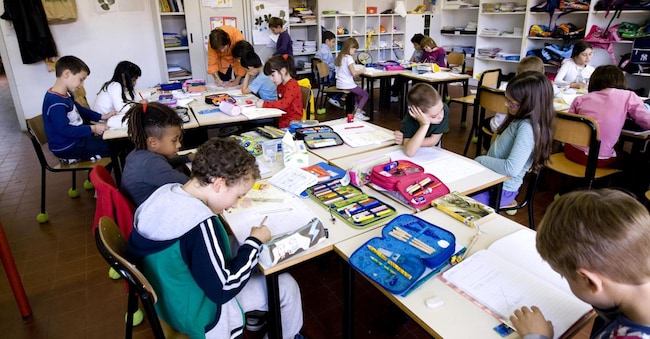
Alunni della II B della scuola elementare di Bottego di Bologna in un'immagine diffusa dall'UNICEF nell'ambito della Campagna ''IO come TU'' per la promozione del diritto alla non discriminazione dei bambini e degli adolescenti di origine straniera che vivono in Italia. ANSA / UNICEF/ITAL2011/Lombardi  +++NO SALES - EDITORIAL USE ONLY+++ ANSA

4' min read

Translated by AI
Versione italiana

4' min read

Translated by AI
Versione italiana

It is not yet clear how many classes will be affected by the new 30 per cent limit on pupils from abroad set out in the latest Education Decree (Decree-Law No. 170/2026), which came into force on 1 October and is currently under consideration by the Senate at first reading. It is likely to be a small number, given that the threshold to be observed when forming classes – which applies from the 2027/2028 academic year and to new arrivals in 2026/27 – includes two codified exceptions: for primary school pupils, having attended at least two years of nursery school; for lower and upper secondary school pupils, having completed three years, having successfully progressed to the next year.

Underlying the Government’s crackdown is a twofold (and concurrent) phenomenon. On the one hand, there is an increase in the number of foreign students and, on the other, a decline in the number of Italian students. This carries the risk that the former’s limited familiarity with our language may also have an impact on the latter, particularly where demographic trends are most pronounced. This is confirmed by data from the Ministry of Education and Merit set out in the explanatory report accompanying the ‘Scuola’ decree: between the 2019/20 and 2024/25 academic years, the number of foreign pupils rose by 10.13 per cent, whilst the number of Italian pupils fell by 8.27 per cent. In practical terms, whilst there were 83,835 new foreign pupils, over five years we have lost around 612,000 Italian pupils (equivalent to the entire population of Palermo).

Loading...

The analysis covers all levels of education, from pre-school to secondary school, and includes both first- and second-generation foreign nationals. This is a national demographic trend which, however, varies greatly across the country; in this context, the government’s aim of avoiding ‘ghetto schools’ must contend with an uneven distribution of the phenomenon from north to south and even from neighbourhood to neighbourhood.

The provincial analysis

The picture is varied. An analysis by *Il Sole 24 Ore* of data from the Ministry of Education reveals that the province with the highest proportion of pupils without Italian citizenship is Prato (29.4 per cent), followed by Piacenza (25.7 per cent) and Imperia (22.5 per cent), compared with the national average of 11.8 per cent.

Apart from Prato, which has historically been home to a large Chinese community, the other 19 provinces in the top twenty are all in the north. Next come Mantua, Parma and Gorizia, and just beyond the top ten – in 12th place – is the first major metropolitan city: Milan, where 19.84 per cent of pupils are foreign nationals.

The first province in the south is Ragusa, which, however, ranks only 41st, with a proportion of 14.2 per cent. The gap between the Centre-North and the South becomes even more apparent when we look at how many provinces have more than 10 per cent of foreign students out of the total enrolment: in the Centre-North, 60 out of 66 do, whilst in the South, just 3 out of 38 do. These are Ragusa, L’Aquila and Teramo.

The trend over five years

It is precisely in the southern provinces, however, that the sharpest percentage increase in the number of foreign pupils has been recorded over the last five years, particularly in Campania: between the 2019/20 and 2024/25 academic years, Salerno and Avellino saw increases of 40 per cent and 38 per cent respectively; Naples (+27 per cent) and Caserta (+25 per cent) have also seen strong growth.

The number of foreign pupils in classrooms, however, is rising across almost the whole of the country. The only exceptions are the provinces of Campobasso (-11 per cent), Perugia (-3 per cent), Pesaro and Urbino (-3 per cent), Arezzo (-2 per cent) and Vicenza (-1 per cent).

If we exclude Prato (+0.16 per cent), where the trend is more stable, there have been increases exceeding the national average of 10 per cent in all provinces where the proportion of foreign pupils in classes already exceeds the 20 per cent average (and where, therefore, breaches of the new 30 per cent cap are likely to be concentrated): in addition to the border areas of Imperia (+35%) and Gorizia (+36%), for example, in the province of Pavia, foreign pupils account for around 21 per cent of the total and have increased by 24 per cent over five years.

There are, however, no exceptions to the decline in the number of Italian pupils, which affects every province in the country. The region hardest hit is Sardinia, with Nuoro losing 14 per cent of its Italian pupils, South Sardinia 13 per cent and Oristano 12 per cent. Declines of more than 10 per cent have also been recorded in the provinces of Basilicata and in four of the six provinces of Apulia. In the north, the regions facing the greatest difficulties are Veneto and Friuli-Venezia Giulia, where more than half the territory has lost one in ten Italian pupils over the past five years.

Loading...

IL TREND

Loading...

Levels of education

Looking at the data broken down by level of education, the highest proportion of foreign pupils is found in primary schools (14.3 per cent), followed by lower secondary schools (12.9 per cent). The proportion is slightly lower in nursery schools (12.6 per cent), whilst it falls to 8.7 per cent in secondary schools.

Prato and Piacenza have the highest rates across all levels of education, with peaks of 36.1 per cent in lower secondary schools in Prato and 32.2 per cent in primary schools in Piacenza. At the other end of the scale is Oristano, with just 1.55 per cent in upper secondary schools and 1.8 per cent in primary schools. Figures of around 2 per cent are also recorded in nursery schools in Barletta-Andria-Trani and in lower secondary schools in Nuoro.

This disparity highlights just how different the needs of local communities are. And the lower proportion of foreign pupils in the South does not necessarily translate into a more favourable environment for classroom learning in these areas. In fact, citizenship is just one of the factors that can contribute to educational disadvantage: difficult economic, social and family circumstances remain the factors that most influence, for example, the results of the Invalsi tests (see the article on the right), particularly in the South.

Copyright reserved ©
Loading...

Brand connect

Loading...

Newsletter Scuola+

La newsletter premium dedicata al mondo della scuola con approfondimenti normativi, analisi e guide operative

Abbonati