Pulse

From butts to 'puffs': Europe grapples with electronic cigarette waste

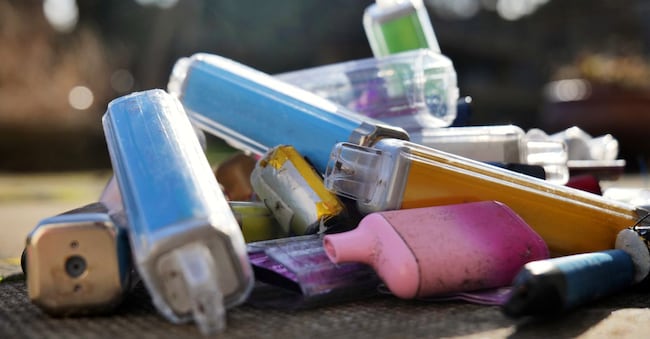
Disposable electronic cigarettes are becoming a serious, new source of urban pollution

by Silvia Martelli (Il Sole 24 Ore), Gianpaolo Sorgi (Voxeurope, France), Ana Somavilla (El Confidencial, Spain) and Ieva Kniukštienė (Delphi, Lithuania)

 Adobe Stock

5' min read

Translated by AI
Versione italiana

5' min read

Translated by AI
Versione italiana

For decades, the symbol of tobacco consumption was the cigarette butt: small, ubiquitous, difficult to dispose of. Today, however, a new, more complex and potentially more dangerous type of waste is appearing in European cities: disposable electronic cigarettes.

Coloured, cheap and designed to be consumed quickly, so-called 'puffs' contain plastic, electronic circuits, chemical liquids and lithium batteries. A combination that turns them, at the end of their use, into real electronic waste. And while the public debate focuses mainly on the effects of vaping on health - particularly among teenagers and the very young - environmental alarm is growing in parallel.

Loading...

Many devices end up in municipal bins or directly in the street, instead of being disposed of in dedicated e-waste circuits. The consequences range from the dispersion of polluting materials to the risk of fires in waste treatment plants caused by damaged lithium batteries.

Faced with the rapid spread of single-use e-cigs, several European countries are starting to take action. Some, such as Belgium and France, have chosen the path of a ban. Others are strengthening collection and producer responsibility systems. In the background, a common question remains: how to handle technological products designed to last a few days, but destined to leave a much longer environmental footprint?

France chooses total ban

France is one of the countries that has taken the hardest line. With a law of 24 February 2025, Paris banned the sale, distribution and even possession for commercial purposes of pre-filled and non-refillable disposable electronic cigarettes.

However, the measure does not introduce a specific collection system for these devices: e-cigs remain covered by the general legislation on electronic waste and batteries. In practice, the devices have to be delivered to the normal collection schemes for small electronic devices and accumulators.

The French authorities recall that these products cannot be disposed of in household waste and that consumers can leave them free of charge at large retail outlets or authorised collection centres. The system is based on the principle of extended producer responsibility, already applied to other electronic waste.

The penalties are severe: up to EUR 100,000 for individuals and EUR 300,000 for companies.

Belgium: first EU country to ban 'puffs'

Belgium also chose the path of the ban, becoming the first EU country to implement it in practice: as of 1 January 2025, disposable electronic cigarettes are banned in all sales outlets.

In the Belgian case, the environmental issue was closely linked to the fight against youth smoking. The federal government included the ban in a broader anti-tobacco package, with restrictions on sales outlets, strengthened controls and the stated goal of creating a 'smoke-free generation'.

But the first months of enforcement show the difficulties. The Belgian authorities have already seized thousands of illegal devices, including products sold online or through informal channels. According to several local media, 'puffs' continue to circulate easily among young people despite the ban.

Ireland: millions of devices go missing every year

According to the Irish Waste Management Association, about 30 million vape are disposed of in the country every year, but only a small fraction is properly delivered to e-waste centres.

The main problem is related to the lithium-ion batteries contained in the devices. If thrown in the waste stream or crushed during waste collection and sorting, they can cause fires in compactor trucks and treatment plants. The industry association estimates that between 2023 and 2025, fires in sorting centres caused more than EUR 56 million in damage, plus approximately EUR 1.7 million in damage to collection vehicles.

According to current rules, e-cigs should be delivered to dedicated collection points for Waste Electrical and Electronic Equipment. But with millions of devices sold each year, only 1.1 million would be returned through these channels.

Experts now speak of a growing environmental emergency. Jason Power, a researcher at the University of Limerick, pointed out that the improper disposal of vape leads to 'risks to life, toxic emissions, further waste of recyclable materials and damage to recycling infrastructure'.

Spain: debate shifts to ban

Spain is also moving towards tighter restrictions on disposable electronic cigarettes, mainly for environmental reasons. The government of Pedro Sánchez is working on a reform of tobacco legislation that includes a possible ban on disposable devices, among other measures.

According to the Spanish executive, these products generate a strong environmental impact because they combine electronic components, batteries and toxic substances with limited recycling possibilities. The issue has now entered the national political debate as part of the strategies against electronic waste and youth vaping. However, the proposal has opened an institutional clash. The Spanish Commission for Markets and Competition has challenged certain aspects of the reform, arguing that the government should consider less restrictive alternatives to a total ban on disposable e-cigs. Thus, the tension between three different demands emerges in Spain: environmental protection, public health and regulation of a rapidly growing market.

Lithuania: producer responsibility

Lithuania, on the other hand, deals with the phenomenon through the ordinary e-waste management system. E-cigarettes, including batteries and cartridges, must be collected via the official e-waste and accumulator circuits. The European principle of extended producer responsibility also applies here: companies must finance the collection and recycling of devices placed on the market. The legislation provides for administrative penalties for those who abandon this waste in the environment or dispose of it improperly. Fines can affect both individuals and companies, depending on the severity of the environmental damage.

Italy: no ban, but growing alarm over WEEE

In Italia, there is currently no national ban on disposable electronic cigarettes, but the issue of disposal is attracting increasing attention from the e-waste industry and trade associations.

Disposable e-cigs are considered to all intents and purposes WEEE - waste electrical and electronic equipment - because they contain batteries, circuits and electronic components. The Italian legislation derives from Legislative Decree 49/2014, which transposes the European WEEE Directive.

Under these rules, retailers - including tobacconists and vape shops - are obliged to take back used devices free of charge when buying a new one ('one-for-one'). For each refused electronic cigarette, administrative penalties of between €150 and €400 may be imposed.

In recent years, some trade organisations have set up dedicated collection systems. As of 2024, for example, several tobacco shops associated with Assotabaccai Confesercenti can join a collection service set up by Logista Italia to take back used e-cigs and their components.

But the main problem remains consumer behaviour. According to the industry, many disposable electronic cigarettes still end up in the rubbish bin or are abandoned in public spaces, with the risk of leaking plastic and lithium batteries.

The underlying problem

The case of electronic cigarettes shows a growing contradiction in European environmental policies: high-tech products are designed for a very short use, but contain complex materials to be processed and recovered. Each device contains plastics, electronic circuits and lithium batteries, components that require specialised collection and recycling chains. When they end up in unsorted waste, they increase the risk of fires and the dispersion of pollutants. This is why several governments are shifting their focus from simple disposal to upstream reduction.

*This article is part of the European collaborative journalism project "Pulse"

Copyright reserved ©

Brand connect

Loading...

Newsletter

Notizie e approfondimenti sugli avvenimenti politici, economici e finanziari.

Iscriviti