
From Puglia to the world, flying (with her little girl) across the piano keys

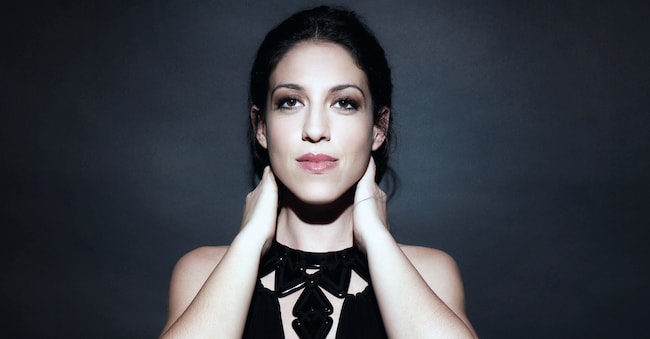
CThere is little to teach an artist such as Beatrice Rana, the world’s foremost Italian pianist: aged thirty-three, she is as much at home at La Scala as she is at Carnegie Hall in New York, capable of captivating her audience every time, not only thanks to her divinely gifted hands, but also and above all because of the programmes she puts together, delivered with unmistakable intelligence, personality, style, taste and class. A few months ago, she became a mother to Margherita, who literally ‘played’ alongside her, held close to the keyboard from the womb right up until her final concerts before giving birth. Now she is ready to get back to work this September, with a packed schedule. We meet her in her native Puglia, as the tenth edition of ‘Classiche Forme’ draws to a close – the international chamber music festival she founded, which has already become a cultural landmark for the Salento region, centred on Lecce and its surroundings.
By some mysterious, hidden twist of fate, this tenth-anniversary Festival bears a prescient title: ‘Family Lexicon’: ‘When I first conceived the idea, Margherita wasn’t even on the horizon: I never imagined that I would weave a family lexicon with her too. At the time, I was referring solely to authors and composers linked by some kind of kinship, particularly in the early 20th century – a period of crisis but also of openness in artistic expression. Instead, I found myself personally drawn into the fray through this experience of motherhood: an entirely new journey, both physical and emotional. There was a before and an after, unlike anything I’d ever experienced: before the birth and after. Overwhelming. Because in my whole life I’ve only ever been away from the piano for a single week: when Margherita was born. And after seven days away, the keyboard seemed extremely small to me.” Small in relation to what she’d been through? Or because motherhood makes you feel so much bigger? “I don’t know; I’m only just beginning to make sense of it. I’ve never felt this way before. And to think that throughout the entire pregnancy we’d experienced music in a symbiotic relationship: I carried on playing whilst she grew, nestled against the instrument. I’d even learnt her preferences, based on the ‘internal messages’: French composers were fine, Prokofiev less so.”
And now it’s back to business: the first tour, a particularly important one, starts in September. ‘I’ll be the soloist in Beethoven’s ‘Fourth’ with the Staatskapelle Dresden and Daniele Gatti. I’ve never played under his baton before. I’m curious and looking forward to it. We’ll be stopping off in four cities – two in Germany and two in Italia: Verona and Merano. Then, from 1 October, I’ll be back to giving recitals: I like to put together a focused programme, just one for each season. Perhaps some people – among artistic directors or music organisers – might turn their noses up at this, as they’d prefer an exclusive programme. But I believe in the need to explore a programme in depth, precisely so that repetition creates a sense of permanence and progress.’ So, following the rescheduled concert in Brescia on 1 October – the programme originally planned for the Brescia and Bergamo International Festival (Bach’s ‘Italian Concerto’, Muzio Clementi’s rare ‘Sonata No. 3, Didone abbandonata’ and, finally, Schumann’s ‘Carnaval’, one of the most complex works in the repertoire), a new Bach-Debussy-Chopin programme is now ready, set to take the audience on a whirlwind tour of concert halls in Ghent, Brussels, Luxembourg, Zaragoza, Madrid and Lisbon, before arriving in Milan on 13 October at the Conservatoire to inaugurate the Società del Quartetto’s programme.
Hot on the heels of that, an important debut awaits her – a giant of the repertoire: ‘Yes, Brahms’s Second Concerto. I’ve never tackled it before. I’ll be performing it with various orchestras in different cities. I’ll start in Stockholm, then move on to Toulouse and Frankfurt before arriving in Paris in early December. With the Chamber Orchestra of Europe, conducted by Yannick Nézet-Séguin, we’ll then take it to New York, to Carnegie Hall. I have further dates there from April 2027.” With an audience that is particularly fond of her, given the enthusiastic reception and sold-out performances of past seasons. ‘New York has a wonderful, warm audience, ready to get excited. However, I now think that my ideal city, where to live in the future, might be Paris.’ And yet this determined pianist from Salento felt the need to return to her roots: why? ‘Puglia is overflowing with tourists, particularly in summer. But my aim with the ‘Classiche Forme’ Festival was to reach out to local residents, my fellow citizens and young people, by offering high-quality programmes featuring the finest performers I know. Lecce was a city brimming with music when I was a little girl…’ That was twenty years ago: what has changed in such a short time? “As a little girl back then, eager to hear the greats, every week I was given the chance to encounter piano giants such as Zimerman, Sokolov and Argerich. The theatre scene was also very vibrant: I remember Katia Ricciarelli; I remember the first time the young Flórez performed here, the leading Rossini and bel canto tenor. Today, everything seems to have fallen dormant. However, with ‘Classiche Forme’, over ten years of activity, I have encountered interest and curiosity, even towards unfamiliar repertoire: for example, I can programme Ligeti’s Second Quartet and the audience follows along, clearly captivated. In general, I think we should have more confidence, be bold in our choices rather than taking refuge in repetitive programmes.”
But the audience trusts her because she has the backing of the much-loved name ‘Beatrice’. Even the children of Arnesano – a town of four thousand inhabitants in the province of Lecce, where Beatrice’s parents, Maria Pina Solazzo and Vincenzo Rana, still live – turn up at her concerts full of enthusiasm. Both pianists – and the first to recognise her special talent when she was around three or four years old – they believe in the need to nurture artistic potential from early childhood: in fact, they set up the ‘Arnesano Music System’, which offers free instrument and orchestra lessons as part of the primary school curriculum. ‘It wasn’t like that before: my sister Ludovica and I were looked at as if we were from another planet, considered strange, because she played the cello and I played the piano, and we spent hours practising shut away at home. Then, towards the end of primary school, when I’d already won a few competitions and the first concert opportunities started coming in, the teachers didn’t always understand me. If I was absent, they wouldn’t excuse it.” They must have changed their minds by now, surely? “Certainly, the cultural approach towards music students has changed. Yet not everything runs smoothly, because we’re now faced with another problem: since Covid, the importance of social media has changed the way artists are viewed; the logic of numbers and ‘likes’ has become overwhelming. You need instant validation. And meanwhile, in general, people’s attention spans are getting shorter. I, on the other hand, believe in the long term, where quality always pays off. Even if the profound depths of musical composition risk remaining the preserve of the few. We see the evidence of this in the concert halls: New York is a very easy city; you always fill the hall, even for the umpteenth repeat performance. In Germany, apart from the happy haven of Berlin, the decline in audiences is evident: the older generation is leaving and there’s no one to take their place.”

