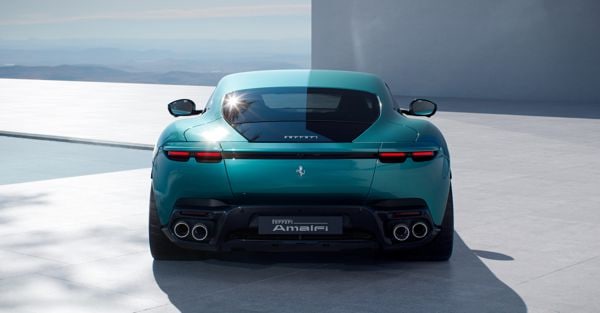
From Rome to Amalfi, the prancing horse's most elegant coupé
The Maranello-based manufacturer renews the model at the base of the range: 640 hp twin-turbo V8 engine and minimalist styling, integrating driving pleasure, safety, comfort and on-board technology.

3' min read
3' min read
After five years, the Ferrari Roma coupe version gives way to a new model: it is called Amalfi and revives the tradition of reds inspired by great Italian locations, such as the unforgettable Portofino.
The Roma had a difficult task: to propose in the Prancing Horse range a performance car, but one that was elegant, less flashy in its lines and sound than the classic Maranello set-up. In short, it was an atypical Ferrari, at the base of the Maranello range, but with the ambition of winning over new Ferraristi, perhaps attracting them from the ranks of fans of the more powerful versions of his majesty from Stuttgart, the Porsche 911.
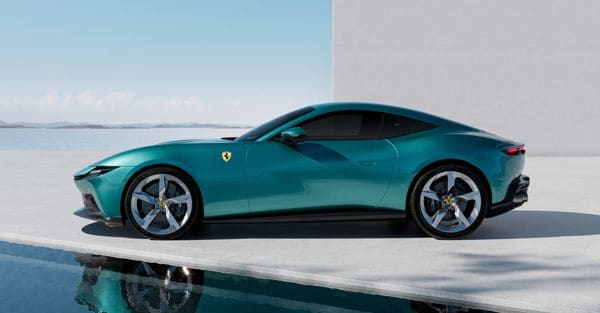
Now the Roma gives way to its heir, the Amalfi, which takes the best of the Roma, a 2+2 sports car (two seats with two rear folding seats) from what was defined as a Formula 1 car in evening dress, and introduces modifications and improvements that enhance its style and performance, without distorting its elegant and highly polished design, the fruit of the work of the team led by Flavio Manzoni. It would be reductive to call it a restyling, but it is markedly an evolution of the previous model. The Amalfi, in fact, takes the best of the Roma to a higher level, while remaining the most accessible car in the Ferrari range, accessible and obviously relative, given that the price list starts at 240,000 euro and, considering the customisations, the bill can increase even more. Among the confirmations of the Amalfi is the twin-turbo eight-cylinder engine and the still clean styling, but now with greater attention to aerodynamics and rear loading, achieved thanks to an active wing at the rear.
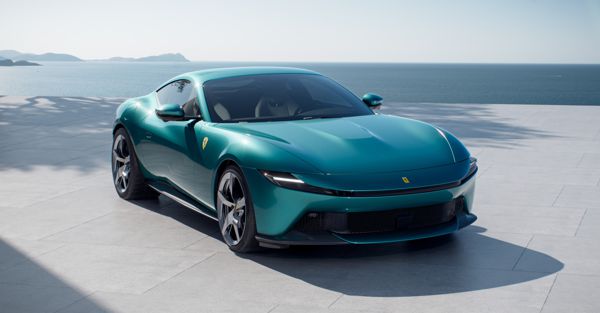
But let's go into the details, starting with the engine, as is appropriate when talking about a Ferrari. It is the familiar and iconic 3,855 cc twin-turbocharged V8 that delivers in the new configuration 640 hp (20 more) at 7,500 rpm and 760 Nm of torque delivered linearly between 3,000 and 5,750 rpm. Specific power is now 166 hp/litre. The turbochargers have been modified and now reach 171,000 rpm, improving throttle responsiveness. There are lightened camshafts and a series of measures aimed at improving smoothness of delivery, as well as a new management unit. The V8 is mated to the familiar eight-speed dual-clutch gearbox, refined in its electronic management. The car sits on 20-inch rims with 245/35 tyres at the front and 285/35 of Bridgestone or Pirelli origin.
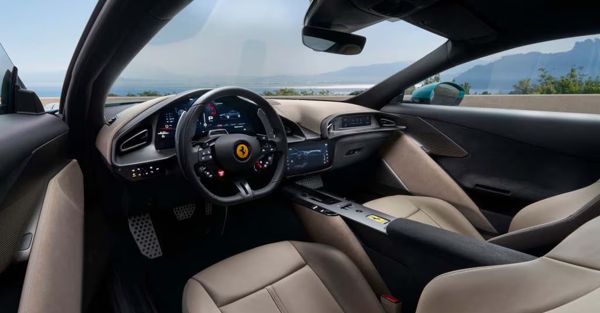
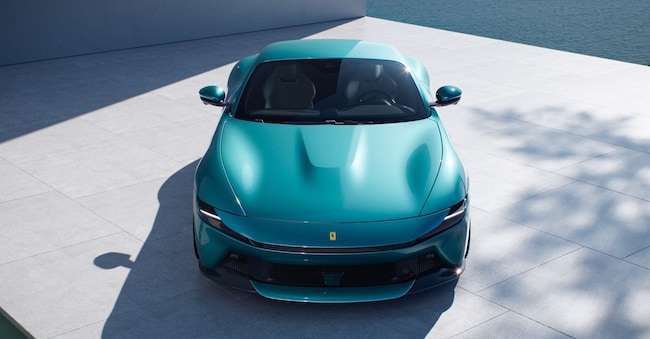
The exterior styling of the Amalfi, which is 4,660 mm long and 1,974 mm wide, has much in common with the Roma but differs from it in that it has a more modern front end, devoid of a classic grille, slim headlights and winking lights. The car exhibits a streamlined style composed of an intersection of flowing surfaces and sharp cuts. The rear, still rounded and muscular, has been fitted with an active wing integrated into the rear window to increase downforce, a large diffuser and a spoiler integrated into the rear window. The entire styling, explained Flavio Manzoni, was defined by a philosophy of subtraction and elimination of superfluous elements, with a clear reference to design masters such as Achille Castiglioni.