
From road to rail: the Brenner Motorway's winning choice
A transport system that integrates road and rail to move goods efficiently; a model that reduces heavy traffic on motorways and helps reduce CO2 emissions

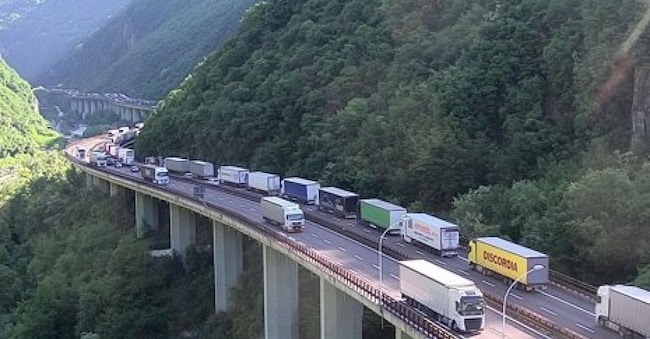
(Il Sole 24 Ore Radiocor)- Combining efficiency in freight transport and environmental protection. A combination that can sometimes be considered antithetical but which Autostrada del Brennero has managed to reconcile through road-rail intermodality. This is a transport system that integrates road and rail to move goods efficiently; a model that reduces heavy traffic on motorways and helps reduce CO2 emissions. Indeed, it must be considered that rail transport covers long distances, while the truck handles the first and last mile. Integration between the two carriers improves sustainability and logistical efficiency. Specifically, the intermodal terminals play a key role in coordinating loading and unloading operations: intermodality promotes greater safety compared to transport by road alone and also optimises costs over medium to long distances.
As early as the 1990s, the directors of the Autostrada Brennero company realised that the artery would reach saturation point. And they had an important intuition: to progressively shift long-distance freight traffic to rail. This led to the decision to invest in the sector: first Str, then Rtc and Lokomotion GmbH were born, destined to operate on both sides of the Brenner and Tarvisio respectively.
A key date is 15 October 2001 when the first goods train left the Munich Riem station in the direction of Verona: it was the beginning of a new phase of continuous growth. Exactly twenty years later, on 15 October 2021, the A22 Board of Directors resolved a capital increase to Str to purchase 75% of another railway company, In Rail. A move that led to a strengthening of the railway asset in which it wants to continue to invest. Already today, Autostrada del Brennero shifts around 1,500 trucks per day to rail thanks to the Group: thanks to the subsidiaries In Rail and Rtc and the associated company Lokomotion, around 30,000 trains are moved each year. This saves the environment almost 300,000 tonnes of CO2 per year.
Intermodal terminals
As mentioned, an important element of road-rail intermodality is represented by intermodal terminals. With this in mind, Autostrada del Brennero, in addition to upgrading the Trento interport, is planning to create an intermodal hub at Isola della Scala, in synergy with Quadrante Europa. That is, a place where trucks can exchange goods with the railway. Autobrennero is not stopping there, however: after land and rail, it is also looking to water, always trying to go one step further into the future. In the company's plans there is also the development of the port of Valdaro, which connects Mantua to the sea through 136 kilometres of canals with no water excursion and therefore navigable 365 days a year.
Brenner Base Tunnel - BBT
The Brenner Base Tunnel completes the picture. In particular, Autobrennero is contributing to the construction of the Brenner Base Tunnel, a mighty work costing more than 10 billion euros that should be completed in 2032 and that will speed up the route and allow the passage of trains considerably longer than at present, from 450 metres to more than 700 metres. The tunnel will connect two states, extending between Innsbruck (Austria) and Fortezza (Italia) over a length of 55 km. The tunnel configuration includes two single-track main tunnels.


