
From Sicily, a two-way race for the title
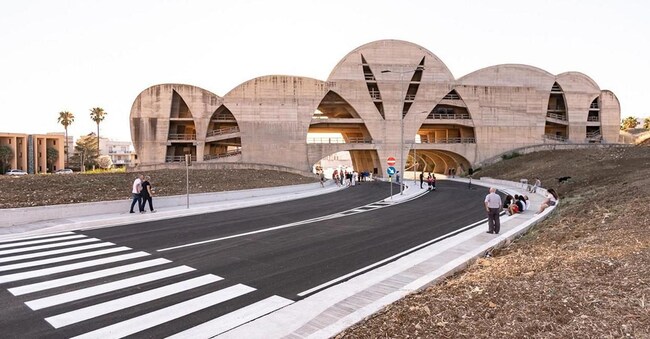
Territories in the field. The candidature of Gibellina, a municipality in the Trapani area destroyed by the earthquake in 1968 and rebuilt by internationally renowned artists and architects who responded to Piero Consagra's appeal, has been made official. On the eastern front of the island, Catania is on the move

2' min read
2' min read
On the one hand Catania, which has already been in motion for a few weeks.On the other Gibellina, the municipality that symbolises the earthquake that struck the Belìce region in 1968 and the municipality that symbolises a reconstruction to which some of the greatest contemporary artists have contributed. These are the two faces of Sicily as it organises itself to compete for the nomination as Italian Capital of Contemporary Art 2026.
The timeframe, according to the announcement of the Ministry of Culture's General Directorate for Contemporary Creativity launched on 15 April, is very tight: there is time until 30 June to submit a candidature. "The new award," explain the ministry, "is established to encourage and support the planning and implementation capacity of Italian cities in the field of the promotion and enhancement of contemporary art. The call for bids finances cultural projects involving activities such as exhibitions, festivals and reviews, as well as the creation and redevelopment of spaces and areas dedicated to the enjoyment of contemporary art'. A million euro will go to the winning candidate, but that is not all that matters in this initiative that aims to give visibility and innovative thrust to territories as has happened and happens with other similar initiatives.
For Gibellina, this candidature has a special value. 'Our history, our works, and the artistic activities always present in Gibellina are the starting point for the candidacy project,' says mayor Salvatore Sutera. The ambition, in this case, is to offer the territory and 'the national and international artistic community the opportunity to link up with the continuous creativity of art that expresses trust according to a definition by Pietro Consagra. It was he who, responding first to the appeal of Ludovico Corrao (the mayor who, after the earthquake of '68, worked to make Gibellina a city of art), involved other of the greatest artists, architects and intellectuals of the time in the reconstruction. "The project," says the mayor, "is taking shape in dialogue with the city, with the municipalities and bodies in the area, with the artists, with the foundations and intellectuals that have always been close to Gibellina and with all those who have already encouraged our work by offering contributions of thought and a vision of the future. Gibellina relies on the MeNo Foundation and Roberto Albergoni who, among other things, oversaw the candidature of Agrigento as capital of culture. In Catania, the worksite for the preparation of the candidacy dossier is already at an advanced stage: the mayor Enzo Trantino has already organised numerous meetings and the municipality has published a call for expressions of interest in the acquisition of project proposals. "The main objective," explain the City of Catania, "is to present a project for the revitalisation of the Etnean capital based on the systemisation of quality cultural and artistic production, capable of creating new opportunities for the local economic system and, at the same time, intensifying social cohesion processes. Fundamental to the development plan of Catania's artistic and cultural strategy is therefore the contribution that comes from the territory'.


