
From Somalia to Kosovo: autumn on the front line for the Armed Forces
On the one hand, the political debate – both within the ruling coalition and in the exchanges between the ruling coalition and the opposition – centres on the resources to be allocated to the sector (read: ‘Sure’); on the other, the Armed Forces, which in recent months have taken on prominent roles (and the same scenario is set to repeat itself this autumn with a similar plot)

Key points
There is a common thread linking, in terms of defence, the events of the summer months and the autumn that is now just around the corner. This is the trend whereby Italia is taking on leading roles in major international missions, from Eastern Europe to the Baltic, and on to the Balkans and the Horn of Africa. All this whilst domestic politics debates whether to draw on the 14.9 billion euros from the EU’s SAFE programme – the final figure settled at just under 9 billion euros – with conflicting positions that are shaking the majority’s foundations, but also fuelling the political debate between the majority and the opposition with just one year to go before the next elections.
Let’s start with what lies ahead. In the second half of September, Miadit will be reactivated in Somalia, the bilateral mission to train Somali and Djiboutian police forces. The operation is the result of a trilateral cooperation agreement between the Italian, Somali and Djiboutian governments, and is aimed at promoting stability and security in Somalia and the entire Horn of Africa region, by enhancing the Somali police force’s capabilities in the areas of security and territorial control. In this instance, the Carabinieri are at the forefront.
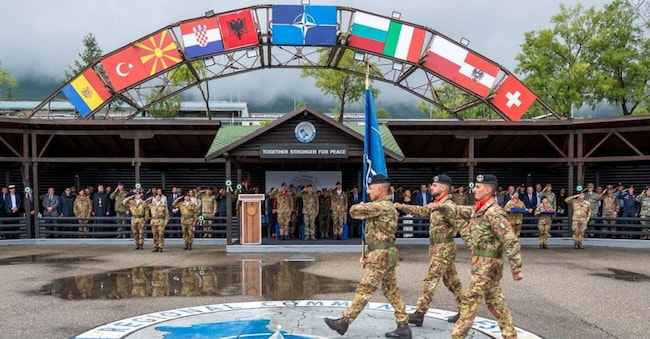
In a few days’ time, probably in October, Italia is set to take command of the KFOR operation in the Balkans, which operates under the NATO umbrella. At present, 29 countries are taking part: 24 members of the Atlantic Alliance and 5 partner nations. The mission has had a chequered history. Following a decision in 2023 to reinforce the contingents in the wake of serious tensions and clashes in northern Kosovo, NATO has recently announced a gradual reduction in troop numbers. At present, around 4,600 military personnel are involved (including around 800 Italians), but the outlook is for a reduction in numbers due to a general stabilisation of the security situation and the gradual strengthening of local security institutions. In reality, the Atlantic Alliance intends to maintain a flexible posture in Kosovo. Should tensions resurface or stability deteriorate, NATO is ready to rapidly reactivate its tactical reserve mechanisms and reinforce the contingent. In this scenario, Italia, which will be in command during this phase, will inevitably play a strategic role in defining the new balance of the mission. Moreover, support for the accession of the Western Balkans to the EU is a cornerstone of our foreign policy.
The final steps
These two elements – the Horn of Africa and the Balkans – form two pieces of a mosaic that has been taking shape over recent months. On Wednesday 8 July, the multinational exercise “Alliance Wall 26”, led by the Italian-led Multinational Battle Group G Bulgaria, concluded in Mokren, Bulgaria. The aim was to consolidate the ability of NATO forces to operate together effectively on the Alliance’s eastern flank. For two weeks, over 700 military personnel from eleven allied countries – Albania, Bulgaria, France, Greece, Montenegro, North Macedonia, Poland, Romania, Spain, the United States and, of course, Italia – trained in the Novo Selo area. The exercise involved live-fire exercises and field manoeuvres, utilising around 100 vehicles and weapon systems, as well as the use of remotely piloted systems for area surveillance and intelligence gathering. The objective was to test the ability of allied units to coordinate rapidly.
On Friday 31 July, at Šiauliai Air Base in Lithuania, Italia assumed command of the NATO Baltic Air Policing mission, taking over from the French and Romanian contingents with Eurofighter Typhoon aircraft from the ‘Air Baltic Thunder III’ Task Force. No sooner had they familiarised themselves with their new role than the first ‘scramble’ was launched: on 3 August, two Eurofighter F-2000s took to the air on the orders of the Combined Air Operations Centre in Uedem to intercept two Russian military aircraft that had entered international airspace over the Baltic Sea. The Italian Air Force crews identified and escorted the aircraft in accordance with NATO procedures. Baltic Air Policing is a permanent defensive mission launched in 2004 following the accession of Estonia, Latvia and Lithuania to the Alliance. On 12 August, following repeated violations of Polish and Romanian airspace, the North Atlantic Council reaffirmed its commitment to strengthening integrated air and missile defences across the entire eastern flank, from the Baltic Sea to the Black Sea, in line with the commitments made at the NATO summit in Ankara in July. Given this scenario, Italia is once again at the forefront.


