Clma

From Spain to Scandinavia the heatwave sweeps across Europe

by Dario Aquaro
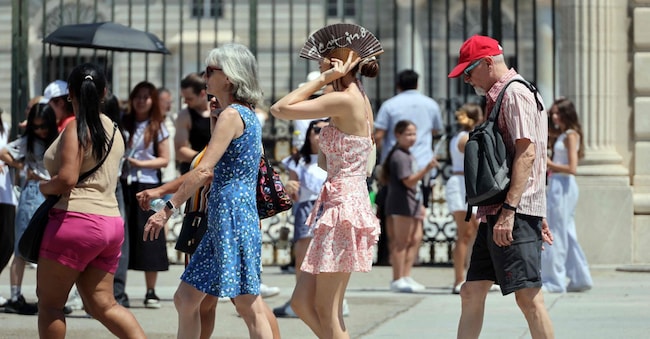
Le persone si riparano dal sole mentre fanno la fila fuori dal Palazzo Reale di Madrid il 2 luglio 2025. L'ondata di caldo che ha colpito l'Europa questa settimana ha battuto i record di temperatura, causato la chiusura delle scuole e aumentato il rischio di incendi. (Foto di Thomas COEX / AFP)

2' min read

Translated by AI
Versione italiana

2' min read

Translated by AI
Versione italiana

With an average temperature of 10.41 degrees, 2025 in Europe was the third warmest year ever, after 2024 and 2020, say data from Copernicus (Global climate highlights report).

Compared to the average for the reference period 1991-2020, temperatures were higher mainly in the North Atlantic, North Sea regions, including northern Great Britain and parts of Scandinavia, and the south-western Mediterranean. And the various heat waves recorded from April to September affected not only Italia and Spain, but also France, Germany and the United Kingdom.

Loading...

"While the deltas of the increases are not so far apart between northern and southern Europe, it is clear that the Mediterranean area, which starts from much higher temperatures, will pay the biggest price in absolute terms.

Italia, Spain, Portugal and Greece are the most exposed areas,' notes Lauro Rossi, programme director of the Cima Foundation.

Summer records, heat peaks in Alentejo (Portugal) or Andalusia (Spain), continue to cause alarm.

In addition to the increases per se, one must therefore analyse the impact of heat waves and thetens of thousands of related premature deaths: around 24,000 in the summer of 2025 alone, as the European Scientific Committee on Climate Change (Esabcc) points out.

The chairman of the board, the German economist Ottmar Edenhofer, also highlights another aspect: 'The economic damage, to infrastructure and tangible assets, currently amounts to approximately EUR 45 billion per year'.

Health and economy. "In Europe, heatwaves very often occur during periods of drought, multiplying the negative effects: because energy demand increases, but production is put in crisis precisely because of the lack of water," comments Rossi, who is also the first author of the European Drought Risk Atlas (coordinated by the Cima Foundation).

'This is how, for example,' he explains, 'the cooling problems of French nuclear power plants or the German difficulties in transporting coal along the Rhine came about.

Extreme heat can slow down productive activities, tourism and compromise liveability.

"The reference for the mortality condition is a wet bulb temperature of 35 degrees, corresponding to 45 degrees at 50 per cent relative humidity. But for the elderly or sick, the threshold is lower.

That is why,' continues Rossi, 'cities are equipping themselves with climate shelters, I am thinking of Barcelona: libraries and municipal spaces that are cooled and where people can spend the hottest hours of the day'.

However, the climate issue is 'moving up' the continent. "Temperatures that were previously typical of the South are now also being seen more frequently in the Centre and North. With disconcerting consequences,' says Rossi. 'The heat waves in France and Germany, for example, have occurred in areas where the population, particularly the most vulnerable groups, are not used to facing such a level of heat. The same level, in regions where these conditions are more frequent and the population is more adapted, would likely have less severe consequences'.

Copyright reserved ©
Loading...

Brand connect

Loading...

Newsletter

Notizie e approfondimenti sugli avvenimenti politici, economici e finanziari.

Iscriviti