
From Tel Aviv to Gaza joy explodes, but fears for the future remain
For one day, Palestinians and Israelis seem to feel the same sentiment, palpable in the streets: relief

TEL AVIV - "There's an agreement!" shouts Palestinian journalist Saleh El-Jafarawi in the dark. He walks among closed houses, laughs to himself and shouts the news at the top of his voice in the night to those who haven't heard it in the north of the Gaza Strip because houses in that area have been left without electricity and Internet connection.
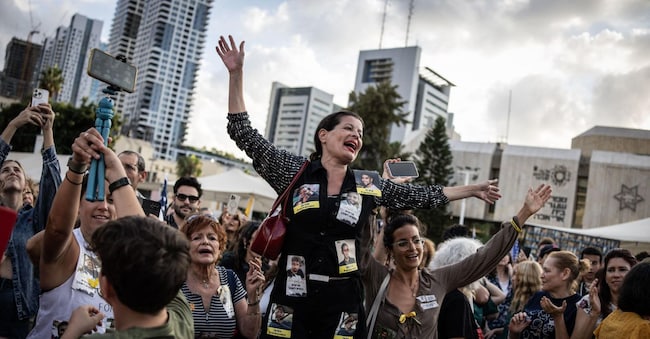
Shortly afterwards, the party breaks out, people pour into the streets and squares: gunshots in the air, fireworks, people celebrating, children dancing. A similar party, with songs, flag-waving, shouts and cries of relief broke out at the same time in Tel Aviv, Israel. In what has been renamed Hostages Square in front of the Art Museum over the past two years, many people pour out in the middle of the night, popping bottles, laughing, jumping. From Tel Aviv to Gaza is barely seventy kilometres, and usually they seem like very distant places, but for one day they finally seem to feel the same thing: relief.
Einav Zaugauker, the mother of a hostage, Matan, is out of breath. "I can't express what I feel," she says, "I'm out of breath, it's crazy." Omer Shem-tov, who was a hostage in Gaza, also has no words to say how he feels, he weeps, but with relief. Some do not hide their fear that something could go wrong in the coming hours. "Until we see the hostages return, until they cross the border, I don't believe it," says Rita Lifshitz, who had two family members kidnapped on 7 October, one of whom died in Hamas tunnels, and is angry that no commission has been set up by the Israeli government to shed light on the delays in the army's arrival on 7 October two years ago.
Even in Gaza people are celebrating, but some are cautious. "We have been in similar situations many times, Israel might resume the war after obtaining the release of all hostages, we never trust them," says Abu Baker, 54, displaced from Gaza City in the south for 18 months, who lost his daughter and grandchildren in the first 15 days of the war, when Israel attacked the refugee camp neighbourhood of Jabalia.
Many fear that there may be reprisals by the army before the long-awaited ceasefire takes place. 'At these junctures,' says Abu Baker, 'they kill more people than on other days.

