Education and orientation

From desks to wards: 1300 young people discovering care and themselves

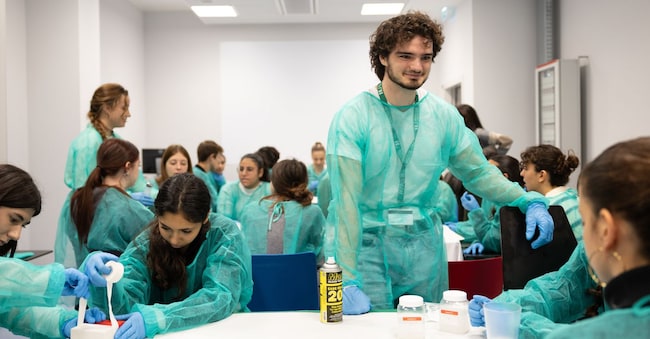
L'Ospedale in Classe' kicks off: the project scheduled from December 2025 to April 2026 that brings the world of care into schools, with simulations, workshops and orientation on the Humanitas University Campus
by School Editorial

4' min read

Translated by AI
Versione italiana

4' min read

Translated by AI
Versione italiana

Over 1300 secondary school students, mainly from Lombardy and the Milan metropolitan area, are about to transform their classrooms into real clinical simulation laboratories. This is the mission of "L'Ospedale in Classe", the 15-hour School-Work Training project promoted by Humanitas University and aimed at fourth and fifth grade classes, scheduled from December 2025 to April 2026.
The initiative was created to offer boys and girls a unique opportunity: to explore the world of healthcare and health professions up close, experiencing first-hand immersive activities, laboratories, simulations and meetings with professionals. A first concrete step towards university orientation and the discovery of Life Sciences.

Human dimension

"With "L'Ospedale in Classe", Humanitas University renews its commitment to Third Mission and Social Responsibility activities in the area, bringing younger people closer to the world of science and care, and contributing to orientation and the school-university transition - underlines Luigi Maria Terracciano, Rector of Humanitas University -. A course that focuses not only on skills, but also on the human dimension of the health professions: listening, empathy, responsibility and teamwork. For some students, it could be a first step towards a future career in healthcare; for others, it will be a valuable opportunity to discover themselves and the value of Science in everyday life".
Leading the workshops on campus are student tutors chosen by the Bachelor of Medicine and Surgery and MEDTEC, the course devised by Humanitas University with Politecnico di Milano, at the end of which students obtain a double degree, in Medicine and Surgery and in Biomedical Engineering.

Loading...

Schools in the area that have already joined the programme include:

- Istituto d'Istruzione Superiore 'Vittorio Bachelet' - Abbiategrasso (MI)

- Technical Institute and High School 'G. Falcone - A. Righi' - Corsico (MI)

- Istituto Tecnico e Liceo 'G. Feltrinelli' - Milan

- Technical Institute and High School 'E. Mattei' - San Donato Milanese (MI)

- Technical Institute and High School 'E. Torricelli' - Milan

- Liceo 'G. B. Vico' - Corsico (MI)

- Liceo 'P. Levi' - San Donato Milanese (MI)

- Liceo Classico Statale 'Giuseppe Parini' - Milan

- Liceo Scientifico 'A. Einstein' - Milan

- Liceo Scientifico 'E. Vittorini' - Milan

- Liceo Scientifico 'Italo Calvino' - Noverasco site and Rozzano site (MI)

- Liceo Scientifico 'Leonardo da Vinci' - Milan

- Liceo Statale 'Salvador Allende' - Milan

- Liceo Scientifico Statale 'R. Donatelli - B. Pascal

- Regina Mundi School - Milan


In the classroom: entering the complexity of care, between communication, ethics, emotions

The first five hours of the course take place directly in the classroom and are dedicated to the medical communication of uncertainty and career guidance. The heart of the proposal will be "Sottopelle" (Under the Skin), a live role-playing game realised in collaboration with Chaos League S.r.l., designed to rethink, together with the students, a question that is only apparently simple: what does it mean to cure today? Through a realistic clinical case, full of difficult choices and emotional elements, the students will put themselves in the shoes of health professionals. The experience will guide them through the complexity of healthcare work: listening, teamwork, shared decision-making, caring for frailty, up to a reflection on stereotypes and the different roles that make up the care network. Each participant will also receive a copy of "Memorie di Alter", the new Humanitas University comic book by Diego Cajelli and Andrea Scopetta, part of the Comics&Science series by CNR Edizioni. A surprising story that combines creativity and research: it is the mannequin Alter, the protagonist of the Simulation Centre, who narrates simulation as a tool for growth and transition to adulthood.

Inside the university: 3D Lab and Simulation Centre

After the classroom training, the course continues with 5 hours of scientific webinars to bring students closer to university lectures. The conclusion of the course includes a Campus tour at the Humanitas University headquarters in Pieve Emanuele. In the 3D Innovation Lab, the students will encounter an environment in which biology, technology and ingenuity mingle to give shape to 3D-printed tissues and anatomical models.
In the Simulation Centre, on the other hand, the students will experience high-fidelity clinical simulation, walking through rooms that reproduce hospital environments, experimenting with realistic procedures and scenarios. The aim is to understand how personal skills, teamwork and the opportunity to practise in a safe environment are crucial to becoming ready and aware professionals. "Skills, including those in the field of care, depend on three elements," concludes Stefania Brusa, scientific coordinator of the Simulation Centre and lecturer at Humanitas University, "knowledge, knowing how to do, knowing how to be. Knowledge can be nurtured by reading texts, publications and any source of updates. Know-how, on the other hand, can be trained in a simulation centre with the use of dummies or task trainers that allow learning in safety. The slogan is: never the first time on the patient; on the dummy we can afford to make mistakes and learn from our mistakes. What is much more difficult, on the other hand, is knowing how to be, which relates to an attitude in our personal sphere. This human factor carries more weight in determining a doctor's competence. The ability to work in a team, to make decisions, to be aware of the situation in which we find ourselves, leadership and communication are essential elements that promote patient safety and successful treatment. In a simulation centre, it is possible to train these non-technical skills before practising in the field. In this context, error becomes a key moment to understand what actions to take to improve. The error becomes something that one accepts and handles better, turning it into conscious learning'.

Copyright reserved ©
Loading...

Brand connect

Loading...

Newsletter Scuola+

La newsletter premium dedicata al mondo della scuola con approfondimenti normativi, analisi e guide operative

Abbonati