
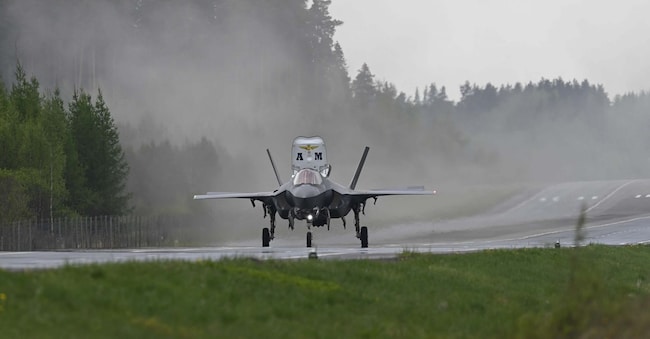
From the F-35Bs landing on a motorway in Finland to Ramstein Flag 2026, NATO is testing its response capabilities
More than 20 bases and operational areas across Europe are involved, from the north (Finland, Sweden, Norway, Denmark) to the south (Spain). The Italian Air Force is participating with F-35 and Tornado fighter jets and KC-767 aircraft for support and in-flight refuelling operations

Key points
- The ACE scheme
- NATO strengthens its presence in Finland and Sweden
NATO exercises are becoming increasingly frequent, designed to test the response capabilities of member states’ armed forces in the event of an attack by a hostile force. Increasingly, Northern Europe, which feels the need to prepare a rapid response in the event of a potential Russian attack more acutely, serves as the setting for these training exercises.
Ramstein Flag 2026, a large-scale NATO air exercise stretching from northern Norway, just a few kilometres from the Russian border, to southern Spain, is now in full swing. It is the largest exercise of its kind within NATO. Eighteen NATO member countries are taking part, including Italia, with over 200 fighter aircraft. The Italian Air Force is participating with F-35 and Tornado fighters, as well as KC-767s for support and in-flight refuelling operations.
The plan also provides for the involvement of US F-35A fighters, French Rafales, German Eurofighters, Swedish Gripens, Finnish F/A-18s, Polish F-16s), as well as support assets (such as ISR – systems designed for intelligence, surveillance and reconnaissance: satellites, drones, aircraft or even cyber networks) and NATO assets (AWACS and RQ-4D), from 12 countries.
The high-intensity multinational live-fly exercise, which will conclude on Friday 19 June, is led by NATO Allied Air Command (AIRCOM), and is designed to train air forces in complex and integrated operations. It is the first exercise conducted entirely under AIRCOM’s leadership, rather than under the individual commands of individual countries or local coalitions. It integrates air, space, land and naval components.
Hosted primarily by Denmark, Spain, Finland, Norway and Sweden, the exercise involves more than 20 bases and operational areas across Europe. There are over 150 daily activities, which may be ‘live’ or ‘simulated’.


