
Giorgetti: tax relief on pay rises for young people. Lega: Forza Italia’s refusal to accept a contribution from the banks is incomprehensible
A 5 per cent levy on banks’ profits, a flat tax for the self-employed with earnings of up to 100, and more funding for security. These are some of the proposals put forward by the Lega during the two-day event in Rome (entitled ‘In your defence – towards the 2027 Budget’) dedicated to the party’s priorities ahead of the budget

Key points
A 5 per cent levy on banks’ profits, a flat tax for the self-employed with earnings of up to 100, the option to retire at 64, and more funding for security. But also the proposal, put forward by the Minister for the Economy Giancarlo Giorgetti, for an ‘agreement with business leaders on a flat tax’ on ‘pay rises for young people’ up to the age of 30. These are some of the proposals put forward by the Lega during the two-day event (entitled ‘In your defence – towards the 2027 budget’) held in Rome to discuss the party’s priorities ahead of the budget. A budget which, according to Giorgetti – who described himself in Cernobbio as a “pragmatic sovereignist” – must be drawn up in accordance with the “principle of realism”. In other words: “do everything possible within the bounds of reality; otherwise, the risks are just round the corner”.
Whilst Matteo Salvini lashes out at the European Union, which ‘is stifling growth with excessive regulation whilst the rest of the world is innovating and streamlining’
Giorgetti: tax relief on pay rises for young people
‘In the latest Budget Bill, we very successfully introduced a policy whereby everyone who renewed their employment contract was subject to a flat tax rate of 5 per cent. “In my view, something similar could be achieved through an agreement between business leaders and employers who invest in young people. They would then increase their salaries, and the State could apply a preferential tax rate – a sort of flat tax – to these salary increases,” said the Minister for the Economy in his speech.
Salvini: a levy on banks can be implemented immediately to tackle high energy prices
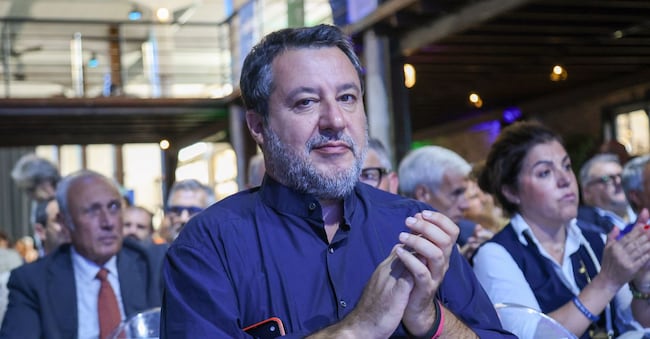
When asked whether a levy on banks could be introduced in the short term to reduce energy costs, Matteo Salvini replied bluntly: ‘Yes’. And at the end of the day, he spoke of a ‘structural and definitive contribution’ intended for the major credit institutions. Shortly before, the League leader had been sitting in the front row listening to Senator Claudio Borghi’s speech on the advisability of a contribution from the banks. When Borghi spoke explicitly about this from the stage, loud applause broke out from the audience (consisting mainly of League executives and directors, as well as representatives of affiliated companies). ‘Is it really so wrong to ask the banks for 5 per cent?’ asks Borghi. ‘Even our friend Sanchez, with whom we disagree on everything, is proposing it. It would generate revenue of around 2 billion for a sector that has been making 50 billion in profits for the past three years; we’re not talking about expropriation, we’re talking about a small contribution’, to be allocated to supporting households and businesses and to strengthening security. Meanwhile, Giorgetti remarked that if there were more ‘competition’ in the banking system, the credit institutions’ excess profits ‘would automatically fall, to the benefit of the community’.
Lega sources: Forza Italia’s refusal to accept a contribution from the banks is baffling
Not least because – and here Borghi addresses the Forza Italia leader Antonio Tajani – ‘whenever he hears talk of taxes, he turns green with envy’; without a contribution from the banks, ‘the taxes for services provided to citizens are paid by the citizens themselves’. The pressure is such that League sources describe “FI’s refusal to contribute as incomprehensible”. All this without ruling out a new solidarity levy on windfall profits in the energy sector, following in the footsteps of the one introduced for 2024 (‘There was already a law passed by the Meloni government two years ago,’ Borghi explains further. ‘It was a “one-off”, but it could be reintroduced. We need to do the maths.’


