Defence industry

From the howitzer to the European drone programme and the submarine, the enhanced cooperation projects between Italy and Germany

In the paragraph devoted to the defence industry in the 'Agreement on Enhanced Cooperation in the Fields of Security, Defence and Resilience between the Government of the Italian Republic and the Government of the Federal Republic of Germany', signed and disclosed at the end of the intergovernmental summit, it is clarified that enhanced cooperation between the two countries could potentially be based on (but would not be limited to) certain existing projects

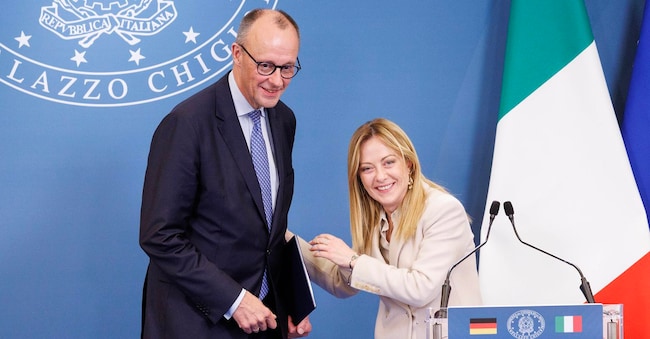
La presidente del Consiglio Giorgia Meloni e il cancelliere federale della Germania Friedrich Merz durante il vertice intergovernativo a Villa Doria Pamphilj, Roma, Venerdì 23 Gennaio 2026

3' min read

Translated by AI
Versione italiana

3' min read

Translated by AI
Versione italiana

In the paragraph dedicated to the defence industry by the 'AAgreement on Enhanced Cooperation on Security, Defence and Resilience between the Government of the Republic of Italy and the Government of the Federal Republic of Germany', signed and disclosed at the end of the intergovernmental summit that took place at Villa Doria Pamphilj in Rome on Friday 23 January in the presence of the Italian Prime Minister Giorgia Meloni and the German Chancellor Friedrich Merz, it is made clear that the enhanced cooperation between the two countries could potentially be based on (but not limited to) existing projects.

Here they are:

Loading...

Land sector: self-propelled artillery systems such as the Panzerhaubitze 2000, the 'VULCANO' family of artillery ammunition or tanks.

Air and space sector: the Eurofighter fighter, the European 'Eurodrone' drone project, the NH-90 multi-role medium military transport helicopter, air defence systems, attack helicopters, the F-35 fifth-generation multi-role fighter.

Maritime sector: Class 212 submarines (including the Near Future Submarine).

The OCCAR projects for multi-jamming capability Responsive Electronic Attack for Cooperative Tasks (REACT) and European Secure Software

Defined Radio (ESSOR).

Here are a few pointers on some projects:

Panzerhaubitze 2000

The PzH 2000 is a self-propelled 155/52 mm howitzer developed by a German consortium formed by Krauss-Maffei Wegmann (now KNDS) and Rheinmetall. It entered service in the late 1990s. The German-made howitzer, considered one of the most advanced and powerful field artillery systems in the world, replaced the decommissioned M109L howitzer between 2008 and 2012. It has a highly sophisticated firing control system, which is controlled by a ballistic calculator, inertial navigator and GPS, as well as a semi-automatic loading mechanism that allows firing rates of up to 3 rounds in 10 seconds or 20 rounds in 3 minutes. The range varies from 30-40 km with standard ammunition to 80 km with guided long-range projectiles, such as Leonardo's Vulcano. The Italian Army has acquired around 70 examples (some produced under licence by Iveco-Oto Melara), using them to replace the old M109Ls. In addition to Germany and Italy, it is used by the Netherlands, Greece, Lithuania, Croatia, Hungary and Qatar. Since 2022, some examples (including 6 from Italy) have been supplied to Ukraine to support defence against Russian invasion.

Vulcan ammunition

Vulcano ammunition, developed by the Italian company Leonardo (formerly Oto Melara), is a family of long-range, high-precision projectiles for naval and land use. The latest addition to the precision munitions family is the Vulcano 120 mm.

Eurofighter Fighter

The Eurofighter Typhoon fighter (aviation nomenclature F-2000A), is the most advanced combat aircraft developed on the European continent. The aircraft is part of the national warning service, guaranteed by the Air Force's air defence departments 24 hours a day, 365 days a year, which, in a matter of minutes, ensures that fighter jets take off to intercept and identify any suspicious air trails detected by radar. The Eurofighter, which has also acquired air-to-ground capabilities, is the result of industrial collaboration between Italy, Germany, the UK and Spain.

Eurodrone

Eurodrone, is a joint European programme launched by Airbus, Leonardo and Dassault Aviation as a government-industry initiative to meet future European needs for an Uncrewed Aerial System (UAS), supported by the governments of France, Germany, Spain and Italy and managed by the European OCCAR (Organisation Conjointe de Coopération en matière d'Armement). The first unmanned aerial system designed to fly in non-segregated airspace, Eurodrone will operate worldwide to support ISTAR (Intelligence, Surveillance, Target Acquisition and Reconnaissance) missions, both at wide range and in operational theatres, ensuring the achievement of operational superiority through a broad modular capability.

The NH-90 multi-role helicopter

The NH-90 is a medium, twin-engine, multi-role, modern, high-tech military helicopter, developed by a European consortium (NHIndustries, including Leonardo, Airbus Helicopters and Fokker) to meet the needs of land and naval operations. It is characterised by being the first fully fly-by-wire helicopter, extensive use of composite materials and can be configured for troop transport, anti-submarine/anti-naval naval missions, search and rescue (SAR) and special operations support.

The U-212 submarine

The Class 212 (or U-212) submarine is a class of technologically advanced attack submarines, used by Germany and Italy, characterised by hybrid propulsion (diesel-electric with fuel cells), which allows them to remain submerged for days without surfacing, offering great autonomy and secrecy. For Italy, they are known as the Todaro Class and represent a remarkable evolution with high performance in terms of autonomy, stealth and the ability to operate in harsh environments.

Occar projects

The OCCAR (Organisation for Joint Armament Cooperation) projects are European military cooperation programmes managed by this international organisation to jointly develop, acquire and operate weapon systems and technologies for the participating nations (France, Germany, Italy, Belgium, Spain, UK), aiming to improve efficiency, standardisation and innovation in European defence by managing the entire life cycle of programmes, such as the Eurodrone.

Copyright reserved ©
Loading...

Brand connect

Loading...

Newsletter

Notizie e approfondimenti sugli avvenimenti politici, economici e finanziari.

Iscriviti