
From the Lambretta to Milano da bere Pepi Merisio and the Italy of the economic boom

3' min read
3' min read
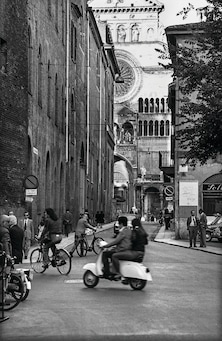
These are the images, the memories that boomers carry in their hearts: those of an industrious, working-class Italy that was on its way to a certain widespread well-being among all social classes. A country divided between Vespa and Lambretta, but the lucky ones bought Fiat 500s by signing bundles of bills of exchange. An Italy in the midst of an economic, industrial and building boom with families discovering the wonders of the refrigerator, the washing machine, the TV, simple games and a sociality characterised by the pleasure of meeting each other.
This is what the images in the exhibition 'Attraverso l'Italia. Photographs by Pepi Merisio', which can be visited in Bergamo in the Exhibition Space of the Sestini Museum of Photography, set up at the Convent of San Francesco in Bergamo until 7 September.
The journey covers with 136 black and white and colour photographs moments of everyday life, landscapes and territories from the 1950s and 1960s to the 1980s, those of the 'Milano da bere'. All captured by the shots of Pepi Merisio, a photographer from Bergamo who has always nurtured an admiration for Italy that he has repeatedly declared: "We are lucky in Italy to have the most man-made and the most beautiful landscape there is". The exhibition is dedicated to the fruitful relationship he had with publishing and in particular with the Italian Touring Club. In fact, the title "Attraverso l'Italia" (Through Italy) is intended as a tribute to the Touring Club's historic series of the same name, published in three series starting in 1930, which the Caravaggio master collaborated on between 1956 and 1972.
The exhibition is opened by a newly created space, where scenic and multimedia devices introduce the visitor to the route and offer an unprecedented glimpse into the photographer's biography. A video recounts Merisio's biography, divided into 20 dates, from 1931 to 2021, with texts and unpublished images of the photographer granted by his son and collaborator, Luca Merisio. The exhibition then continues in six sections. Four are geographical in nature and cross the Bel Paese from North to South, describing through images the Italy of villages, walled cities and squares, the Italy of churches, markets and processions, but also the Italy of means of transport, motorways and early organised tourism. Two thematic sections explore particularly significant publishing experiences in the photographer's biography: in addition to his collaboration with Tci for the historic series Attraverso l'Italia (Through Italy), his commitment to the monumental Terra di Bergamo, a three-volume work published by Bolis in 1969 on the occasion of the centenary of the Banca Popolare di Bergamo. The final section hosts an unpublished audiovisual interview made with Merisio in 2018, on the occasion of the deposit of his archive at the Museum.
A journey that provides an opportunity to reflect on the transformations of the Italian landscape. From North to South, from the uncontaminated peaks of the Gran Paradiso, inhabited by ibexes, to the life of fishermen in the tuna fishery of Favignana, through iconic images such as the slow ride of a motorbike on the railway bridge over the Po: each photograph is testimony to a changing Italy, recounted with intensity.

