
From the London Invitational to Fair Play: in search of alternative models for trade fairs
Galleries are trialling new, more intimate formats to avoid the hassle and expense of large-scale events in conference centres

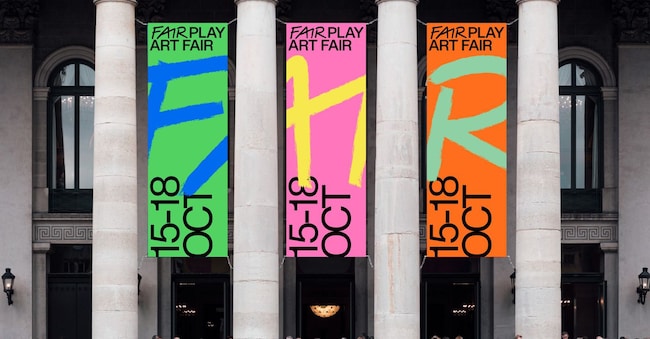
This edition of Frieze London 2026, from 14 to 18 October, saw the emergence of several parallel fairs, which do not seek to replace the main event but rather to offer an alternative, each in its own way. In the current market, art fairs represent a period of enthusiasm and a gathering of collectors that has a beneficial effect on the gallery business for months – before, after and during the event. However, they also place a considerable strain on the finances and stability of those in the sector.
London Invitational
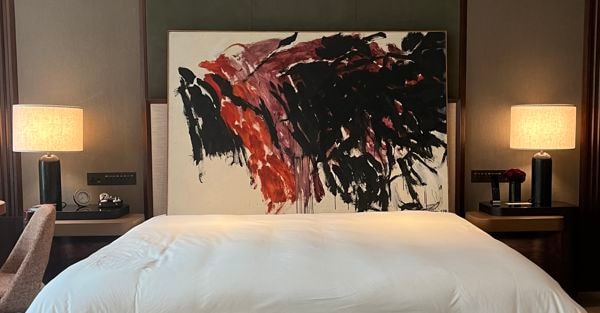
Against this backdrop, alternative proposals have emerged, such as London Invitational, which took place from 15 to 18 October at the new The Chancery Rosewood Hotel in London, housed in the former US embassy on Grosvenor Square. Founded by James Cope, an English gallery owner who has been running the eponymous gallery in Dallas, Texas, for 12 years, the event hosted a dozen predominantly American galleries within the luxurious hotel. “After years of art fairs, I began to feel a sense of weariness and dissatisfaction,” said Cope. “I wanted to create an alternative model of art fair that appealed to me – one that was more intimate, more thoughtful, and that fostered human connections.” And so the first Dallas Invitational was born, featuring around ten other gallery owners who were friends of Cope’s. After the first edition at the Fairmont, the fair moved to the Rosewood, which contacted Cope when it opened in London to bring the event there as well.
The trade fair at the hotel
The concept behind the hotel works because it offers a homely yet neutral atmosphere. It is a ‘home away from home’, where visitors can give free rein to their curiosity to discover and explore. This format dates back to the 1990s. A notable example is The Gramercy International Art Fair, founded in 1994 at the Gramercy Park Hotel in New York, which later evolved into The Armory Show. In Milan, too, the Milano Flash Art Fair took place in 2004, organised by Giancarlo Politi at the Hotel Tocq, featuring 60 Italian and international galleries. “My initiative is a reaction to the mega-fair held at the conference centre, with hundreds of galleries and excessive costs,” continues James Cope. “It may well be true that sales are made at the fair, but it’s not the sort of environment you want to be part of or spend your time in.” The costs of taking part in the London Invitational have not been disclosed, but they amount to the cost of a hotel room, plus an additional sum to cover certain incidental expenses, such as the dinners organised by the fair. James Cope, in fact, does not earn any money from organising the fair; rather, he takes part like all the other galleries and earns money from the sales of his own works. “Sales do happen; otherwise, the galleries wouldn’t come back year after year,” he comments. “I don’t intend to compete with the major fairs, but to offer an alternative. It’s like the fashion industry: there are the big brands and there are the small boutiques, and they coexist.” In his room, there were paintings by two emerging artists: Coco Young priced at $20,000, alongside small works by Michelle Rowling priced at $12,000.
The 12 participating galleries mainly presented works by young artists, but also included works by artists who are no longer with us and secondary-market works, such as the London gallery Vardaxoglou, which specialises in 20th-century British artists, or Franklin Parrasch from New York, which staged a series of works based on perception. François Ghebaly exhibited works by Jessie Makinson, Marius Bercea and Koichi Sato at prices ranging from 5,000 to 18,000 dollars, immediately selling several pieces by Jessie Makinson. Marinaro featured works by Alessandro Teoldi, an Italian artist based in New York, whilst Bel Ami in Los Angeles showcased paintings by the Japanese artist Minami Kobayashi priced between $17,000 and $33,000.
Minor Attractions
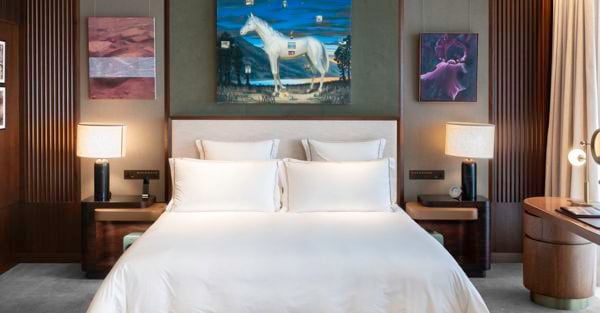
For several years now, there has been another art fair taking place in a London hotel: Minor Attractions, launched by gallery owners Jonny Tanna of Harlesden High Street and Jacob Barnes of Season 4 Episode 6, in 2023 at The Mandrake, a luxury boutique hotel with a unique character, featuring just 33 rooms and a quirky atmosphere, somewhere between the artistic and the theatrical. Compared to the first edition, which was a great success, the quality has declined over the following two years. This year, the fair has moved to another new London hotel, The Newman, featuring 75 galleries across 16 rooms. This year, in fact, exhibitors were given the option to share rooms and display as few as a single artwork, but the result is far more chaotic. Participation fees ranged from £1,000 for a single artwork in a room to £9,000 for an entire room, but some exhibitors were not particularly satisfied, partly due to organisational difficulties on the opening night.


