
From *Metamorphoses* to *The Great Beauty*
A magnificent exhibition on Ovid’s legacy: 80 works are juxtaposed with those in the collection to commemorate a number of myths: Leda, Arachne, Perseus and Narcissus

There is no more complete metamorphosis than that of the villa ‘fuori Porta Pinciana’. The Borghese Gallery is a delightful pastiche of eras, tastes and artists, in a state of constant evolution: even Ovid would have liked it. Cardinal Scipione Borghese, who commissioned the construction of the Casino Nobile to house his collection, envisaged architecture as a cultural mechanism that weaves together myth, beauty and self-representation into a unique language of meaning. And so what better venue than the Borghese Gallery for the exhibition Metamorphoses. Ovid and the Arts, born of a collaboration with the Rijksmuseum in Amsterdam and curated by Francesca Cappelletti and Frits Scholten, who explain in the catalogue: ‘Our collections share an interest in the “indigenous” art of the 17th century: Roman Baroque, centred on Bernini’s sculptures, and its Dutch counterpart, an expression of Amsterdam’s bourgeois society, immortalised by Rembrandt and Vermeer. From these distinct yet complementary contexts emerges a result of extraordinary richness: an ambitious exhibition that spans centuries and diverse forms of expression to do justice to Ovid as the supreme source of artistic inspiration.”
The Metamorphoses is a torrent of 200 myths, in which gods, humans and nature change form in an endless flow that begins in chaos and blossoms into beauty. The work, an immense collection of tales, has retained its uniqueness over the centuries, thanks in part to the Ovide moralisé written in early 14th-century France, right up to its philological rediscovery during the Renaissance, and artists continue to draw inspiration from those verses. From the very creation of the world, from that indistinct matter held together by discord, to which a nameless god brings order. In the Mariano Rossi Hall, with scenes from ancient Rome on the ceiling, we embark on a reinterpretation of such a pervasive poem: Louis Finson’s four Elements are bodies of energy and matter, much like Anicka Yi’s works from the Pinault Collection – flickering movements awaiting the birth of butterflies. Life begins from chaos, and the exhibition highlights certain myths to illustrate the interplay between myths and styles: thus, whilst observing the prestigious loan from the National Gallery in London of Pollaiolo’s Apollo and Daphne (c. 1470–75), one is spellbound by the mirroring effect with Gian Lorenzo Bernini’s (1622–65) masterpiece of the same name: Apollo rests his hand on Daphne’s hip and realises, in despair, that beneath that hint of bark beats the maiden’s heart. But she wants nothing to do with his love and is already turning into a laurel tree. Bernini brings the marble to life; Daphne’s hair is now branches and her toes are roots.
Once again, Bernini, with his The Rape of Proserpina (1621–22) and its intensely sensual muscular forms, takes centre stage in the section leading into the realm of the dead: Rubens depicts Orpheus and Eurydice (1636–38, from the Prado) as they make their way through the darkness of Tartarus ‘through silent stillness’, whilst Agostino Carracci’s Pluto almost terrifies us. With the myth of Arachne, the young woman who challenges Minerva in the art of weaving, we enter those fertile pages of the Metamorphoses, with allusions and foreshadowings concerning artistic practice. Weaving threads means weaving words, to write poetry, and Tintoretto’s Minerva and Arachne (c. 1575–85, from the Uffizi) depicts the beginning of the challenge, leading to the maiden’s transformation into a spider, alongside Rubens’s sketch created for the Torre de la Parada. And, watching over the story, are the busts of Scipione Borghese, by Bernini, in a continuous and skilful interplay between masterpieces from the Borghese Collection and the exhibition. It is an all-encompassing flow, like the light of summer.
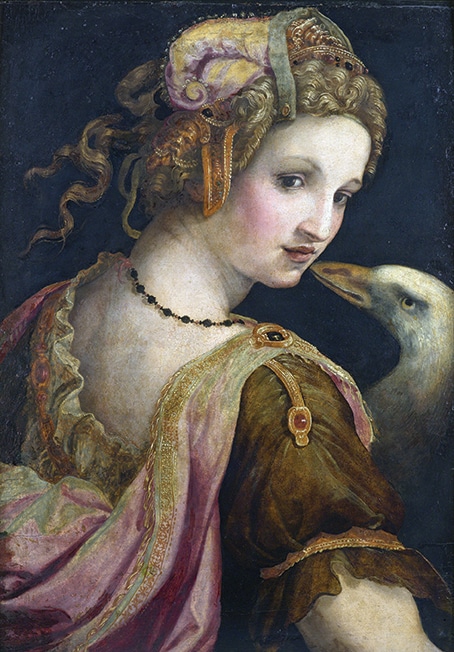
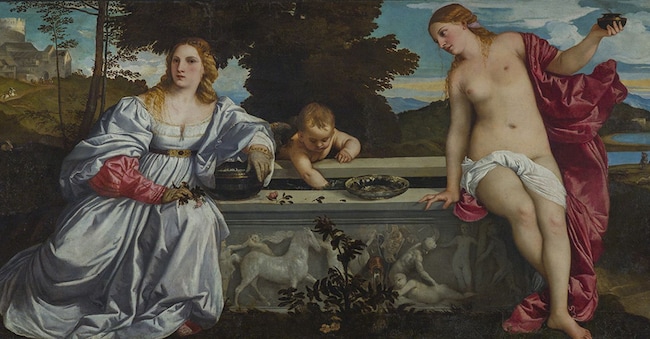
The myth of Arachne leads on to the love affairs of Jupiter, who also transforms himself to deceive women, and to the extensive section on Leda and the Swan, beneath whose guise the father of the gods conceals himself as he unites with the Queen of Sparta to father several children, including Castor and Pollux. From the Leda of the 2nd century AD, who lifts a veil to protect the swan, to the beautiful version by Michele di Ridolfo del Ghirlandaio (c. 1560–70) and that by Leonardo and Giovanni Antonio Bazzi (before 1517), set in a garden as lush as an embroidered tapestry. There are also plenty of wonders to be found in the myth of Pygmalion who, disillusioned with women, sculpts a female figure so perfect that he falls in love with it, and Venus warms the material to turn it into flesh, as in the works of Jean-Léon Gérôme (c. 1890), in which the statue’s colour shifts from the white of marble to a rosy hue. Transformations continue with Perseus, who reappears in works by Rodin and Rubens, and in an evocative lapis lazuli oval painted in oil by Antonio Tempesta (1610–20). It concludes with the power of love, which moves and transforms everything. Cupid is an unpredictable force, as Titian reminds us in Sacred Love and Profane Love (1515–16). And Narcissus represents love’s most tragic outcome: his head is reclined in a Roman-era marble sculpture; he surrenders himself to Nature in Nicolas Poussin’s oil painting (c. 1629, from the Louvre), whilst in the Millefleurs Tapestry from Boston he is reflected in the water, unable to recognise himself, until he dies and flowers bearing his name bloom. Everything multiplies, even the tapestry, thanks to a mirror at the foot of the work – yet another stroke of genius in the bold and theatrical staging by choreographer Hubert Le Gall for an exhibition that is, in itself, a surprising transformation because – in the words of Ovid – ‘omnia mutantur, nihil interit’ (XV, 165, everything changes and nothing is lost).
One more change: on the top floor, the Galleria Borghese is putting the finishing touches to the exhibition layout to display works from the storerooms. Soaring walls, three large sliding grilles that run from the bottom to the top to make the works accessible to visitors and conservators. Director Francesca Cappelletti offers us this preview, made possible by funding from the National Recovery and Resilience Plan (PNRR) and set to open in the autumn. For centuries, the Villa of Scipione Borghese has applied to the letter the final verse of Metamorphoses: ‘siquid habent veri vatum praesagia, vivam’ (XV, 879, ‘if the prophecies of the poets contain any truth, I shall live’). The Gallery, art and we ourselves shall live on for ever.


