Space

From Earth's moons a possible mineral reserve

It would be necessary to divert asteroids and bring them into a stable orbit to extract cobalt, gold and lithium

by Leopoldo Benacchio

3' min read

Translated by AI
Versione italiana

3' min read

Translated by AI
Versione italiana

A year or so ago, the Earth had two moons for a couple of months, not just one as we are used to thinking. The second, temporary and not visible to the eye, was a small asteroid, 10 metres in diameter, named 2024 PT5 by specialists in the field. It was simply caught by the gravitational attraction of our planet, which deflected its orbit for a few days, causing it to revolve around us, and then let it go.

A threat under observation

This is not the first time this has happened: in 2020, in February, there was the same phenomenon, two moons for the Earth, thanks to a very small asteroid, let's say three metres in diameter, and something similar was observed other times further back in the years.

Loading...

These asteroids, like all others that are visible to telescopes, are being watched by space agencies, including the European one, because they can be a serious danger to us if they crash into Earth.

Extraction tests

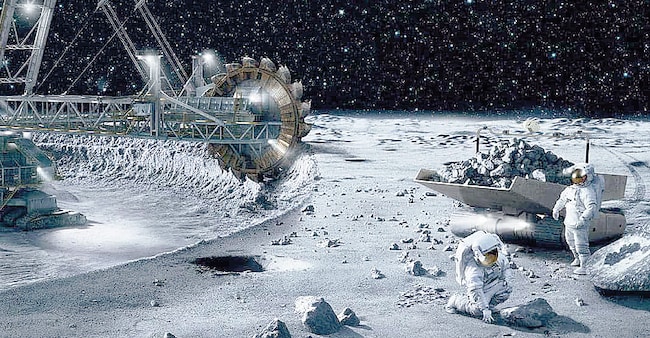
However, no one has so far thought of using this opportunity to carry out the trial run of capturing and extracting valuable minerals from the asteroid itself, asteroid mining, which has been talked about for several years. These celestial bodies would be a natural reservoir of minerals that are either scarce or valuable here on Earth.

Precious Minerals

At current prices, the value of the minerals contained in just one of these space-travelling rocks is incredible: at least a hundred billion dollars per asteroid in platinum, gold, cobalt and especially lithium.

However, the cases are different: if you bring home lithium it is still OK, but if you bring home half an asteroid's worth of gold and platinum there are problems of overabundance. Even for lithium there are problems, now it is needed more than ever for batteries and telephones, but if tomorrow you were able, as is hoped, to use other much less rare materials, what would happen, one wonders.

Previous ones

So far, we have two excellent examples of a mission to an asteroid with the recovery of a sample of material, thanks to NASA's Osiris-REx and Japan's Hayabusa2 missions, which brought a few grams of material back to earth. The cost per gram in these two cases is in the region of a hundred million dollars per gram, and more. Impossible then. The fact is that, in both cases, the two asteroids visited by the American and Japanese probes were quite far away, as are almost all these bodies, contained in areas, for example, between Mars and Jupiter.

So why not take advantage of these mini-moons, which are very close, a few hundred thousand kilometres and not many millions as with other asteroids?

The reason seems to be very simple: the field of mineral extraction from asteroids is populated by many start-ups, but none, at the moment, is ready to take the plunge.

The technique to be used in this case, according to TransAstra, an American company among the most advanced in the field, is to capture the asteroid, divert its trajectory and put it in a comfortable and stable orbit so that it can be reached several times to extract the minerals.

The Problem of Gravity

It is at this point that a well-known but unexpected actress enters the scene: gravity, the same force that makes us break a glass on the floor if it slips out of our hands. This attraction depends on mass, and asteroids have very little mass compared to the Earth: so how do we land without ending up like a tennis ball bouncing off the surface of the asteroid itself?

Difficult problem, one can anchor there, but the only attempt, made on comet C67/P by the Rosetta probe years ago, went wrong. Besides, asteroids do not stand still: not only do they rotate, in the case of mini-moons, around the Earth, but also around themselves, like a stick that whirls upwards when we throw it, but also rotates on itself before falling to earth.

In the NASA and Japanese missions, the two spacecraft used only scratched, literally, the surface with a robotic arm.

Then there is the problem of cosmic rays, which are not exactly a treat even for mining machines or robotic miners, and also that, as many sceptics of these projects claim, the very low gravity would not allow the formation of minerals that are too complicated, as is hoped.

Opportunities and problems. This will probably be clarified in 2029, with the NASA mission called Psyche. Launched in 2023, the probe will then arrive at the asteroid of the same name and study it properly.

Last problem, mentioned earlier: if we brought a few trillion dollars of gold and lithium to Earth, what would happen to our planet's economy?

Copyright reserved ©
Loading...

Brand connect

Loading...

Newsletter

Notizie e approfondimenti sugli avvenimenti politici, economici e finanziari.

Iscriviti