2026 World Cup

From the TV monopoly to participatory streaming: the ‘Cazé revolution’ in Brazil

In Brazil, Cazè TV, a YouTube channel, has acquired the rights to broadcast all 104 World Cup matches live

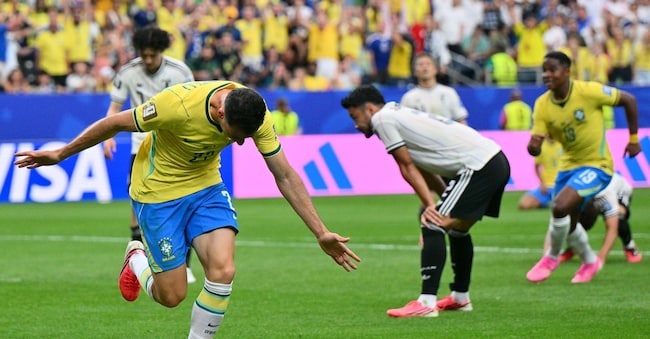
Il brasiliano Gabriel Martinelli esulta dopo aver segnato il gol del 2-1 durante la partita dei sedicesimi di finale della Coppa del Mondo FIFA 2026 tra Brasile e Giappone, disputata a Houston, negli Stati Uniti. (EPA/Sam Wasson)

3' min read

Translated by AI
Versione italiana

3' min read

Translated by AI
Versione italiana

There is one image that, more than any other, captures the paradigm shift currently taking place in the sports rights market: millions of users connected simultaneously to a live stream on YouTube, commenting, reacting and sharing in real time, whilst the match unfolds on screen. This is not an experiment, but a business model set to redefine the landscape of sports entertainment.

Its testing ground is Brazil, a traditional stronghold of mainstream television, and the star of the show is CazéTV. Born almost as a joke from an idea by the streamer Casimiro Miguel – known as ‘Cazé’ to millions of followers – the channel has transformed itself in just a few years from a platform for comedy content into a credible competitor to the giant TV Globo, the undisputed ruler of football broadcasting ever since the 1982 World Cup in Spain.

Loading...

The turning point came in 2022, when Cazé joined forces with the sports marketing company LiveMode: rights acquired on favourable terms, digital experimentation and a narrative style that was completely different from that of traditional television.

The World Cup in Qatar represents the first large-scale test. Twenty-two matches broadcast free of charge, peaks of almost 7 million concurrent viewers and, above all, proof that digital distribution can be not only sustainable but highly profitable. This is the point of no return: football is now firmly part of the streaming platform ecosystem, where the audience is no longer passive but actively engaged.

Today, with the new World Cup – streamed in full for free in Brazil – the phenomenon has come of age. The figures are more indicative of the media economy than of mere entertainment: over 12 million devices connected for the Brazil v Morocco match, around 2 billion reais raised in sponsorship (almost 400 million euros), and a combined following of over 30 million thanks to the involvement of influencers. And that’s not all: the schedule runs 24 hours a day, featuring supplementary content, highlights, behind-the-scenes footage and social media interactions.

The real game-changer, however, is not just quantitative but qualitative. CazéTV taps into a profound shift in consumer behaviour: Millennials and Gen Z don’t simply ‘watch’ the match; they experience it as a shared event. Real-time chats, memes, reactions, and even gamification elements such as live betting: the sporting event becomes a social hub rather than a linear product. In this sense, free streaming is not a low-cost model, but a strategic lever for expanding the user base and monetising through advertising, branded content and sponsorship.

The impact on the market is disruptive. TV Globo still holds the lead in terms of overall audience figures, but is struggling to attract younger viewers – the very demographic on which the future value of the rights depends. The reduction in the number of matches broadcast is a sign of a gradual erosion of its monopoly. In other words, the competitive advantage no longer lies solely in the availability of rights, but in the ability to build a digital ecosystem around the event.

CazéTV’s growth is part of a global trend that has seen new players – from OTT platforms to independent content creators – enter the sports rights market. However, the Brazilian case has a distinctive feature: the integration of the influencer economy and the sports business. Casimiro is not just a broadcaster, but a personal brand capable of engaging communities. The case of Cape Verdean goalkeeper Vozinha, whose follower count soared from 50,000 to millions in just a few hours following a promotion during a live broadcast, demonstrates the potential for social amplification that extends beyond the world of sport.

The presence of high-profile investors, including Cristiano Ronaldo, also signals the growing interest of international capital in hybrid distribution models, where premium content and free access coexist on a global scale.

The point, to put it in economic and industrial terms, is that the value of rights is gradually shifting from mere exclusivity to the ability to generate engagement. In a context where attention is the real currency, platforms such as CazéTV demonstrate that accessibility can be more profitable than scarcity.

For football, and more generally for the sports industry, the message is clear: the future will not be a mere evolution of television, but a complete overhaul of it. And Brazil continues to prove itself a leading laboratory for cultural and economic innovation.

Copyright reserved ©
Loading...

Brand connect

Loading...

Newsletter

Notizie e approfondimenti sugli avvenimenti politici, economici e finanziari.

Iscriviti

Tutto mercato WEB