
More than 10 billion in investment is set to flow into Europe from the PIF fund
140 projects have been submitted to expand commitments across Europe. The plan also aims to diversify the Saudi economy by involving Italian companies
by Lorenzo Pace
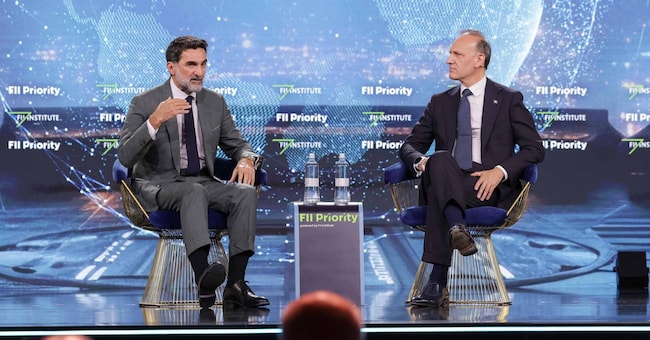
Europe remains at the heart of the PIF’s – the Public Investment Fund – investment plans. Indeed, the fund regards it as one of the pillars of its global strategy. But the relationship is changing, and Governor Yasir Al-Rumayyan makes no secret of this. In Rome, on stage at FII Priority Europe – the international summit which concludes today – the head of the Saudi sovereign wealth fund has charted a new course, characterised by less capital outflow and greater ambition in terms of inflows. Because the aim, after having ‘brought Arabia to the world’, will be to ‘bring the world to us’. And both Europe and Italia, as has already happened, will be involved.
Almost 100 billion invested since 2017
Let’s take things in order. The starting point for the on-stage debate with Sace’s chairman, Guglielmo Picchi, was the investment track record. Since 2017, the PIF has invested nearly 100 billion dollars in Europe, contributing 70 billion to GDP and creating 160,000 jobs. A significant proportion of these investment flows has been directed towards Italia: Aramco, the world’s largest energy company, of which Al-Rumayyan is chairman, has invested 80 billion in Europe, a quarter of which has gone to Italia in the form of supplies and contracts.
The new strategy
Yet the future will not be the same as the past. “The percentages will fall,” said Al-Rumayyan, “but there will still be investment.” In other words: the PIF will continue to finance projects in Europe, but to a lesser extent than in previous years. The 140 programmes presented in Rome – with a total potential value of €10.4 billion by 2030 – represent less than the fund has invested over the past decade. Part of the explanation is bureaucratic. As Al-Rumayyan puts it bluntly: the main challenge is not finding opportunities in Europe – of which there is no shortage – but managing the regulatory aspects. “The positive thing is that European politicians are keeping a close eye on this situation.”
The real reason for the rebalancing, however, lies elsewhere. The PIF’s five-year plan – which runs until the end of 2030 – has shifted its focus. The aim is to attract investors in order to diversify the country’s economy and thereby reduce risks. Six areas are considered priorities: tourism, urban development, logistics, advanced manufacturing, clean energy and Neom, the city of the future in the Tabuk desert. It is in this context that the partnerships with Italian companies should be understood. Here are a few examples. Pirelli has been called upon to contribute to the development of the Saudi automotive industry. Similarly, in the yachting sector, an agreement has been reached with Azimut Benetti.
The energy front
On the energy front, and in particular with regard to renewables, Al-Rumayyan made it clear that fossil fuels remain irreplaceable. This applies not only to oil and gas in the strict sense: the chemical industry, fertilisers and entire sectors of global manufacturing still depend on them. ‘We must be realistic.’ And artificial intelligence – a sector in which Aramco is investing with increasing focus – further complicates the picture: it requires enormous amounts of energy, and ‘that energy cannot become two or three times more expensive’.

