In collaboration with the Regional Council of LombardyPioneers. 80 years of voting and representation

"Diva"

From pioneers to the ballot box: the long road to citizenship

Eighty years ago, Italian women finally became citizens. This milestone was the result of decades of struggle to secure the right to elect their own representatives and to have a voice

(Ansa)

8' min read

Translated by AI
Versione italiana

8' min read

Translated by AI
Versione italiana

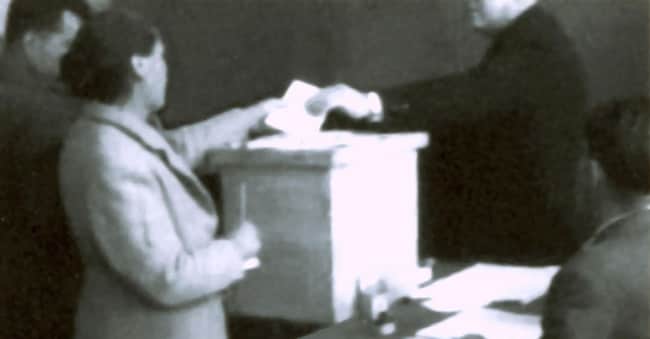
(Il Sole 24 Ore Radiocor) – On 10 March 1946, in the first post-war local elections, Italian women entered the polling booths en masse for the first time: this marked their electoral debut. A few months later, on 2 June, they turned out to vote in the referendum asking the nation to choose between the monarchy and the Republic and to elect the Constituent Assembly. The images of women queuing at polling stations for the first time are etched in everyone’s mind (not least thanks to Paola Cortellesi’s splendid film *C’è ancora domani*), but it is important to remember that the queue outside the polling stations did not begin that day: behind those ballot papers lies almost a century of struggles, symbolic candidacies, campaigns by associations and committees, and the commitment of female journalists, workers, intellectuals and activists who fought a long battle, demanding that women be transformed from subjects and second-class citizens into active participants in public life. With equal rights and equal dignity compared to men.

In 1946, therefore, first through local elections and then through a referendum, modern political participation took shape, as Maurizio Ridolfi, Professor of Contemporary History at the University of Tuscia, recalls. A referendum which, ‘by calling all Italians (women alongside men) to the polls for the first time, represented a full exercise of popular sovereignty and national reunification, following the traumas of the World War and the Civil War’. A truly epoch-making moment, which helped to heal the rifts that had divided the country. But how did we get there?

Loading...

Before the vote: when being Italian did not mean being a citizen

As the engineer and professor Amalia Ercoli-Finzi recently pointed out, in Italia, women — including those with a high level of education and university graduates — were granted the right to vote some forty years after the introduction of extended male suffrage, which allowed even illiterate men to vote. ‘A paradox that speaks volumes about the country at that time,’ said the engineer.

Let’s take a step back to understand what this country was like back then. Italia had been founded in 1861; it was not even a century old and there were – as mentioned – clear divisions: between North and South, between religion and civil society, between town and country, and between workers and the middle classes. And between women and men. But not in all the states, prior to unification, were women’s circumstances the same. In some regions, including Lombardy-Veneto (where the Austrian code was in force) and Tuscany, there were forms of broader administrative participation, reserved, for example, for women of high social standing who could exercise the right to vote in administrative matters by proxy. However, with the unification of Italia and the process of harmonising the individual legal systems, in those areas the path towards equal rights – rather than progressing – suffered a setback, and from this point onwards a political debate began not only on universal suffrage but, more broadly, on equal rights between men and women.

Thus, in 1861, as the Kingdom of Italia was being established, a group of Lombard women addressed Parliament for the first time with a petition: they simply signed themselves ‘Italian Women Citizens’ and asked that the new Civil Code should not remove the rights they enjoyed under Austrian law, in particular the right to dispose of their own property without their husband’s guardianship. It was a seemingly limited demand, but it already contained a politically fundamental word: ‘citizens’.

The pioneers of universal suffrage in Lombardy

The decades spanning the late 19th and early 20th centuries were characterised by intense and lively debate on universal suffrage in the United States and Europe, albeit with different approaches, directions and outcomes. In Italia, Milan was one of the key centres of activity on the issue of women’s suffrage; however, Italia would ultimately lag behind many other countries on the Old Continent in achieving this goal.

It was in Milan that Anna Maria Mozzoni, one of the most important figures in Italian and international political life at the turn of the 20th century, centred her work and her commitment: highly active in social and political spheres, she fought throughout her life for women’s suffrage, tabling and supporting motions in the Italian Parliament in 1877 and 1906 (when, as we shall see, a young Maria Montessori made a heartfelt appeal in support of universal suffrage). Mozzoni was one of the first in Italia to transform the demand for equal rights into a specific claim to citizenship. In 1880, together with Paolina Schiff and Cristina Lazzati, she founded the League for the Promotion of Women’s Interests in Milan, one of the first organised groups within the Italian suffrage movement. Linda Malnati, a teacher, activist and one of the founders, alongside Mozzoni, of the Milanese Pro-Suffrage Committee, was also always at the forefront of the campaign for women’s right to vote, whilst also engaging in intense political activity within the ranks of the Milanese socialist movement, alongside Anna Kuliscioff and Carlotta Clerici.

During those years, also in the Lombard capital, Ersilia Bronzini Majno was active; she was one of the most active and influential figures in the women’s emancipation movement, and one of the founders of the Italian Women’s Union, an association established in 1899 to support the rights of female workers, offering the first forms of assistance for sickness, disability and maternity. Working alongside her was Alessandrina Ravizza, a philanthropist who devoted herself primarily to charitable work.

Years of struggles and demands, but also of clashes and attempts to reconcile the various positions and factions – particularly the socialists and Catholics – who found themselves at odds with one another in 1912 – with the missed opportunity of Giolitti’s major electoral reform, which extended the right to vote to more men whilst still excluding women.

From this point onwards, the First World War, fascism and the suppression of political freedoms brought these struggles and demands to a halt. In Italia, it was not until 1 February 1945 that a decree finally recognised Italian women’s right to vote, and 1946 that they were also granted the right to stand for election. Mozzoni, Schiff, Majno, Ravizza, Malnati, Kuliscioff: many of the women who had paved the way never lived to see that day. But the 1946 vote was also the result of their struggle.

Loading...

The Voices of Maria Montessori and Grazia Deledda

Before 1946, the drive towards universal suffrage also involved concrete efforts and unsuccessful experiments, including those spearheaded by two women who would leave their mark on Italian history.

The first was Maria Montessori. On 26 February 1906, she signed a ‘Proclamation to Italian Women’ in the newspaper *La Vita* – a text that had already been posted on the walls of Rome – in which she urged women to register on the electoral roll, arguing that the law did not explicitly prohibit it. Following this appeal, many women registered on the municipal electoral rolls in various Italian cities, but the Courts of Appeal blocked the attempt. Only in Ancona did the Court of Appeal, presided over by Ludovico Mortara, recognise the registration of ten female teachers on the political electoral roll; the Court of Cassation subsequently quashed the ruling and the women were removed from the electoral roll in 1907.

In 1909, in Nuoro, it was Grazia Deledda’s name that appeared on the Radical Party’s electoral lists for the elections to the Chamber of Deputies. A provocation, given that women did not even have the right to vote: she received only 34 votes, 31 of which were contested.

The story is geographically far removed from Milan, but highlights a contradiction which, in Lombardy at that time, was at the heart of an increasingly organised struggle. Whilst Deledda was standing for election in Sardinia, Milan was one of the main centres of the suffragist movement in Italy, and Deledda’s candidacy thus became, symbolically as well, a sign of a possibility that the Milanese suffragists were seeking to transform into a right. But that is not all: Deledda’s connection with Lombardy began with her marriage to Palmiro Madesni of Cicognara, a hamlet of Viadana (Mantua). The couple spent long holidays and extended stays in her husband’s homeland: the atmosphere of the Po Valley and the River Po inspired several of her ‘Po Valley novels’, including *Nostalgie* (1905) and *Annalena Bilsini* (1927).

War changes the picture: voting as a democratic issue

During the Fascist era, democracy was abolished for everyone, but it was women’s rights that suffered the greatest setbacks, as their freedoms and opportunities were curtailed even more than those of men. Nevertheless, women continued to build social and political networks and, through the Resistance, many of them took on public, organisational and political roles: in a sense, the war and the Resistance created the political conditions in which a demand that had remained on the margins for decades could finally become part of the process of democratic reconstruction: in the aftermath of the Second World War, women’s contribution to society, the workforce and the Resistance made political reform unavoidable. In 1944, the UDI, the Alliance for Suffrage and the FILDIS formally requested that the Bonomi government include women in the new electoral regulations.

1945: The right to vote becomes law. First the right to choose, then the right to be chosen

The first turning point came with the decree of 1 February 1945, which extended the right to vote to women aged 21 and over. Pius XII also weighed in on the doctrinal front, reaffirming the equal dignity of men and women, whilst emphasising the specific role of women.

However, the 1945 decree did not guarantee the right to stand for election: full legal equality was only achieved with Decree No. 74 of 10 March 1946, which enshrined the definitive eligibility of women on the eve of the vote for the Constituent Assembly and the institutional referendum.

March 1946: the first time at the ballot box and in the places where decisions are made

The sight of women at the polling stations was a historic moment, marking a momentous turning point. Despite fears of a low turnout, there was an extremely high turnout: out of 10,329,635 women registered on the electoral roll, 8,441,537 turned out to vote. Only 2,000 women were elected to local councils. In June of the same year, female turnout for the institutional referendum and the Constituent Assembly reached 89 per cent of those registered on the electoral roll (the figure for men was 89.2 per cent). Of the total number of voters, 24,947,187, 12,998,131 were women.

But the image of men and women talking to one another as equals whilst queuing at polling stations is not the only one. Equality also extends to decision-making bodies: in the local elections held between 10 March and 17 April 1946 (7,105 municipalities involved), of the approximately 150,000 municipal councillors elected, just over 2,000 were women, almost all of whom were elected in regions of central and northern Italy — including Tuscany, Emilia-Romagna, Lombardy and Piedmont. In particular, four female councillors were elected in Milan: the Socialist Maria Caldara, the Christian Democrat Adele Capelli Vegni, and the Communists Giovanna Boccolini Barcellona and Maria Carnevale; whilst the municipality of Borgosatollo (Brescia) boasts the distinction of having Lombardy’s first female mayor, Alda Arisi, elected for the Italian Communist Party (PCI).

2 June 1946: the vote becomes a public right

Following the local elections, 2 June marked the definitive entry of women into political life, with the referendum on the choice between a republic and a monarchy and the election of the Constituent Assembly. Women can finally decide the future of their country; for the first time, they are entering the process through which those decisions and the rules of democratic coexistence are forged.

Twenty-one women were elected to the Constituent Assembly, including the Lombard women Laura Bianchini and Maria Maddalena Rossi, from the very region of Lombardy that had served as a testing ground for the struggle for universal suffrage. It was from here, following the 1946 election, that the journey towards equality really began. Because having the right to vote does not automatically mean having equal access to power. 2 June 1946 opened the door to political citizenship. To walk through that door, to enter the institutions, to be elected, to govern and to reach the places where decisions are made would take further decades. The story of the 80 years that followed is the story of how many women walked through that door and how much space they carved out for themselves once they had entered.

Copyright reserved ©
Loading...

Brand connect

Loading...

Newsletter

Notizie e approfondimenti sugli avvenimenti politici, economici e finanziari.

Iscriviti