
AlcaSpace, based in Vicenza, has developed a thermal vacuum chamber for the space station
The technology will help to refine the module used to study cosmic rays and dark matter

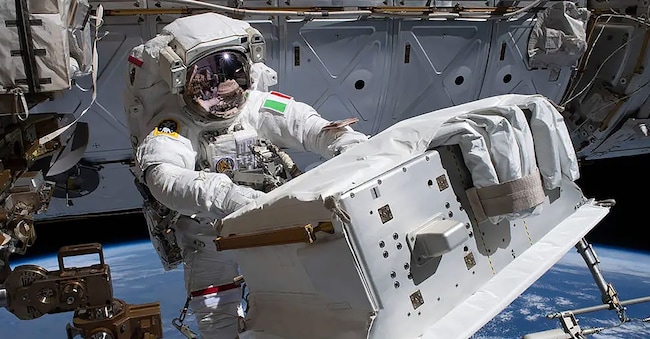
Based in Schio, in the province of Vicenza, a company with around forty employees has carried out a test that will lead to a key implementation on the International Space Station (ISS) in 2027. Alca Technology’s space division, AlcaSpace has built the thermal vacuum chamber required to qualify the upgrade of the AMS-02 particle detector, one of the most important experiments on the ISS. Installed in 2011, it is the result of an international collaboration led by Nobel laureate Samuel Chao Chung Ting, aimed at studying cosmic rays, antimatter and dark matter.
The new module, “L0 Upgrade”, is a carbon-fibre disc over three metres in diameter and weighing almost 500 kilograms. It will triple the measurement capacity: the data that AMS-02 has collected over 15 years can be acquired in three, or five years at most.
The cost of the project — electronics, silicon detectors, carbon-fibre structure — amounted to 5 million euros, funded by the National Institute of Nuclear Physics (INFN) and the international scientific collaboration. Added to this figure is an unspecified but substantial contribution from NASA, which includes astronaut training and two extravehicular activities that have already been carried out.
Adopting a proactive approach to technology transfer, the INFN’s Perugia group, led by Giovanni Ambrosi, chose not to use a traditional facility – where the cost would have been between one and two million euros – but instead collaborated directly with AlcaSpace, thereby reducing the cost to less than a third. The thermal vacuum chamber, capable of reproducing temperatures ranging from -180 to +150 degrees Celsius, was originally commissioned by Turin-based Space Industries, which specialises in satellite constellations. AlcaSpace has expanded its size and performance capabilities.
The operational arm of the experiment comprises the INFN sections and the university departments in Perugia, Trento, Rome (La Sapienza, Tor Vergata), Milan-Bicocca, Pisa and Bologna, which are also funded by the Italian Space Agency. The detector was assembled at CERN in Geneva, the hub for collaboration with partners from Switzerland, Germany, Spain and MIT in Boston. The vibration tests were carried out by the specialist firm Centrotecnica in Milan.

