Bikeconomy

From tourism to artificial intelligence, cycling looks to the future

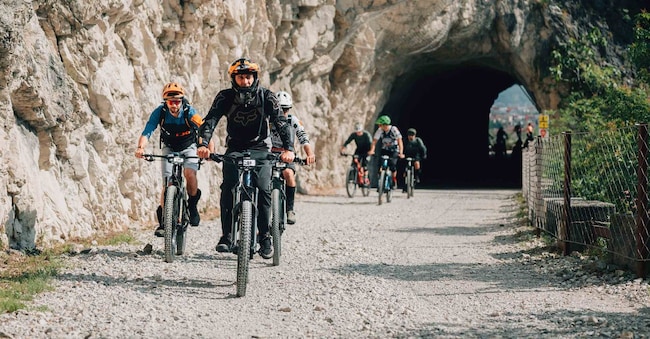
At the Bike Festival, three days of races, debates and presentations on off-road biking as a means of discovering the area and attracting tourism under the banner of sustainability and personal experience
by Pierangelo Soldavini

 (Pia Nowak)

3' min read

Translated by AI
Versione italiana

3' min read

Translated by AI
Versione italiana

RIVE DEL GARDA - The bicycle that goes it alone is not a near prospect, and probably not even a real one, because two-wheelers are based on people and relationships. But artificial intelligence is making inroads into the industry as a support for a personal and customised experience, made up of emotions tailored to the individual.

The pick for algorithms on two wheels is the pedal-assisted bicycle, built on the platform of a constantly evolving electric motor that allows a mountain of data to be collected with each pedal stroke: on the route, on the bicycle, and on the cyclist. "We are building a wealth of information that lays the foundations for tailoring experiences to the individual, based on the cyclist's physical assessment, preferences and route characteristics," comments Stefano Udeschini, founder of Epic Trail, who is a guide by trade and creates mountain bike routes. But he emphasises that he can never fully rely on AI to replace scouting in the field and knowledge of the context: 'We need the personal touch to trigger the emotion.

Loading...

AI on two wheels

In any case, 'the intelligent personal assistant, capable of integrating information and data between routes and people to evaluate the best experience will arrive within two to three years,' says Tatjana Finger, founder and CEO of Consult4AI, which is also focusing on cycling applications.

But artificial intelligence could also be useful to better manage the flow of people throughout the year and on the same day, avoiding as much as possible the traffic jams and excessive traffic that can also occur on cycle paths in those territories that have made cycling a tool of communication and tourist offer.

As is the case in Trentino's Upper Garda region, where two-wheelers represent an alternative and complementary tool to wind surfing and the mountains as a basis for offering sustainable tourism under the banner of movement and health.

Certified Route Network

One million people arrive in the northern region of Lake Garda every year, making up a total of 4.2 million overnight stays. Of these, six out of ten use a bicycle at least once during their stay. But there are not a few who come specifically to cycle on the network of 1,500 kilometres of cycle paths, including tracks and dirt roads, that criss-cross the entire region.

It is a network that has conquered, first in Europe, the Gold certification of the International Trail Rating System, which guarantees coherence and quality of the routes with consistent information, orientation and safety at the service of cyclists, ensured by the continuous maintenance work of about fifteen Garda Trentino boys throughout the year.

Outdoor Platform

The certification was made official on the occasion of the Bike Festival, the three-day event dedicated to off-road biking which, with races, guided tours, stands and tests of the latest electric mountain and gravel bike models, attracted 80,000 people last year.

"Born thirty-two years ago to support cycling as a means of getting to know the area, the Bike Festival aspires to represent the best platform at a European level for outdoor cycling," says Oskar Schwazer, general manager of Garda Trentino. It is not a trade fair, but an event for enthusiasts with three strong points: it offers bike tests with 2,000 bikes to try out in a context where people cycle all year round, it arrives at the beginning of the season, allowing holidays to be planned, and it focuses on the Italian character of an area with a quality offer starting with food and wine.

Today less than a quarter of incoming tourists are Italian, almost half are German, while the rest are increasingly international, from England to Poland to Brazil.

"Building on these foundations, the Bike Festival aims to grow in terms of quality and content, offering itself as a stimulus and comparison for companies, from the digitalisation of the bike world, starting with artificial intelligence, to sustainability, not only in functional terms," concludes Schwazer, who cites as an example a problem that arises in the face of the first wave of renewal and replacement of the ebike fleet. 'An end-of-life problem of bicycles is starting to be tackled'.

It is no coincidence that at the Bike Festival there is a bicycle washing system that guarantees the recovery of water, which - one can bet - will then be used in the bike hotels in the Garda Trentino area.

Copyright reserved ©
Loading...

Brand connect

Loading...

Newsletter

Notizie e approfondimenti sugli avvenimenti politici, economici e finanziari.

Iscriviti

Tutto mercato WEB