
Transport a brake on development in the South
The report. Maritime transport is doing well, but critical issues remain in rail and air transport with a strong dependence on road connections

3' min read
3' min read
Southern Italy plays a key role in maritime transport, thanks to hubs such as Gioia Tauro and the ports of Campania, Puglia and Sicily. However, it has strong criticalities in the rail and air sectors, as well as an over-dependence on road transport. The infrastructure gaps with respect to the North negatively affect the competitiveness of southern companies and, more generally, the efficiency of the country system.
This is what emerges from the first report of the Freight Insights Observatory, promoted by the Conftrasporto Foundation and the National Centre for Sustainable Mobility (Most). And all this against the backdrop of a change that has taken place in the business system: 'Italian road haulage has matured a great deal in recent years,' says Vittorio Marzano, lecturer in transport engineering at the University of Naples Federico II and director of the Most. 'There is a move towards greater aggregation of companies and it is quite evident how the larger companies are invoicing more.
Italy confirms its third place in Europe in terms of tonnage handled by sea, but the ports of southern Italy continue to suffer from poor logistics integration: only 12.9% of goods by sea in Europe pass through Italian ports, with most of the traffic concentrated in Liguria, Veneto and Lazio. The southern ports have indisputable strengths but also obvious criticalities: among the strengths are their strategic position in the Mediterranean and international connections; among the criticalities are management fragility (Gioia Tauro and Taranto cases) and poor rail-port connections. The ports of Gioia Tauro with more than a third of national containers, Cagliari, Taranto and Palermo show an uneven trend, with double-digit declines in traffic between 2018 and 2024, only partly offset by the increase in Ro-Ro and containers in specific ports. The maritime connectivity of the South is still low, with few weekly departures and a network poorly connected to the back-port rail system. In the Ro-Ro/Ro-Pax network, southern ports have fewer weekly departures than the main northern hubs, compromising the development of intermodality.
The rail gap remains evident. Rail freight transport, which could be a sustainable alternative to road, shows disappointing performance. Between 2011 and 2024, tonne-kilometres grew by only 1.2%. Among the elements noted by the Observatory is the 25.5% drop in national transport with negative effects especially for the South, where efficient intermodal hubs are lacking, and while international traffic has grown by 58.5%, the benefits have been absorbed almost entirely by the North, leaving the South on the margins of the major European routes. The characteristics of the South seem to remain unchanged over time: few intermodal hubs (Marcianise, Nola, Bari, Gioia Tauro), an incomplete network and small silhouettes. Among the strengths identified are the potential of Gioia Tauro and the Bari-Bologna connection. On the other hand, critical points include poor rail-sea integration and the absence of competitive intermodal services.
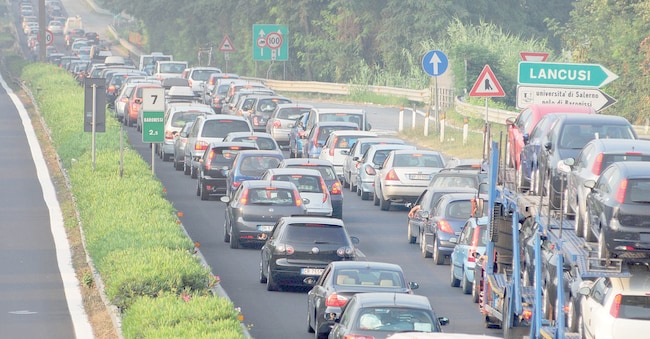
Road transport remains prevalent, but flows along the South-North and Sicily-Central Italy routes are unbalanced: returns are often with empty loads and average saturation is lower than at national level. Data from 320 freight companies show that the South and Sicily account for a small share of national full truck load flows; fill factors on return journeys are less than 60-75%; loading and unloading operations remain concentrated in the North-West. In the South the prevalence of heavy industrial vehicles remains, traffic concentrated on a few routes (A1, A2, Adriatic ridge, Naples-Bari, Palermo-Catania). Among the strong points are direct connections with ports and hinterlands, while on the critical side, urban congestion (Naples, Bari, Palermo), insufficient maintenance of the secondary network, and delays in works should be highlighted.

