
From Treccani a biographical dictionary dedicated to women: out of oblivion
Three illustrated volumes, over 2,500 pages and more than a thousand images illuminate 65o protagonists in all fields of knowledge

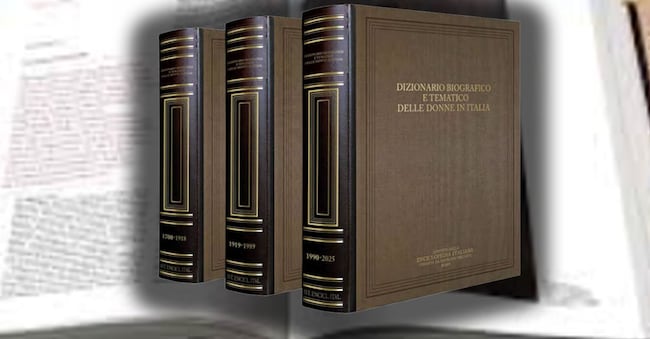
It was one of the gaps to be filled. An offensive gap. That they, the women, did not deserve. And Treccani, one of the highest cultural institutions in the country, has responded with a work that has been edited in its own right: precious, profound, encyclopaedic. 8 March is therefore also celebrated with these three illustrated volumes - over 2,500 pages and more than a thousand images - dedicated to the hundreds of often forgotten (when not ignored) Italian women who have contributed to the growth of the country. They have done so in various fields with a sharp eye, with intelligence, modernity, and the ability to be there in spite of deep-rooted prejudices and violent ostracisms. These are lives that in themselves speak of their strength, instructive experiences that constitute an example for the new generations, pioneers who have paved the way in sectors dominated by men, figures linked to the territory to which they have imprinted an unmistakable stamp. The work, guided by scientific director Emma Giammattei, starts in the 18th century and reaches the present day, closing in 2025 and illuminating the protagonists of literature, theatre, art, politics, social commitment, fashion, sport, cinema and much more. Alongside well-known names (Nilde Iotti, Maria Montessori, Sibilla Aleramo, Anna Magnani, Carla Fracci, Anna Maria Ortese, and further back Eleonora Duse, Carolina Invernizio, Cristina Trivulzio), the first Italian lawyer, Lidia Poët, the first Olympic gold medallist, Ondina Valla, the lady of Milan's Piccolo Teatro, Giuseppina Vinchi, the creators of Diabolik, Angela and Giuliana Giussani, are celebrated. We rediscover writers now out of public memory like Luisa Adorno, versatile and talented actresses like Piera Degli Esposti, innovative teachers like the mathematician Emma Castelnuovo, singers as unfortunate as they are gifted like Mia Martini. Homage is paid to Tina Anselmi, the first woman appointed as minister, as well as to Rita Levi-Montalcini, Nobel Prize winner for discoveries in the field of neuroscience, to whom the work is dedicated, and to the only Nobel Prize winner in Italian literature (this year we celebrate the centenary of the award), Grazia Deledda. The work, whose signatures are both female and male, can be appreciated in its complexity and richness also because of the obligatory, extremely difficult and painful selection (perhaps a greater effort could have been made on the twenty-one Constituent Mothers, on the eve of the 80th anniversary of 2 June 1946, reserving them - alongside the eight present - a thematic chapter and finding a space for the youngest, with a significant personal and political experience: Teresa Mattei). Gratitude for the Dictionary, available in Treccani shops in Rome and Milan and through the publishing house's sales channel, is accompanied by the hope that the work will be a new starting point. And that it will continue to snatch from oblivion the many Italians of whom we no longer have any memory. Because a country that forgets does not just lose its past: it jeopardises its future.
© REPRODUCTION RESERVED


