
From the Val d'Aveto the bitter awarded in London as the best in the world
British and American awards for Fugazzi family liqueurs. The famous Fabbrizii made from a great-grandfather's recipe found in a drawer

3' min read
3' min read
An old great-grandfather's recipe found in a drawer, inside a tin biscuit tin, from a century ago. A fortuitous discovery, which brought to light the figure of an ancestor, of whom it was barely known that he made a bitter, and which transformed a family of engineers into a liquor production company. An enterprise that, thanks to Amaro Fabbrizii, reproduced according to the original recipe, and a gin created on the wheel, has won first place in the most prestigious awards in the sector, in London and New York.
It sounds like a fairy tale, or rather, one of those stories that would have caught the attention of the young readers of a Mickey Mouse of many years ago (Here, Quo and Qua find the recipe of a distant relative among the paperwork of Scrooge McDuck's warehouse and set out to make Amaro, with Uncle Donald), but it is reality. The herbal bitter created in the early 1900s by Giovanni Fabbrizii and, after his death, forgotten, despite having won the gold medal at the 1906 Genoa Exposition, was brought back to the headlines by his great-grandchildren and in June, in the Riserva version, won the gold medal at the World liqueor awards 2025, in the bitter section, which crowned it the best Amaro in the world, for this year. But since one cherry leads to another, the Fugazzi family, owner of the (now once again) famous recipe, decided to take another liqueur of its own production to the Fancy food fair in New York (29 June-1 July): Gin Rusagni, which won the double gold medal in the Riserva variant (category The fifty best barreled gin) and the silver medal in the traditional version (category The fifty best gin 1).
Telling this unique entrepreneurial story is the young entrepreneur, and now liquor producer, Fabrizio Fugazzi. 'My family and I,' he explains, 'started in engineering: we had a family-run firm, which my father Giorgio had founded in the early 2000s. He had travelled the world, following Ansaldo Energia plants. Then we built the Wideurope engineering studio, in which my father's second wife, Laura Cabona, also worked. The business grew and, in 2017, we were acquired by Mott Macdonald, a very large British consulting group with a turnover of 2 billion. Thanks to us they opened an office in Genoa and we stayed together for three years. Then they let us out, overnight, Anglo-Saxon style'.
Meanwhile, however, fate was at work. "Laura, while emptying her parents' house, found, in a drawer, a tin biscuit tin with a recipe book inside, handwritten by her great-grandfather Giovanni, whose surname was indeed Fabbrizii, and many other documents. That is, letters certifying the appreciation of the bitter by the influencers of the time. That is, the noble families to whom the samples were sent and who replied with letterhead and coat of arms. There was also the missive in which Giovanni was awarded the gold medal at the 1906 exhibition in Genoa'.
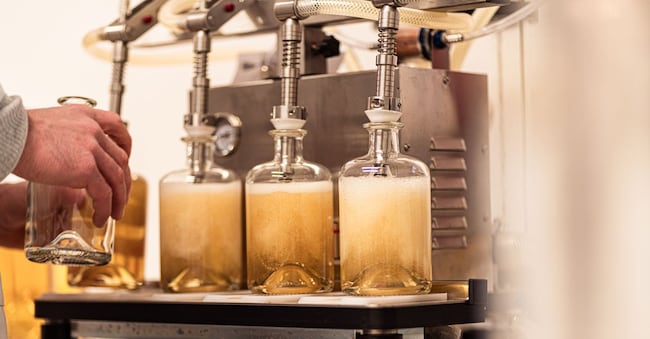
At that point, the business idea was sparked off: the Fugazzi's thought of trying to recreate the Fabbrizii bitter and set up a liqueur factory, renovating a building in the centre of Rezzoaglio, in Val d'Aveto, a village where they have a country house. 'We have created,' he says, 'a workshop and a sales area and, from summer 2021, we started the activity. We also called in an expert to try out great-grandfather's original formula, with seven herbs, and some variations. In the end, when the tasting was done in the dark, the origianle tasted best. After all, we don't know how much testing Giovanni Fabbrizii had done in his time before marketing the bitter'. Today, the company's turnover is still small, around 150,000 euro per year. But now we have landed in the large-scale retail trade, primarily with Coop, and a little also with Conad and Gulliver'.


